
UK Defects Liability Period: 6–12 Months and Why Liability Can Last 12 Years

The defects liability period is the window after practical completion, commonly six to twelve months, during which your contractor must return to fix defects at their own cost. It starts running once practical completion or a taking-over certificate is issued. Critically, its expiry doesn’t extinguish your legal rights over latent defects, which can surface years later and remain claimable under separate limitation rules.
TL;DR:
The defects liability period typically lasts six to twelve months and begins after practical completion or the taking-over certificate, but does not cover latent defects discovered later.
Different contract forms treat defect correction and notification procedures differently, with JCT, NEC, and FIDIC having specific rules on remedy times and formal notice requirements.
Properly documenting defects and issuing timely, precise notices during the DLP is crucial for maintaining legal rights and ensuring timely repairs.
The DLP’s expiry does not eliminate a contractor’s liability for latent defects, which can surface years after completion and are subject to separate limitation periods under law.
Latent defects insurance (LDI) generally covers structural faults for ten to twelve years and is recommended for projects with significant structural work or long-term risk.
Table of Contents
What is the defects liability period and when does it start?
How JCT, NEC and FIDIC treat defects: practical differences you must know
Notification, access, rectification and retention during the DLP
Latent defects and limitation periods: why DLP expiry is not the end
Defects liability insurance (LDI): what it covers and when to use it
A practical checklist for employers and contract administrators
Why most homeowners misunderstand the defects liability period
What is the defects liability period and when does it start?
A defect is any element of the work that fails to meet the contract’s standard, whether that’s cracked plasterwork, a leaking roof, or an electrical fault. The defects liability period (DLP) exists to give the contractor a defined chance to put these right before the project is treated as fully closed out.
The clock starts at practical completion (used in JCT contracts) or the taking-over certificate (the FIDIC equivalent). It ends when the period expires or when the certificate of making good defects is issued, confirming the contractor has completed remedial work satisfactorily. According to LexisNexis, most UK contracts set a DLP of between six and twelve months, though nothing stops parties agreeing longer. If the contract stays silent on duration, JCT’s default position is six months.
There’s a crucial distinction that trips up a lot of homeowners and even some contract administrators:
Patent defects are visible or discoverable through reasonable inspection, such as a poorly fitted door or an uneven floor.
Latent defects are hidden faults, like inadequate waterproofing behind a wall, that only reveal themselves once damage occurs, often long after the DLP has closed.
When a defect is spotted during the DLP, the employer or contract administrator issues formal notice. The contractor is contractually obliged to return and remedy it at no extra cost, provided the fault stems from their workmanship or materials, not from wear and tear or misuse.
How JCT, NEC and FIDIC treat defects: practical differences you must know
Not every standard form handles defects the same way, and the differences matter when you’re negotiating terms or working out who does what once a fault appears.
JCT contracts use the term “rectification period” rather than defects liability period, though the mechanics are near identical. The architect or contract administrator compiles a schedule of defects, typically near the end of the rectification period, and instructs the contractor to remedy them within a reasonable timeframe. Per RICS guidance, JCT periods often run to twelve months, sometimes twenty-four on larger schemes, with a six-month default if the contract particulars leave it blank.
NEC contracts take a more proactive stance. The contractor must correct defects whether notified or not, and the “defects date” concept sets a fixed point after which the employer can no longer instruct corrections for that phase. NEC also allows project-specific “defect correction periods,” meaning urgent items, a failed fire door, say, can carry a shorter fix window than cosmetic snags.
FIDIC, common on international and larger commercial projects, uses a “defects notification period” managed by the engineer rather than an architect. The engineer certifies when defects are made good, and notice procedures under FIDIC tend to be more formal, with specific timeframes for issuing notices that, if missed, can weaken the employer’s position.
Notification, access, rectification and retention during the DLP
Getting the paperwork right during the DLP protects your legal position far more than most employers realise.
How to give effective notice:
Reference the specific contract clause covering defects (not just “please fix this”).
Describe the defect precisely, including location, date discovered and suspected cause.
Attach photographic evidence and, where relevant, a snagging list.
State a reasonable timeframe for the contractor to respond and attend site.
The contractor holds a right of access to return and remedy defects during the notified period, and the employer generally cannot bring in another contractor unless the original one fails to act within a reasonable time. If that happens, most standard forms allow the employer to instruct third-party remedial works and recover the reasonable cost from the contractor, though this route should be a last resort given the disputes it tends to generate.
Delays in issuing that certificate are a genuine practical headache. The Building Engineering Services Association notes that retention release delays cause real cashflow strain for contractors, and most disputes get resolved commercially rather than through formal proceedings. Our guide to retention in building contracts covers the mechanics in more depth.
Pro Tip: Keep a written log of every site visit during the DLP, even brief ones. If a dispute over remedial timing arises later, a dated diary entry carries far more weight than memory alone.
Latent defects and limitation periods: why DLP expiry is not the end
Expiry of the DLP closes the contractual chapter on notified defects, but it does not close the door on latent defects discovered afterwards.
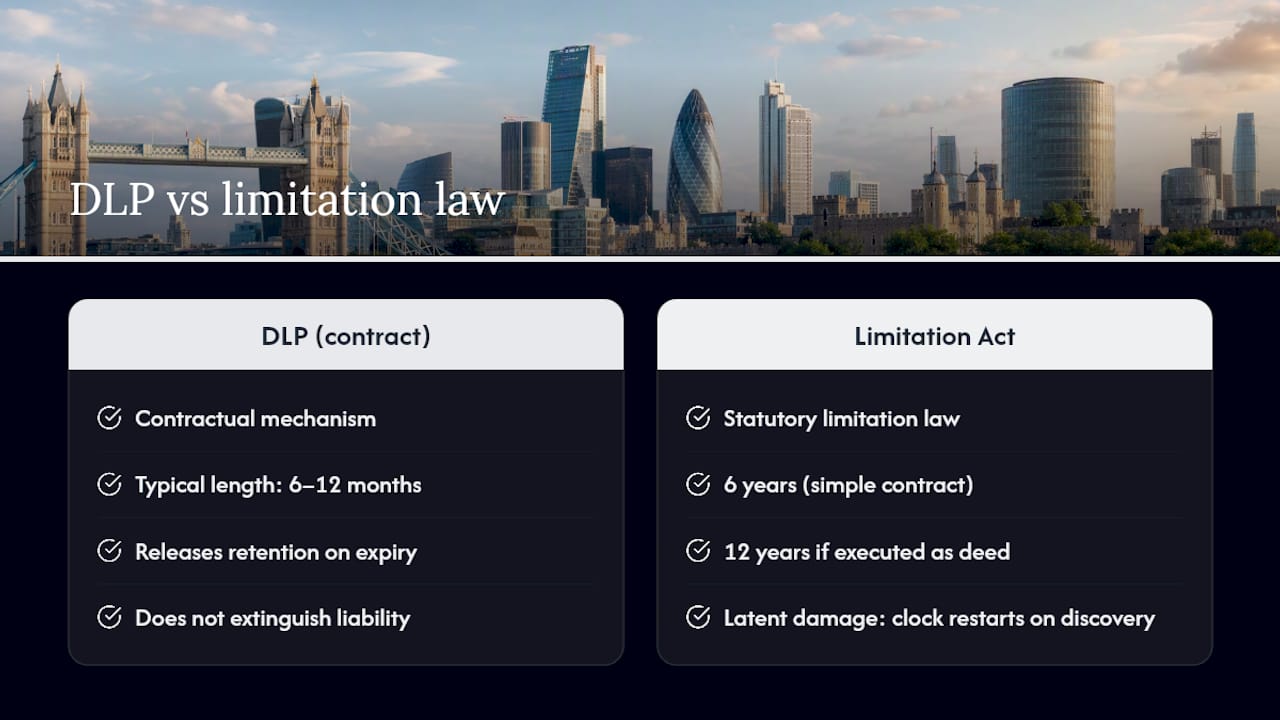
The defects liability period is a contractual mechanism, not a limitation period. Its expiry triggers release of retention and the certificate of making good, but it does not cap or extinguish a contractor’s underlying liability for latent defects, which continues to run under separate limitation law.
Under the Limitation Act 1980, claims for breach of a simple contract must generally be brought within six years of the breach, extending to twelve years where the contract is executed as a deed, which is why collateral warranties are so often drafted as deeds on larger schemes. For latent damage, the clock can effectively restart from the date the defect was, or reasonably could have been, discovered, rather than the date the work was carried out.
The Building Safety Act 2022 has reshaped this landscape further for residential buildings, extending certain limitation windows and increasing scrutiny on long-tail defect claims. One striking illustration of what long-tail exposure actually looks like in practice is the One Hyde Park litigation against Laing O’Rourke, where systemic latent defects surfaced years after completion and resulted in substantial remediation costs, a sharp reminder that a clean DLP sign-off is no guarantee of long-term protection.
Defects liability insurance (LDI): what it covers and when to use it
Latent defects insurance fills the gap left once the DLP and even standard warranties run out. It’s a first-party, no-fault policy, meaning you claim on your own cover without needing to prove the contractor was negligent, which matters enormously if the original contractor has since dissolved or gone insolvent.
According to Marsh, LDI typically covers structural defects for ten to twelve years from practical completion, aligning neatly with the twelve-year limitation period for contracts executed as deeds.
Developers often buy LDI to satisfy lender requirements or to allow earlier release of retention monies.
Cover typically excludes cosmetic or non-structural snagging, focusing instead on load-bearing and weatherproofing failures.
Premiums are usually calculated as a percentage of reconstruction value, with residential schemes commonly priced somewhere in the region of 0.5% to 1.5% at inception, though this varies by insurer and building type.
For homeowners undertaking a major extension or loft conversion, LDI is worth discussing with your broker if the project value or complexity warrants it, particularly where structural work is involved.
A practical checklist for employers and contract administrators
When a defect appears, whether during the DLP or years later, the sequence you follow matters as much as the defect itself.
Document immediately. Photograph the defect, note the date discovered, and keep a running diary.
Issue written notice citing the relevant contract clause, not an informal email or phone call alone.
Decide the remedial route. Give the original contractor first refusal to fix it; only appoint a third party if they fail to respond within a reasonable time, and keep evidence to preserve any right of recovery.
Manage retention carefully. Don’t release the final tranche until the certificate of making good is properly issued, but avoid unreasonable delay that damages the contractor relationship and your project’s cashflow. Cashflow pressure from delayed retention release can also affect how development funding is structured, so it’s worth flagging early to any lender involved.
Escalate to insurers or solicitors only once informal routes are exhausted, or immediately if the defect suggests a structural or safety risk.
Pro Tip: A thorough snagging list at practical completion, rather than a rushed walk-through, prevents the majority of DLP disputes before they start. Our snagging list guide sets out what to check room by room.
At Tenen Ltd, we’d add one thing most checklists miss: planned preventive maintenance. Reactive fixes address today’s defect; a planned maintenance schedule catches the small issues, hairline cracks, sticking windows, slow drainage, before they become the expensive latent defects nobody notices until year eight.
Three takeaways before your next contract signing
Set the DLP duration and notice mechanics explicitly in the contract; don’t rely on defaults you haven’t checked. Document and notify defects in writing the moment you spot them, and keep dated evidence throughout. For anything structurally significant, discuss latent defects insurance or deed-based collateral warranties with your solicitor well before practical completion, not after a problem appears.
Why most homeowners misunderstand the defects liability period
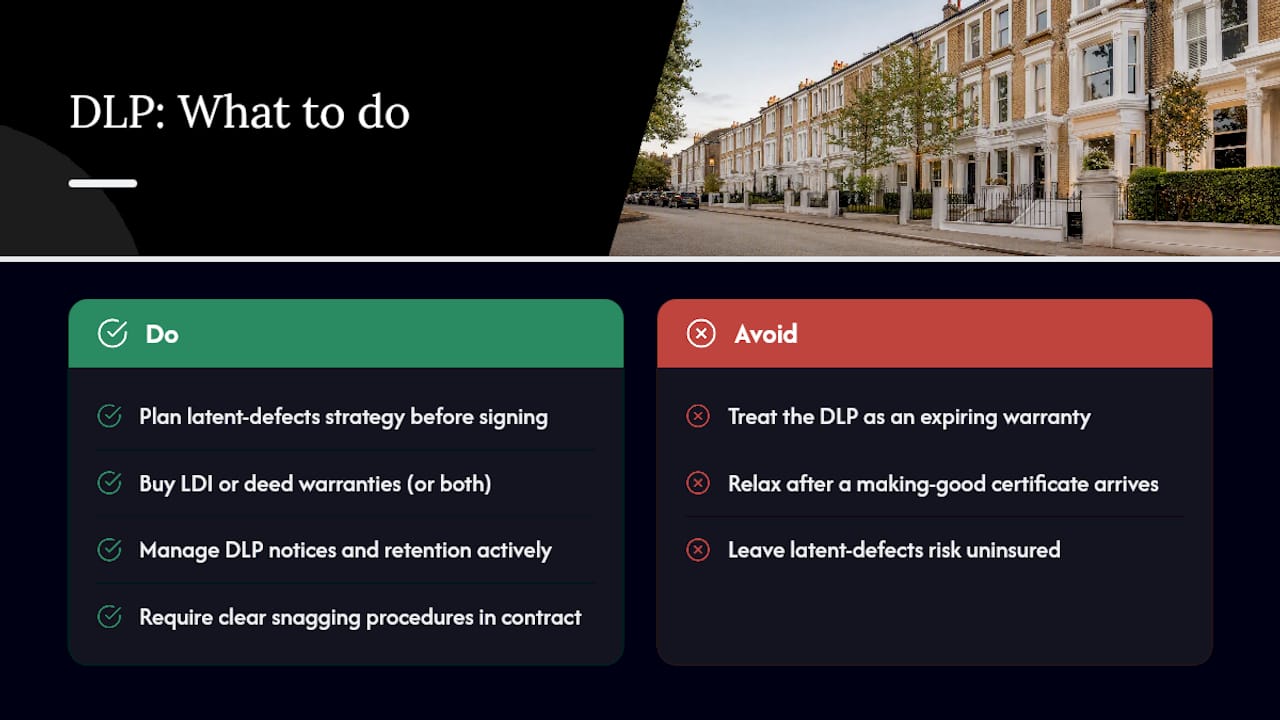
The biggest misconception is treating the DLP as a warranty that protects you for a fixed window and then simply expires. It doesn’t work that way, and conflating the two leads homeowners to relax at exactly the wrong moment, right after the certificate of making good defects lands on the doormat.
What the research on this consistently shows is that the real exposure sits in latent defects, the ones that don’t announce themselves during a twelve-month rectification period because they haven’t failed yet. The One Hyde Park case is instructive precisely because it wasn’t a snagging dispute; it was a structural failure that surfaced years after everyone assumed the project was closed. Conventional advice focuses heavily on managing the DLP itself, notices, retention, making-good certificates, and that’s necessary but not sufficient.
If I had to prioritise one thing for homeowners and contract administrators alike, it would be this: decide your latent defects strategy, whether that’s LDI, deed-based warranties, or both, before the ink dries on the building contract, not after the DLP has quietly expired and everyone’s attention has moved elsewhere.
— Mateja
If you’re weighing up remedial work following a defects dispute, or planning a new extension, refurbishment, or loft conversion with a contractor who takes the DLP seriously from day one, Tenen Ltd’s extension services are built around clear contractual terms and proper snagging procedures from the outset, giving West and Central London homeowners fewer surprises long after the scaffolding comes down.
This article is general information, not a substitute for advice from a qualified lawyer. Consult a qualified legal professional about your own circumstances before acting on anything here.
Sources
Recommended
Comments