
Retention in building contracts: what you need to know

Retention in building contracts is a contractual withholding of a percentage of each interim payment, held by the employer or main contractor as security for completion and defect correction. No statutory ban is currently in force in the UK, but the government has proposed significant reforms, including measures to restrict or ban cash retentions, as part of its late-payment package progressing through Parliament in 2026. Until any ban takes effect, retention remains a negotiable commercial term, not a legal entitlement.
Here is the bottom line before you read further:
Who retains: the employer retains from the main contractor; the main contractor mirrors that deduction down to subcontractors
Typical percentages: 3–5% of interim payments is standard market practice, halving at practical completion
Usual release triggers: half released at practical completion; the remainder released on expiry of the defects liability period or issue of the final certificate
Pro Tip: Check whether your contract uses the phrase “held on trust” or simply “withheld.” That single distinction determines whether retained money is protected if the other party becomes insolvent — and most standard forms do not include trust wording by default.
Key takeaways
Retention in building contracts is a contractual mechanism, not a statutory requirement, and the terms you negotiate now will determine your cash-flow exposure and legal protection throughout the project.
Point | Details |
Retention is contractual | No UK law mandates retention; the percentage, triggers, and trust status are all negotiable. |
Typical rate is 3–5% | Market practice withholds 3–5% of interim payments, halving at practical completion. |
Trust wording is critical | Without “held on trust” language, retained sums are unsecured if the paying party becomes insolvent. |
Reform is progressing | The government’s 2026 late-payment package proposes restricting retentions, but no ban is yet in force. |
Tenenltd offers clear terms | Tenenltd sets out retention terms explicitly in every contract, with defined release triggers from the outset. |
Table of Contents
What does retention actually mean in a building contract?
Retention is the portion of each interim payment that the paying party holds back rather than paying immediately. The purpose is threefold: it incentivises the contractor to return and correct defects, it gives the employer commercial leverage during the defects liability period, and it provides a financial cushion if the contractor abandons the project or fails to complete.
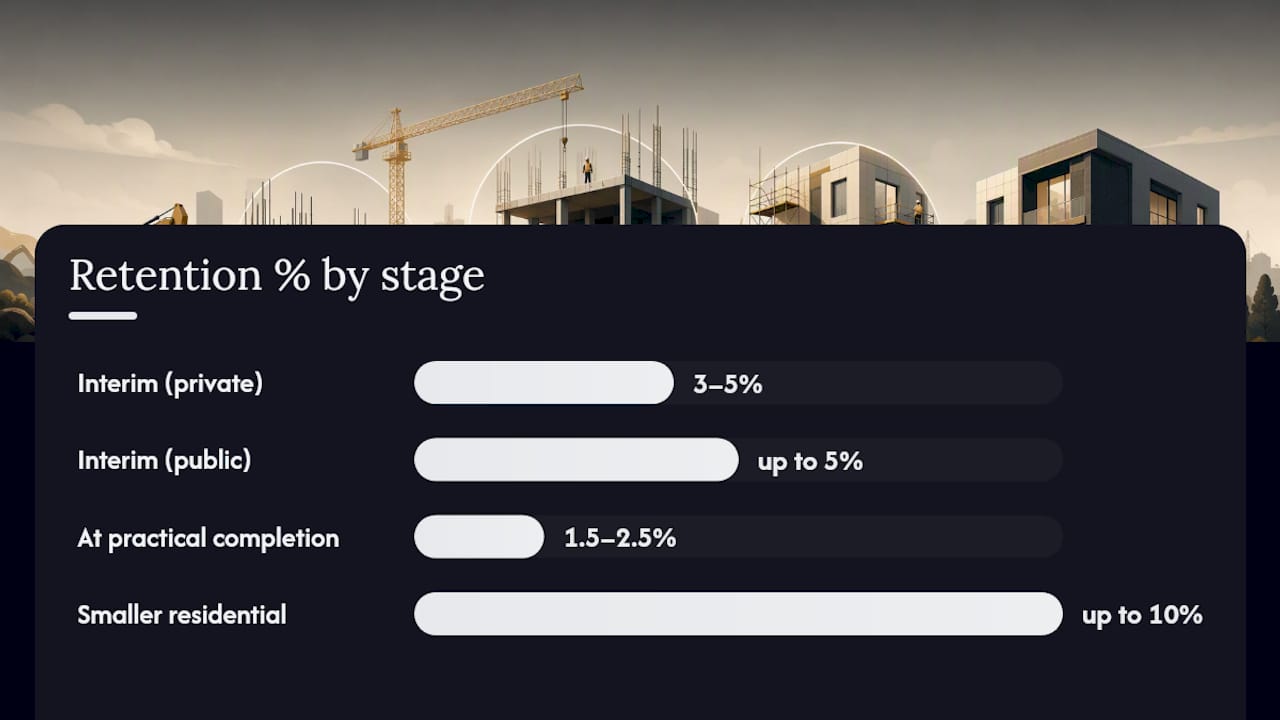
Market practice commonly withholds 3–5% of interim payments, though some contracts, particularly on smaller private projects, push this to 10%. The retention fund builds up as interim payments are made, then halves at practical completion, with the balance released after the defects liability period ends.
The supply-chain effect is significant. A main contractor who has 5% retained by an employer will typically retain the same percentage from each subcontractor. That means a subcontractor working on a large project may have a material portion of its turnover locked up for 12–18 months or longer, creating genuine cash-flow pressure throughout the supply chain.

Typical retention mechanics at a glance:
Stage | Retention % withheld | Who commonly uses this pattern |
Interim payments (pre-completion) | 3–5% (private); up to 5% (public) | Both public and private sector |
At practical completion | Halved (half remaining) | Standard across most forms |
After defects liability period | Released in full | Standard across most forms |
Smaller residential projects | Up to 10% in some cases | Private sector, homeowner contracts |
Pro Tip: Check whether the contract expresses retention as a percentage of the “contract sum” or of each “interim payment valuation.” The calculation base matters: a percentage of the contract sum can produce a larger withheld amount early in the project than a rolling percentage of valuations.
How JCT and NEC contracts handle retention differently
Both the Joint Contracts Tribunal (JCT) and the New Engineering Contract (NEC) include retention mechanics, but they treat the subject quite differently. Understanding that difference helps you negotiate from the right starting point.
Under JCT standard forms, retention is built into the default payment provisions. The employer holds a retention percentage from each interim certificate, with release tied to practical completion and the issue of the final certificate. JCT does not automatically require retention to be held on trust or placed in a separate account, though the JCT suite does include optional trust wording that parties can elect to use. Practical Law notes that the function, standard-form treatment, and negotiation points for cash retentions are well-established, and recommends that parties expressly agree release triggers rather than relying on default wording.
NEC takes a different approach. Retention is not a default term; instead, it is an optional mechanism activated by including Option X16 in the contract data. NEC guidance also notes that careful specification of what constitutes “Completion” can reduce or even eliminate the need for a retention fund altogether, which is a practical drafting route worth exploring.
Feature | JCT standard forms | NEC (Option X16) |
Retention included by default | Yes | No — optional via Option X16 |
Typical halving trigger | Practical completion | Completion as defined in contract data |
Final release trigger | Issue of final certificate | Defects correction period expiry |
Trust/ring-fencing | Optional wording available | Not automatic; requires express drafting |
Negotiation flexibility | Moderate — amend standard clauses | High — Option X16 can simply be omitted |
Common negotiation points in standard-form contracts:
When exactly the retention halves (practical completion vs. sectional completion for phased projects)
Whether the defects liability period runs from practical completion or from the date of the final certificate
Whether the employer must certify defect rectification before releasing the second half
Whether retention is held in a designated account or simply withheld from the employer’s general funds
The maximum retention cap, particularly on long-running contracts where the fund can grow large
On phased or sectionally completed projects, the timing of retention release becomes more complex. Each section may trigger its own halving event, so the contract should specify whether retention is calculated and released section by section or against the project as a whole.
What the UK government’s 2026 proposals mean for retention
Retention is contractual, not statutory. No UK legislation currently mandates or prohibits it. That position may change: the government has described its late-payment reform package as the largest crackdown on late payments in over 25 years, and the proposals progressing through Parliament include measures targeting retention payment abuses.
The policy trajectory has been building for years. A 2017 government consultation examined the risks of retention for insolvency and recommended better protection mechanisms. The government’s response to its late-payment consultation set out next steps for tackling poor payment practices, and industry bodies including Build UK published a Roadmap to Zero Retentions advocating a phased move away from cash retentions.
The UK government’s 2026 late-payment package represents a significant legislative push on construction retentions. The proposals include measures to restrict or ban cash retentions and introduce enforcement powers — but as of the date of this article, no statutory ban is in force and existing contracts remain governed by their negotiated terms.
If a ban is enacted, the practical effects would include:
No new contractual cash retentions permitted after the commencement date
Transitional rules for contracts already in place (likely grandfathering existing retention funds)
Enforcement powers for the relevant authority to act against non-compliant payers
Existing retained monies potentially subject to new release or protection requirements
The Housing Grants, Construction and Regeneration Act 1996 already governs payment notices, pay-less notices, and adjudication rights in construction contracts. Retention sits alongside that framework: a contractor can use the Act’s adjudication route to challenge a wrongful withholding, but the Act does not itself regulate whether retention can be taken or at what rate.
Protecting yourself: legal risks and alternatives to cash retention
The most serious risk with cash retention is insolvency. If retained sums are not held on trust or placed in a ring-fenced account, they form part of the holder’s general assets. Should the employer or main contractor become insolvent, the party owed retention becomes an unsecured creditor, often recovering little or nothing. Retention deposit schemes and third-party holding mechanisms exist precisely to address this risk, protecting retained sums from insolvency and improving supply-chain security.
Legal risks to watch for:
Retained sums lost in employer or main contractor insolvency (unsecured creditor position)
Ambiguous release triggers that allow the paying party to delay certification indefinitely
Cross-contract set-off, where the paying party deducts sums from one contract against retention on another
Late or refused final certificates that prevent the second half of retention from being released
Retention withheld beyond the defects liability period without a valid pay-less notice
The practical alternatives to cash retention each carry different risk profiles:
Mechanism | How it works | Key advantage | Key risk |
Cash retention (default) | Percentage withheld from payments | Simple, no upfront cost | Unsecured on insolvency |
Retention deposit scheme | Funds held by independent third party | Protected from insolvency | Requires counterparty agreement |
Retention bond/guarantee | Surety provides guarantee in lieu of cash | Contractor retains cash flow | Bond cost; surety credit risk |
Escrow/third-party account | Funds held in joint account | Strong protection | Administrative cost and complexity |
Performance bond | Covers broader performance risk | Wider security for employer | Higher cost; not retention-specific |
Pro Tip: If your counterparty shows signs of financial stress (slow payment on other contracts, CCJs, or a recent change of directors), insist on a retention deposit scheme rather than a retention bond. A bond requires the surety to pay out, which takes time; a deposit scheme holds the cash already, so recovery is faster if the counterparty fails.
A practical drafting checklist for retention clauses
Getting the clause right at the outset avoids most retention disputes. LexisNexis guidance is clear: parties should expressly agree whether retention will be used, the precise release triggers, and the legal status of the funds, rather than relying on default market practice or standard-form wording that may not reflect their intentions.
Numbered drafting checklist:
Define the retention percentage — state it as a percentage of each interim payment valuation, not the contract sum, and set a maximum cap
Define the calculation base — gross valuation, net valuation, or a specified portion (e.g. excluding materials on site)
State the halving event precisely — “practical completion” under JCT, “Completion” under NEC, or a bespoke definition for phased works
State the final release event and timing — expiry of defects liability period, issue of the defects certificate, or the final certificate, with a longstop date
Include “held on trust” wording — specify that retention is held on trust for the contractor and must not be mixed with the employer’s general funds
Specify who controls the retention fund — name the account holder, the bank, and the conditions for withdrawal
Address insolvency — state what happens to the retention fund if either party becomes insolvent before release
Set out the evidence required for release — completion certificate, defects rectification sign-off, or a specific notice from the contract administrator
Include a pay-less notice requirement — the paying party must serve a valid pay-less notice to withhold any sum beyond the agreed retention percentage
Address sectional completion — if the project has phases, specify whether retention is calculated and released per section
Worked calculation example:
Contract value: £200,000
Interim payment valuation: £80,000
Retention rate: 5%
Retention withheld at this stage: £4,000
At practical completion (retention halved): £2,000 released, £2,000 retained
At expiry of defects liability period: remaining £2,000 released
Sample clause wording (halving at practical completion):
“The Employer shall hold the Retention Fund on trust for the Contractor. Upon the issue of the Practical Completion Certificate, one half of the Retention Fund then held shall be released to the Contractor within 14 days. The remainder shall be released within 14 days of the expiry of the Defects Liability Period, subject to the issue of the Defects Certificate.”
Pro Tip: When tendering, consider offering a reduced contract price in exchange for a reduced or zero retention. If the employer insists on retention, counter-propose a retention bond so you retain your cash flow.
How to claim or recover retention that has been withheld
The starting point is always the contract. Before escalating, check what notice or certificate the contract requires before retention is released, and confirm you have complied with every condition.
Step-by-step recovery process:
Gather all payment certificates, interim valuations, and the practical completion certificate
Calculate the exact sum due, including any retention that should have been halved at practical completion
Serve a formal written request for release, referencing the specific contract clause and the release trigger that has occurred
If the paying party does not respond or issues a pay-less notice, check whether the notice is valid (served in time, with the required detail)
If the withholding is disputed or the pay-less notice is defective, serve a notice of intention to refer to adjudication
Refer the dispute to an adjudicator under the Housing Grants, Construction and Regeneration Act 1996 — adjudication produces a binding interim decision within 28 days
If the adjudicator’s decision is not honoured, enforce it through the Technology and Construction Court
Preserve limitation arguments: the six-year limitation period for contract claims runs from the date payment fell due, not from the date of the dispute
Red flags that suggest a dispute is developing:
The employer or main contractor delays issuing the practical completion certificate without a valid reason
The defects certificate is refused or not issued despite defects being rectified
A pay-less notice is served late or without adequate grounds
Retention is withheld beyond the defects liability period with no explanation
The paying party attempts to set off sums from a different contract against your retention
Pro Tip: Adjudication is your fastest route to interim recovery. It costs less than litigation and produces a decision in 28 days. Even if the paying party challenges the decision in court, they must usually pay first and argue later — which is exactly the cash-flow relief you need.
How Tenenltd approaches retention on its projects
Tenenltd has been delivering home extensions, loft conversions, and full property refurbishments across West and Central London since 2006. On residential projects, retention clauses are handled transparently from the outset.
For most homeowner projects, Tenenltd’s approach to retention reflects the scale and nature of the work:
On smaller renovation and refurbishment contracts, retention is typically reduced or structured as a modest holdback released promptly on completion and sign-off
On larger extension and loft conversion projects, where phased payments are common, any retention is clearly defined in the contract with explicit release triggers tied to practical completion and defects sign-off
Where a client requests additional security, Tenenltd is open to discussing ring-fenced arrangements or bonds rather than open-ended cash retention
Transparency about payment terms is part of how Tenenltd works. Every project starts with a clear, itemised quotation and a written contract that sets out payment milestones, retention (if any), and the conditions for final release. Clients in Fulham, Chelsea, Kensington, Chiswick, Hammersmith, and Notting Hill can check the areas Tenenltd serves and discuss contract terms directly before signing anything.
Pro Tip: If you are a homeowner negotiating a building contract, ask your contractor to show you the exact clause that governs retention release. A contractor who cannot point to specific wording is a contractor whose contract does not protect you adequately.
A contractor’s honest view on retention
Retention is one of those contract terms that sounds reasonable in principle and causes disproportionate pain in practice. The logic is sound: hold back a small sum to make sure the builder comes back and fixes any snags. The problem is that “small sum” compounds across dozens of subcontractors and dozens of projects, and the release mechanism is often vague enough to allow indefinite delay.
From a contractor’s perspective, the fairest arrangements are those where:
The retention percentage is genuinely modest (3% or less for residential work)
The release trigger is objective and tied to a certificate, not to the employer’s subjective satisfaction
The second half is released promptly after the defects period, without requiring the contractor to chase repeatedly
What contractors will typically ask for: a reduced retention rate in exchange for a competitive price, or a retention bond in lieu of cash. What they will often concede: a modest holdback on the final payment, provided the release date is fixed and the defects period is no longer than 12 months.
The real trade-off is between cash flow and risk allocation. A contractor who accepts a 5% retention on a £500,000 project has effectively extended £25,000 of unsecured credit to the employer. That is a commercial decision, not a legal obligation. Knowing that distinction puts you in a much stronger negotiating position.
Working with Tenenltd on your next project
Planning a home extension or loft conversion in West or Central London? Tenenltd offers something that most homeowners genuinely value: a contractor who explains the contract before you sign it, not after a dispute arises.

Every Tenenltd project comes with a clear written contract, defined payment milestones, and transparent retention terms. You will know exactly when any holdback is released, what triggers that release, and what your rights are if there is a disagreement. For homeowners in Fulham, Chelsea, Kensington, Chiswick, Hammersmith, and Notting Hill, that clarity is built into every proposal from day one. Get in touch to discuss your project and review the contract terms together before any work begins.
Sources
The following UK-focused references are worth reading directly if you are drafting, negotiating, or disputing retention clauses:
This article provides general information about retention in building contracts and is not a substitute for legal advice. For complex disputes or bespoke contract drafting, consult a solicitor or quantity surveyor with construction law experience.
Recommended
Comments