
Practical Completion UK: Stop Handover Delays for Owners & Developers

Practical completion is the contractual moment when your building work is finished enough to hand over, even if minor snags remain. It’s not a legal or statutory term. It typically unlocks possession of the property, releases a portion of retention money, starts the defects liability period, and stops liquidated damages accruing. The date on the certificate becomes the reference point for almost everything that follows.
TL;DR:
Practical completion depends on the contract terms and case law, largely focusing on whether only trivial defects remain that do not hinder use.
JCT contracts often rely on the contract administrator’s judgment for practical completion, while NEC contracts specify clear criteria that streamline dispute resolution.
Certification triggers financial changes such as retention release, the start of the defects period, and stopping liquidated damages, all outlined in the contract; timing and amounts are critical.
Most disputes stem from documentation delays or unclear conditions precedent rather than unfinished work, making early agreement on paperwork essential.
Practical completion does not require perfection, but misaligned expectations on paperwork or minor snagging can cause significant delays or disagreements.
Table of Contents
What does practical completion mean in a UK building contract?
How do JCT and NEC contracts treat practical completion differently?
What happens financially once practical completion is certified?
What do the leading practical completion cases actually decide?
Practical completion handover checklist for homeowners and developers
How Tenen Ltd manages practical completion on London projects
Get managed handover and snagging support for your London project
What does practical completion mean in a UK building contract?
Practical completion has no fixed statutory meaning. It’s shaped entirely by what your contract says and by decades of case law interpreting similar wording, which is why two projects can define “complete” quite differently.
The test courts apply most often is the de minimis principle: works are practically complete when only trifling defects remain, ones that don’t stop the building being used for its intended purpose. A missing door handle is trifling. A leaking roof is not. RICS guidance notes that courts and certifiers routinely distinguish patent defects (visible, obvious faults spotted at handover) from latent defects (hidden problems that surface later, sometimes years after occupation).
The certifier, usually an architect, contract administrator, or project manager, makes this judgement call. It’s a professional opinion, not a mechanical checklist. Get it wrong and they carry liability risk, which is exactly why certifiers can be cautious about signing off too early.

How do JCT and NEC contracts treat practical completion differently?
Your contract form determines how much room there is for argument, and the two dominant UK forms handle it quite differently.
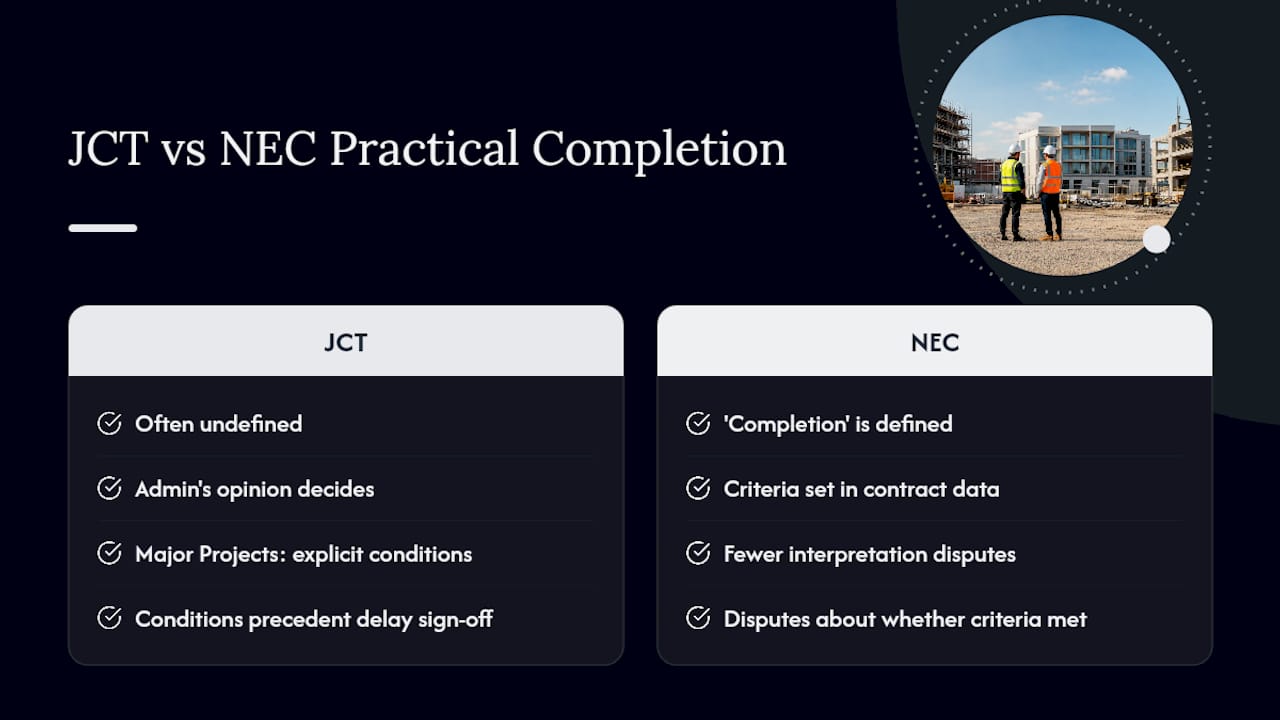
JCT contracts often leave practical completion undefined, relying instead on the contract administrator’s opinion at the time. The exception is JCT Major Project Construction Contract, which can attach explicit conditions, such as statutory approvals or delivery of as-built drawings, before certification is issued.
NEC contracts take a more prescriptive route. NEC4 ECC uses the defined term “Completion,” set out in the contract data with specific criteria the works must meet. This tends to produce fewer disputes about interpretation, though it shifts the argument towards whether those defined criteria have actually been met.
Either way, conditions precedent written into the contract can lawfully delay certification. If your agreement says certain documents must land before sign-off, no amount of finished brickwork changes that. Read your contract’s completion clause before work starts, not after a dispute begins.
What happens financially once practical completion is certified?
Practical completion triggers several changes at once, and most of them involve money changing hands or risk changing owner.
Retention release: contracts commonly release a portion of the retained sum at practical completion, with the remainder held until the defects liability period ends.
Defects liability period: typically runs 6 to 12 months from the certificate date, during which the contractor must fix defects that emerge.
Liquidated damages: these stop accruing once practical completion is certified, which is why contractors push hard for the date and clients sometimes resist it.
Insurance and site risk: responsibility for security and insurance usually passes to the client at this point.
These consequences are set out clearly by contract commentary, and getting the amounts and dates right matters because they feed directly into the final account. Understanding the defects liability period properly, rather than assuming it’s a vague grace window, avoids a lot of friction later.
How is a practical completion certificate issued?
Certification follows a fairly predictable sequence, though the paperwork is where most delays happen.
The contractor notifies the certifier that the works are, in their view, ready.
An inspection takes place, producing a snagging list of outstanding minor items.
The certifier weighs the snagging list against the de minimis test and forms a professional opinion.
A written Practical Completion Certificate is issued, recording the date, defects liability period, and retention figures. RIBA’s domestic certificate template shows the standard fields used across UK residential projects.
Documents often sit as conditions precedent, meaning certification can’t happen until they’re delivered. As-built drawings, the health and safety file, commissioning certificates, and warranties are the usual culprits, and paperwork delays are a genuine bottleneck on otherwise finished projects. A well-drafted contract allows draft versions to satisfy the condition, with finals following shortly after, so physical completion isn’t held hostage by admin.
Pro Tip: Agree in writing who compiles the snagging list and by what date. Keep every version with a timestamp. When a dispute over “was it really finished” surfaces months later, a dated paper trail settles it faster than anyone’s memory.
What do the leading practical completion cases actually decide?
A handful of cases still do most of the work in UK practical completion disputes, and each one supports a specific practical rule.
Jarvis v Westminster established that practical completion doesn’t mean perfection, only that defects remaining are trifling. William Press v Bickerton narrowed that further, ruling that only defects visible at the point of certification count towards that trifling test, not problems that surface afterwards. Emson v Protea examined how contracts should be read when practical completion wording is ambiguous. Mears v Costplan reinforced the same theme: courts lean on the de minimis principle and treat the certifier’s judgement with real weight, provided it’s rationally exercised.
The practical lesson is that courts rarely overturn a certifier’s opinion outright. Disputes tend to concentrate on documentation gaps and disagreements over what counts as trifling, and those are usually resolved through adjudication before litigation becomes necessary.
Practical completion handover checklist for homeowners and developers
Before you sign off on possession, work through this list rather than relying on a verbal assurance that “it’s basically done.”
Walk the property with the contractor or contract administrator and produce a dated, photographed snagging list.
Confirm receipt of Building Regulations completion certificates, as-built drawings, O&M manuals, and warranties.
Check the retention amount released against what the contract specifies, and note what’s held back for the defects period.
Arrange your own buildings insurance from the certified date, since risk typically passes to you at that point, as covered in this renovation insurance guide.
Record any defect that appears during the liability period in writing, with dates, rather than raising it informally on site.
How Tenen Ltd manages practical completion on London projects
Documentation bottlenecks, not unfinished brickwork, cause most of the delays we see on West and Central London refurbishments and extensions. Missing O&M manuals or an incomplete health and safety file can stall a certificate on a house that’s otherwise ready to live in.
Our approach sequences deliverables early: draft as-built drawings and commissioning paperwork get prepared alongside the build, not scrambled together at the end. Where a client needs to move in before every final document lands, we negotiate which items can reasonably follow practical completion, a pattern Pinsent Masons’ guidance also recommends as standard good practice. Snagging is tracked against dated photographs from day one, so nobody’s arguing about condition six months later.
What actually catches people out at practical completion
Most disputes over practical completion aren’t really about the building. They’re about paperwork nobody agreed a timetable for. Homeowners assume “finished” means every document is in hand; contractors assume a snagging list of minor items is normal and shouldn’t hold anything up. Both are right, which is exactly the problem.
The fix isn’t clever legal drafting, it’s earlier conversation. Decide before work starts which documents are genuinely conditions precedent and which can follow within a set number of days. Set that timetable at the point of appointment, not at the point of frustration. If you’re reviewing a contract now, check its completion clause against the definitions this article has covered, and if anything’s ambiguous, get it clarified in writing before signing.
— Mateja
Get managed handover and snagging support for your London project
Tenen Ltd is the alternative to chasing certification paperwork yourself, sequencing as-built drawings, health and safety files, and warranties from the start so practical completion isn’t held up by missing documents on your extension or refurbishment. Our in-house project management coordinates snagging, retention timing, and certification alongside the build itself, not as an afterthought once the trades have left site.

If you’re planning a home extension in London, a loft conversion, or a full refurbishment, ask for a site survey and a handover checklist as part of the initial quote. It puts the documentation timetable on the table before a single wall comes down, which is precisely where these disputes get avoided.
This article is general information, not a substitute for advice from a qualified lawyer. Consult a qualified legal professional about your own circumstances before acting on anything here.
Sources
FAQ
Can a contractor claim an extension of time after practical completion?
Generally no. Extensions of time relate to the period before practical completion, since that’s when liquidated damages can accrue; once the certificate is issued, that mechanism no longer applies.
What is the difference between practical completion and final completion?
Practical completion marks handover with only trifling defects outstanding, while final completion comes at the end of the defects liability period once all remaining issues are resolved and the final retention is released.
What is the definition of practical completion under a JCT contract?
JCT contracts typically leave practical completion undefined, leaving it to the contract administrator’s professional opinion based on case law principles like de minimis, with the JCT Major Project form being an exception that can specify explicit conditions.
Can I sell a house without a completion certificate?
You can sell without a practical completion certificate, since it’s a contractual document rather than a legal requirement, but a lender or buyer will usually still expect Building Regulations completion evidence, which is a separate statutory sign-off.
Recommended
Comments