
What renovation insurance UK really means for your project

If you’re planning an extension, loft conversion or full refurbishment in London, “renovation insurance” almost always refers to the insurances your contractor holds, not a policy you buy yourself. This article uses the term that way: the public liability, employer’s liability and contract works cover a professional builder carries to protect you, your property and their team throughout the job. Before you sign anything, ask your contractor for three things.
The insurer’s name, the policy type and a live policy number you can verify.
A written contract with a detailed schedule of works.
Confirmation of whether the project needs planning permission or falls under permitted development.
Get these upfront and you’ll avoid the vast majority of disputes that derail London renovations. A reputable firm, such as Tenen Ltd, should hand over this information without hesitation. Hesitation itself is often the clearest signal you need.
Key Takeaways
Hiring confidently for a UK renovation means verifying your contractor’s insurance, contract and planning status before signing, not after.
Point | Details |
Clarify the meaning first | “Renovation insurance” here means your contractor’s public liability, employer’s liability and contract works cover. |
Request three documents | Insurer name, policy number and a written schedule of works before you sign any contract. |
Check planning status early | Confirm permitted development or Article 4 restrictions with your local authority, not assumptions. |
Match cover to project scale | Contract works insurance should reflect the full rebuild value, not the contract price. |
Choose a proven local contractor | Tenen Ltd supplies insurance evidence and an itemised schedule of works as standard on every West and Central London project. |
Table of Contents
What house renovation insurance UK covers on a contractor-led project
Three types of cover matter on a typical domestic job. Public liability insurance protects you if a worker damages your property or injures a passer-by or visitor. Employer’s liability insurance is a legal requirement for any contractor with staff, covering injury to their own employees. Contract works or all-risks insurance covers loss or damage to the works themselves, including materials on site, if there’s a fire, flood or theft mid-project.
Public liability: typically £2 million to £10 million for domestic works in London.
Employer’s liability: required by law to meet a statutory minimum level, which reputable firms adhere to or exceed for employee injury protection.
Contract works cover: should match the full rebuild value of the works, not just the contract price.
For terraced houses in Fulham or period conversions in Notting Hill, where a mistake can affect a neighbour’s party wall or a shared structure, this cover isn’t a formality. It’s what stands between you and a five-figure repair bill that isn’t yours to pay.
Pro Tip: Ask whether contract works cover extends to existing structures, not just new build elements. Many policies exclude damage to the parts of your house the contractor didn’t build, which matters enormously on a loft conversion or full refurbishment.
Who is responsible for insurance and compliance on a UK renovation?
Responsibility splits fairly cleanly between contractor and homeowner, and confusion here is where most disputes start.
Your contractor should:
Hold and produce valid public liability, employer’s liability and contract works insurance.
Manage site safety, including scaffolding, waste and access.
Vet any subcontractors and confirm they carry their own cover.
You, as the homeowner, should:
Check every certificate before work starts, not after.
Tell your own home insurer that building works are taking place, since many policies require notification.
Confirm whether the project needs planning permission or qualifies as permitted development.
Permitted development lets many single-storey extensions and loft conversions proceed without a full application, provided they sit within the limits set out in Schedule 2, Part 1 of the 2015 Order. Larger rear extensions can trigger a neighbour consultation scheme, and loft conversions fall under Class B, with their own size and height conditions detailed on the Planning Portal. Crucially, many West and Central London boroughs have removed these rights via Article 4 directions on conservation areas, so always check with your local planning authority before assuming permitted development applies to your street.
How do I check a contractor’s insurance before signing?
Verifying paperwork takes twenty minutes and it’s the single most valuable thing you’ll do before committing to a project.
Request the documents on headed paper. Ask for the insurer’s name, policy number, cover limits and expiry date, ideally with a note confirming the policy applies to works at your specific address.
Call the insurer directly. Most insurers will confirm a policy is active if you quote the policy number, even without disclosing full terms.
Match cover to project scale. A loft conversion or rear extension in Chelsea or Kensington, where rebuild values run high, warrants contract works cover in the hundreds of thousands, not a token £50,000 policy.
Check the schedule of works alongside the insurance. A properly sequenced programme signals a contractor who runs an organised site, which correlates strongly with fewer claims in the first place.
For most London extensions and refurbishments, public liability of £5 million or more and contract works cover matching the full rebuild value are the ranges worth expecting, though every project differs.
Pro Tip: Ask your contractor to email the insurance documents rather than just showing them on site. A written record protects both parties and gives you something to reference if a dispute arises later.
What questions should I ask a contractor before hiring them?
Bring these questions to every quote meeting, and don’t accept vague answers.
Can you show me your current public liability and employer’s liability certificates?
Can I see a sample contract and a full schedule of works for a project like mine?
What’s the warranty period on workmanship, and does it cover materials too?
Who will actually be on site day to day, your own team or subcontractors?
What happens if the project overruns, and how is that communicated?
Watch for red flags: a contractor who won’t produce documentation, a contract with no defined scope or payment schedule, or a request for a large cash-only deposit before any paperwork is signed. If you spot one of these, pause. Ask for written clarification, and if the answer doesn’t satisfy you, it’s worth speaking to another firm rather than pressing ahead on hope.
Timeline and cost realities for London renovation projects
London’s renovation market punishes poor planning more than most regions, because idle labour and rework cost more here than almost anywhere else in the UK. Build these lead times into your expectations from day one.
Kitchens typically require several weeks from order to fitted completion, reflecting common lead times in London renovation projects.
Bespoke windows and doors can take six to twelve weeks to arrive, so order early if your extension depends on them.
Structural work involving party walls or scaffolding often carries additional insurance premiums, which a good contractor will flag at quotation stage, not halfway through the job.
Vacant-property cover, extended scaffold insurance and cover for occupied properties mid-renovation all add small but real costs. Build float into both your budget and your programme. A schedule of works that sequences trades properly is one of the strongest defences against the delays that push London renovations over cost.
Tenen Ltd: local experience and what to expect at a site survey
Tenen Ltd has worked across Fulham, Chelsea, Kensington, Chiswick, Hammersmith and Notting Hill since 2006, delivering extensions, loft conversions, full refurbishments and kitchen and bathroom renovations for homeowners who expect precision at every stage.
Every project runs under director oversight, with insurance evidence supplied as standard, not on request.
You’ll receive an itemised schedule of works before you sign anything, sequencing trades and setting inspection points so nothing is left to guesswork.
Compliance checks, including planning and permitted development status, are confirmed before work begins, not discovered halfway through.
At a Tenen Ltd site survey, expect a detailed walk-through of your property, a written quotation broken down by trade, and clear answers to every insurance and compliance question you raise. That transparency is precisely what separates a smooth renovation from a stressful one.
What most guides get wrong about renovation insurance
Most advice on this topic treats insurance as a box-ticking exercise: get a certificate, file it away, move on. That misses the point entirely. The certificate matters far less than what sits behind it, whether the cover limit actually matches your project’s rebuild value, whether the schedule of works has been thought through, and whether the person handing you the paperwork will still answer your calls in week six of a ten-week kitchen fit.

Conventional wisdom also underplays planning risk. Homeowners assume permitted development covers them because a neighbour did something similar last year, then discover their street sits under an Article 4 direction that removed those rights years ago. Checking with your local authority, not your neighbour’s memory, should come before any conversation about insurance certificates.
If there’s one thing I’d tell every West or Central London homeowner starting this process, it’s this: prioritise the schedule of works as much as the insurance documents. A contractor who produces both without prompting is telling you far more about how they’ll run your project than any certificate alone ever could.
Ready to plan your renovation with a trusted local team?
Tenen Ltd is the local alternative to piecing together your own team of trades and hoping the paperwork lines up. For homeowners across Fulham, Chelsea, Kensington, Chiswick, Hammersmith and Notting Hill, that means one contractor holding full responsibility for insurance, compliance and programme, rather than you chasing certificates from three different subcontractors.

A site survey with Tenen Ltd gets you a written, itemised schedule of works, verified insurance evidence, and a transparent quotation broken down by trade before you commit to anything. Whether you’re planning a rear or side extension, a loft conversion, a full property refurbishment or a kitchen and bathroom renovation, the process starts the same way: book a survey and get your questions answered on site, with someone who’ll still be there to answer them in week six.
Authoritative guidance and practical tools to consult
For planning checks, see GOV.UK’s permitted development guidance and Planning Portal’s loft conversion pages for scheduling advice.
Frequently asked questions
Do I need renovation insurance if I’m hiring a contractor? You don’t buy a separate policy yourself in most cases. Your contractor should hold public liability, employer’s liability and contract works insurance covering the whole project, and you should verify these before work starts.
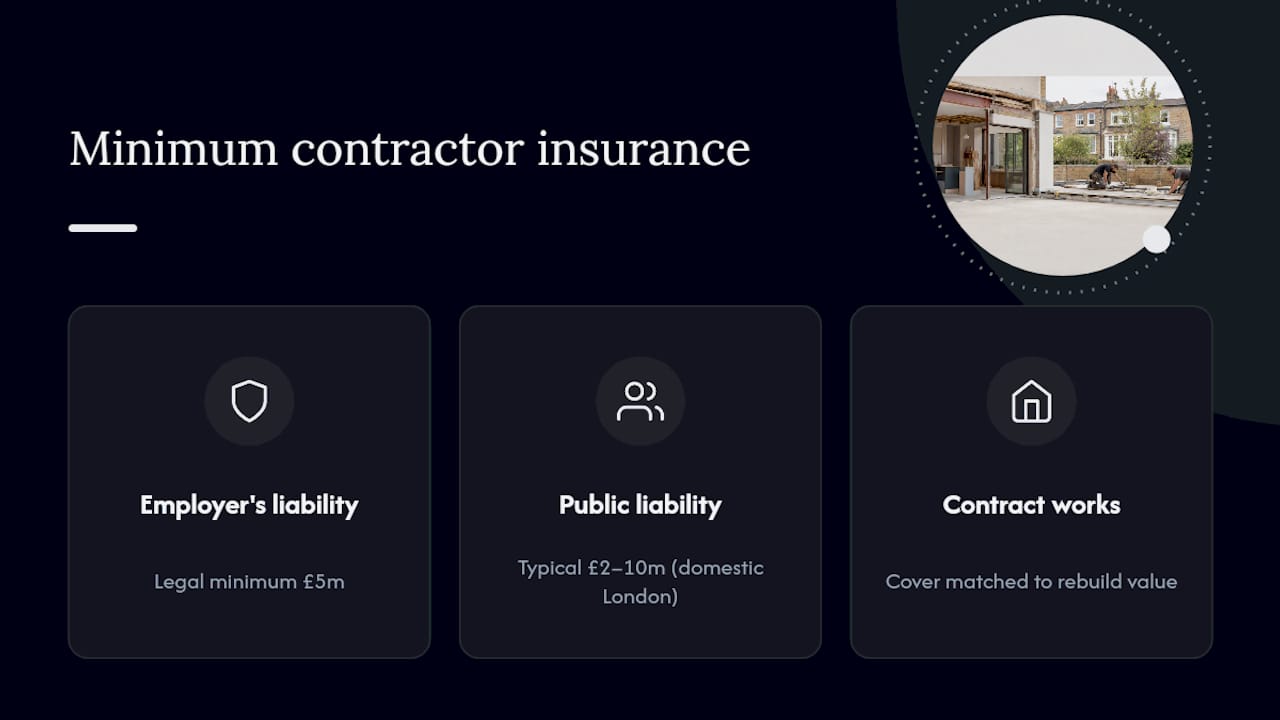
What’s the minimum insurance a UK contractor should carry? Employer’s liability of £5 million is a legal minimum where staff are employed. Public liability commonly ranges from £2 million to £10 million for domestic London projects, with contract works cover matched to rebuild value.
Does my home insurer need to know about renovation work? Many home insurance policies require notification once structural work, extensions or extended vacancy periods begin. Check your policy wording and call your insurer before works start to avoid invalidating cover.
Do I need planning permission for a loft conversion or extension in London? Many projects qualify under permitted development, but several West and Central London boroughs have removed these rights through Article 4 directions on conservation areas. Confirm your specific street’s status with the local planning authority before assuming.
What happens if I need to make an insurance claim during my renovation? Contact your contractor immediately and request they notify their insurer in writing, keeping photographs and a written record of the damage or incident. If the claim involves your own home insurance, notify your insurer separately and keep both processes documented.
Sources
Recommended
Comments