
Fire safety in renovation: what homeowners must know

TL;DR:
Renovation work creates specific fire risks by disrupting safety measures like fire compartments and alarms. Proper management, including formal plans and active homeowner engagement, reduces the danger during construction. UK regulations require approval for certain fire safety changes to ensure ongoing protection and safety compliance.
Fire safety in renovation is the coordinated set of measures, management roles, and regulatory controls that protect occupants and property from fire during construction or alteration works. Most homeowners focus on design choices and budgets when planning a refurbishment. Few realise that the building work itself creates a window of genuine fire risk, one that requires active management from day one. NFPA research records an average of 4,440 fires annually in structures under construction in the US alone. That figure reflects a global pattern: renovation sites are uniquely vulnerable, and the UK is no exception. Understanding what is fire safety in renovation means understanding why your home needs a different level of protection the moment work begins.
How do renovations increase fire risks compared to finished buildings?
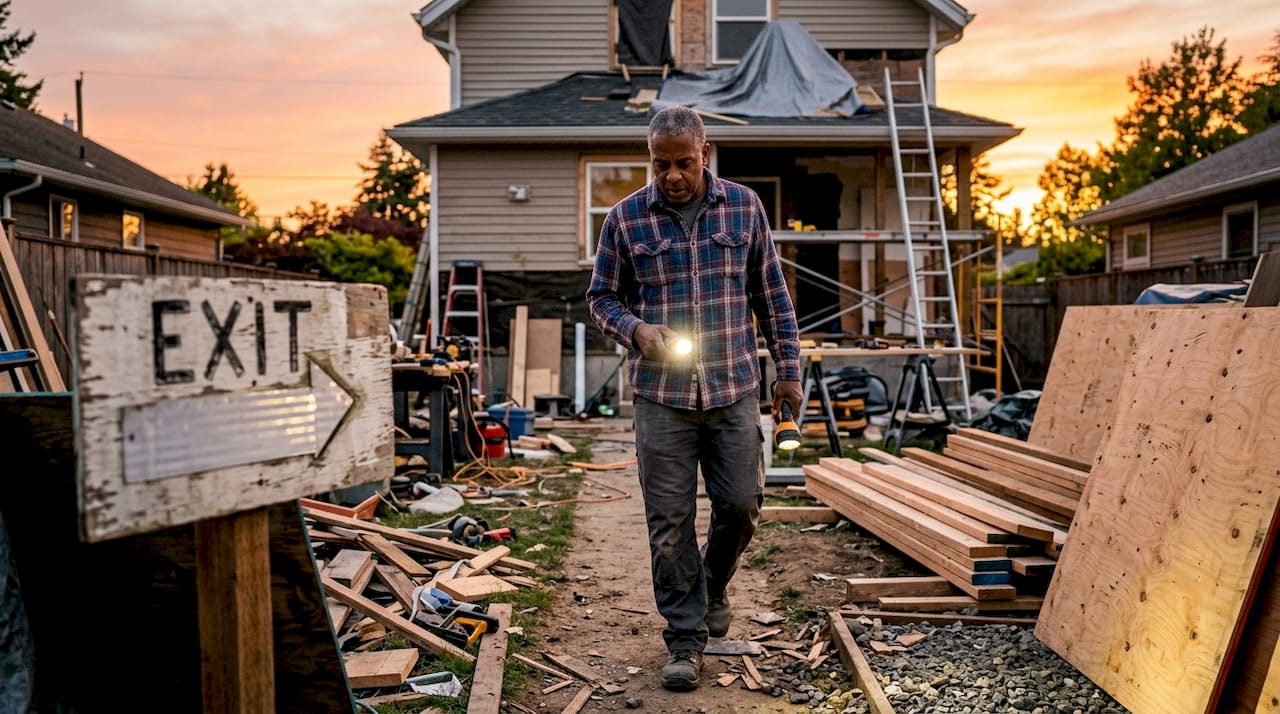
Renovation work disrupts the fire safety measures that were originally designed into your home. Compromised fire compartments and excess combustible materials are the two leading causes of delayed fire detection and rapid spread on renovation sites. A finished building has sealed walls, fitted fire doors, and working alarms. A building mid-refurbishment has none of those guarantees.
The specific risks that arise during renovation work include:
Exposed utilities. Stripping walls and floors reveals live wiring and gas pipework. Accidental damage to either creates an immediate ignition source.
Combustible materials. Timber offcuts, sawdust, oily rags, and solvent-based paints accumulate quickly on site. Each one is a potential fuel load.
Disabled detection. Dust from sanding, plastering, or drilling triggers nuisance alarms. Workers often cover or disconnect smoke detectors to avoid interruptions, leaving the building unprotected.
Hot work. Welding, grinding, and angle cutting generate sparks that can smoulder in hidden cavities for minutes before igniting. Hot work permits and fire watches after welding or grinding are critical precisely because smouldering ignition may occur minutes after work stops.
Blocked escape routes. Skips, scaffolding, and stacked materials regularly obstruct hallways and exits, slowing evacuation.
Temporary loss of suppression systems. Sprinkler systems and fire doors are sometimes removed during structural work, leaving no passive protection in place.
Pro Tip: Before any contractor starts work, walk every escape route in your home and photograph it. Check those routes weekly throughout the project. If a route becomes blocked, address it the same day.
What formal fire-prevention programmes are vital during renovation?
The industry standard for managing fire safety on renovation sites is NFPA 241, which requires a written fire prevention programme and a designated manager for any construction or renovation project. This is not a bureaucratic formality. It is the framework that keeps every other safety measure coordinated and accountable.
A formal fire prevention programme under NFPA 241 covers the following responsibilities:
Appoint a fire prevention programme manager. This person oversees all fire safety activity on site, from training workers to enforcing hot work controls.
Produce a written fire safety plan. The plan must address egress routes, housekeeping schedules, hot work procedures, evacuation plans, and training requirements. It must be approved by the relevant local authority before work begins.
Manage compromised protection systems. When fire doors, alarms, or sprinklers are removed or disrupted, temporary alternative safeguards must be planned, installed, and verified by recommissioning tests before handover.
Enforce daily housekeeping. Combustible waste must be removed from site every day. Oily rags need sealed metal containers. Timber offcuts should not be allowed to accumulate overnight.
Implement a hot work permit system. Every welding, grinding, or torch operation requires a permit. A 30-minute fire watch after each hot work activity is the minimum standard recommended under IFC 2021 guidelines.
Brief all occupants and workers. Everyone on site needs to know the evacuation plan, the location of temporary extinguishers, and who the fire prevention manager is.
Hereford & Worcester Fire and Rescue recommends providing temporary extinguishers and emergency lighting during renovation phases. These are not optional extras. They are the minimum baseline for any occupied home undergoing significant work.
Pro Tip: Ask your contractor directly whether they have a written fire safety plan for your project. A professional contractor will have one ready. If they cannot produce it, that is a red flag worth acting on before work starts.
How does UK regulation affect fire safety during residential renovations?
The Building Safety Regulator (BSR) sets the legal framework for fire safety compliance during renovation work on higher-risk buildings in England. Changes that affect fire safety components such as fire doors, detection systems, or escape routes are classified as “notifiable changes” and require BSR approval before work begins. This is not simply a planning formality. Proceeding without approval can invalidate your building’s safety case and expose you to significant legal liability.
The BSR’s risk-based approach means homeowners must assess, document, and notify before altering any protected fire system. The practical steps are:
Identify notifiable changes. Any alteration to fire doors, compartment walls, alarm systems, or escape routes triggers the notification requirement.
Document the proposed change. You must produce a written assessment showing how fire safety will be maintained during and after the alteration.
Obtain approval before starting. Temporary fire safety measures must be fully documented and included in the approval process to maintain continual compliance.
Verify on completion. All reinstated or new fire safety systems must be tested and signed off before the building is reoccupied.
The table below summarises the BSR change control categories relevant to residential renovation:
Change type | BSR requirement | Homeowner action |
Fire door removal or replacement | Notifiable change | Notify BSR, obtain approval, document temporary measures |
Alarm or detection system disruption | Notifiable change | Notify BSR, install temporary cover, retest on completion |
Escape route alteration | Notifiable change | Notify BSR, maintain alternative route throughout works |
Compartment wall removal | Major change | Full BSR assessment and approval required before work starts |
For homeowners planning extensions or loft conversions, understanding home extension regulations in 2026 is the right starting point for staying compliant throughout the project.
What practical fire safety measures can homeowners take during renovation?
Fire prevention in home renovation comes down to a set of consistent, daily habits rather than a single checklist completed at the start of the project. AICO advises against disabling smoke alarms during renovation work and emphasises testing interconnected alarms after dust settles. That guidance reflects a wider principle: protection must be maintained throughout, not just at the beginning and end.
Practical renovation fire safety tips for homeowners include:
Use temporary dust covers on detectors. Fit purpose-made covers over smoke and heat detectors during dusty work. Remove them immediately after each session and test the alarm before leaving the room.
Never permanently disable an alarm. Nuisance alarms caused by dust tempt occupants to remove batteries or disconnect units entirely. The safer practice is always a temporary dust cover, not disconnection.
Keep escape routes clear at all times. Hallways, stairwells, and external doors must remain unobstructed throughout the project. Brief your contractor on this requirement before work begins.
Store and dispose of combustibles correctly. Oily rags must go into sealed metal bins at the end of each working day. Solvent-based paints and adhesives need locked, ventilated storage away from the main building.
Manage electrical loads from power tools. Extension leads and temporary power supplies are a common source of overload fires. Use RCD-protected leads and avoid daisy-chaining adaptors.
Retest all alarms after work completes. Once dust has fully settled, test every interconnected alarm in the system to confirm full functionality before the building returns to normal use.
Pro Tip: Set a weekly five-minute fire safety check into your renovation schedule. Walk the site, confirm detectors are covered but present, check escape routes, and verify combustible waste has been cleared. Five minutes a week can prevent a catastrophic outcome.
For broader guidance on preparing for a West London renovation, including how to manage safety considerations from the planning stage, Tenenltd has published practical advice for homeowners across Fulham, Chelsea, and Kensington.
Key takeaways
Fire safety in renovation requires active, documented management of every disrupted protection system, from smoke detectors to escape routes, throughout the entire project.
Point | Details |
Renovation creates unique fire risk | Compromised compartments, exposed utilities, and disabled alarms make renovation sites significantly more dangerous than finished buildings. |
Formal programmes are non-negotiable | NFPA 241 requires a written fire prevention plan and a designated manager for any renovation project. |
UK regulation demands prior approval | BSR classifies changes to fire doors, alarms, and escape routes as notifiable, requiring documented approval before work starts. |
Detector management is critical | Use temporary dust covers rather than disabling alarms, and retest all interconnected systems after dust settles. |
Hot work needs a fire watch | A minimum 30-minute fire watch after welding or grinding is the baseline standard under IFC 2021 guidelines. |
Why fire safety in renovation deserves more than a tick-box approach
The most common mistake I see homeowners make is treating fire safety as something to sort out once, at the start of a project, and then forget. They ask the contractor whether they have a fire plan, get a yes, and consider the matter closed. The reality is that fire safety during renovations is a living process. It changes every week as different trades move through the building, new materials arrive, and protection systems are temporarily removed and reinstated.
What I have observed over years of working on London refurbishments is that the sites with the fewest incidents are the ones where the homeowner stays engaged. Not in a way that slows the project down, but in a way that signals to every contractor on site that safety is a genuine priority. That signal changes behaviour. Workers are less likely to leave oily rags on the floor or cover a detector and forget about it when they know the homeowner will notice.
The importance of fire safety in renovation also extends beyond the physical risk. If a fire occurs during a project and it emerges that notifiable changes were made without BSR approval, or that alarms were disabled without proper cover, the insurance implications can be severe. Your home insurance policy almost certainly contains clauses about maintaining fire detection. Breaching those clauses during a renovation can leave you unprotected at exactly the moment you need cover most.
My honest advice is to treat fire safety as a project management discipline, not a compliance exercise. Appoint someone, whether that is your contractor or yourself, to own it actively. Review it weekly. And if you are working with a professional refurbishment company, ask them to walk you through their fire safety plan before the first tool is lifted.
— Mateja
How Tenenltd approaches fire-safe renovation in London
Tenenltd has been delivering high-quality refurbishments and extensions across West and Central London since 2006. Every project, from a full property refurbishment to a loft conversion, is managed with regulatory compliance built in from the outset.

The team at Tenenltd understands the Building Safety Regulator requirements and the practical fire safety obligations that come with occupied home renovation. Whether you are planning a rear or side extension in Fulham or a full property refurbishment in Kensington, Tenenltd manages the compliance process so you do not have to. Speak to the team about your project and get expert guidance from a company that has been doing this properly for nearly two decades.
FAQ
What is fire safety in renovation?
Fire safety in renovation is the set of coordinated measures, management roles, and regulatory controls that protect a building and its occupants from fire during construction or alteration works. It covers everything from detector management and hot work controls to formal written fire prevention programmes.
Do I need BSR approval to change a fire door during renovation?
Yes. Under Building Safety Regulator rules, replacing or removing a fire door in a higher-risk building is a notifiable change. You must document the proposed alteration, notify the BSR, and obtain approval before work begins.
How should I protect smoke alarms during renovation work?
Fit purpose-made temporary dust covers over smoke and heat detectors during dusty tasks, and remove them immediately after each session. AICO advises against disabling alarms entirely and recommends testing all interconnected units once dust has fully settled.
What is a hot work fire watch and why does it matter?
A fire watch is a period of active monitoring after welding, grinding, or torch work, during which a designated person checks for smouldering materials. IFC 2021 guidelines recommend a minimum 30-minute fire watch because smouldering ignition can occur well after the work has stopped.
Does my home insurance cover fires during renovation?
Most home insurance policies contain clauses requiring you to maintain working fire detection. Disabling alarms without proper temporary cover, or making notifiable changes without BSR approval, can invalidate your cover. Check your policy terms with your insurer before work starts.
Recommended
Comments