
Building regulations overview for West London homeowners

TL;DR:
Building regulations govern safety, energy, and structural standards for residential projects in England. Homeowners in West London must often obtain approval through detailed applications, inspections, and documentation to ensure compliance and secure property sales. Starting compliance early and choosing experienced contractors streamlines projects and avoids costly delays caused by missed requirements.
Building regulations are statutory national standards governing building work in England, covering safety, health, energy efficiency, and accessibility. For homeowners in West London planning a loft conversion in Fulham, a rear extension in Chiswick, or a full refurbishment in Kensington, understanding this regulatory framework is not optional. It is the foundation of every compliant, insurable, and saleable home improvement project. This building regulations overview explains what the rules require, how the approval process works, and where homeowners most commonly go wrong.
What does a building regulations overview cover?
Building regulations set the minimum technical standards for how construction work must be carried out. They are created under the Building Act 1984 and apply to most significant building work, including extensions, loft conversions, and structural alterations. Approved Documents are the government’s preferred route to demonstrating compliance. They are not the only route, but alternative solutions require robust justification and are rarely cost-effective for residential homeowners.
The regulations are distinct from planning permission. Planning permission decides whether you can build. Building regulations govern how you build. Many homeowners in West London assume that planning approval means they are fully compliant. It does not. Both consents are separate, decided by different bodies, and both are frequently required for the same project.
What are the main parts of building regulations?
Building regulations are organised into 18 technical Parts, labelled A to S (excluding I and N). Each Part has its own Approved Document setting out accepted compliance methods. For residential projects, the most relevant Parts are:

Approved Document | Subject | Typical project relevance |
Part A | Structure | Extensions, loft conversions, structural alterations |
Part B | Fire safety | Loft conversions, HMO works, escape routes |
Part F | Ventilation | All habitable rooms, kitchens, bathrooms |
Part L | Energy efficiency | Extensions, new dwellings, heating systems |
Part M | Access | New builds, some extensions |
Part P | Electrical safety | All electrical installation work |
Part A governs structural integrity. Any extension or loft conversion in Hammersmith or Notting Hill must demonstrate that the existing structure can carry the new loads. Part B covers fire safety, which is particularly relevant for loft conversions where escape routes must be protected. Part P requires that electrical work is either certified by a registered electrician or inspected by Building Control.
The 2026 updates introduce significant new requirements under the Future Homes and Buildings Standards. New dwellings must now include on-site renewable electricity systems. Approved Documents L and F have been updated to tighten energy and ventilation standards. Overheating analysis is now mandatory for new homes, and EV charging infrastructure is required in new builds and many extensions. If you are planning a home extension in 2026, these changes affect your project directly.
Pro Tip: Check whether your project triggers the 2026 ventilation and energy updates before submitting drawings. Projects notified to Building Control from june 2026 onwards fall under the new rules, and retrofitting compliance mid-build is expensive.
How does the building regulations approval process work?
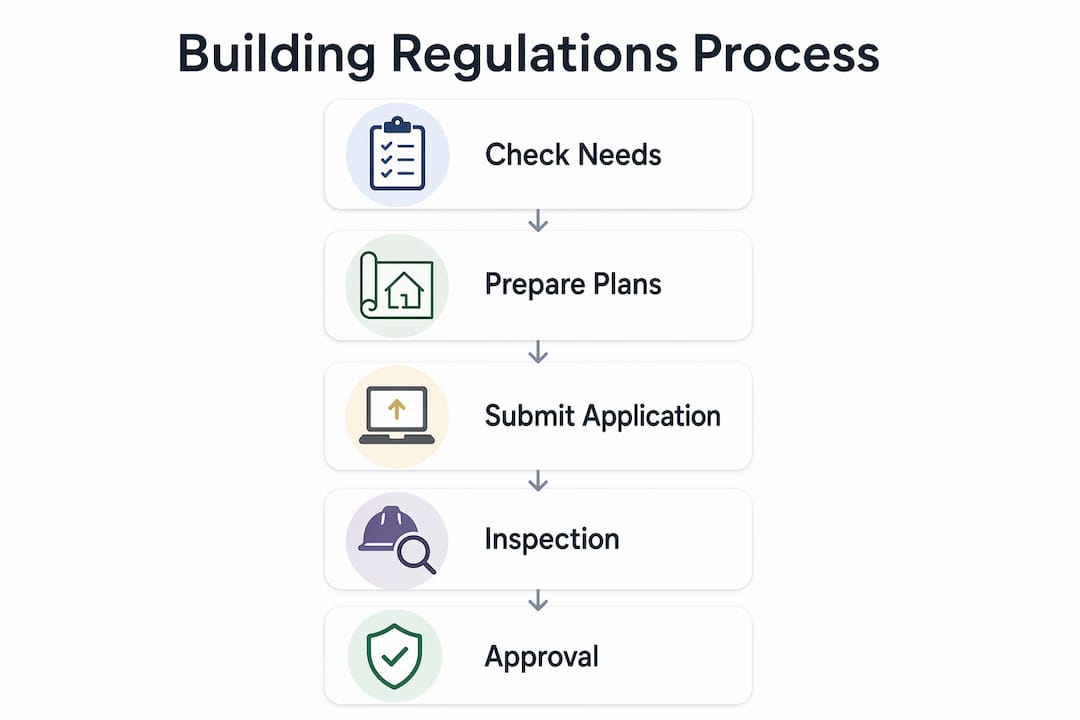
Getting building regulations approval follows a clear sequence. Understanding each step prevents costly delays and protects your investment.
Choose your application route. There are two main routes: Full Plans Application and Building Notice. A Full Plans application requires detailed drawings, structural calculations, and a specification submitted before work starts. Building Notice allows you to start faster but carries real risk. If the inspector requires changes mid-build, rework is expensive and disruptive.
Submit to a Building Control Body. You can use your Local Authority Building Control (LABC) or a Registered Building Inspector (formerly known as an Approved Inspector). Both have the authority to review plans and carry out inspections. Your choice affects cost and turnaround time, so it is worth comparing both options for your specific project.
Attend inspection stages. Building Control inspects at defined stages throughout the build. For a typical extension, these include foundation excavation, damp-proof course, structural frame, insulation, and final completion. Missing an inspection stage can invalidate your approval and force you to expose completed work for retrospective inspection.
Collect your Completion Certificate. Once all inspections pass, Building Control issues a Completion Certificate. Without this certificate, property sales face serious complications. Solicitors and mortgage lenders require it as proof of lawful construction. Losing it or failing to obtain it is one of the most common and costly mistakes West London homeowners make.
Retain all documentation. Keep every inspection record, approval notice, and correspondence. Registered building inspectors now require a full documentary trail under the Building Safety Act 2022. This paperwork protects you at the point of sale and in any future dispute.
Pro Tip: For loft conversions and extensions, always choose the Full Plans route. The upfront time investment in detailed drawings pays back immediately by reducing the risk of mid-build changes. For loft conversion projects in West London, this is standard practice among experienced contractors.
How do building regulations relate to planning permission?
Planning permission and building regulations are decided by different bodies and serve entirely different purposes. Planning permission is granted by the Local Planning Authority, which in West London includes councils such as the London Borough of Hammersmith and Fulham, the Royal Borough of Kensington and Chelsea, and the London Borough of Hounslow. Building regulations approval is granted by Building Control, either local authority or registered inspector.
For most significant projects, you need both consents. A rear extension in Chelsea typically requires planning permission for the change in appearance and building regulations approval for the structural and technical standards. Getting one without the other leaves your project legally incomplete.
There is a third compliance layer that many homeowners overlook. The Construction (Design and Management) Regulations, known as CDM Regulations, place legal duties on homeowners as clients, even for small domestic projects. The Health and Safety Executive sets out these duties clearly. You are responsible for appointing a Principal Designer and Principal Contractor on notifiable projects, and for ensuring site safety is managed throughout. Ignoring CDM obligations is a legal risk, not just a procedural one.
Planning permission: granted by the Local Planning Authority, governs design and land use
Building regulations: granted by Building Control, governs technical construction standards
CDM Regulations: managed by the HSE, governs health and safety on site
All three can apply simultaneously to the same project
Understanding how to build in West London means recognising that compliance is multi-layered, not a single tick-box exercise.
What do homeowners get wrong about building regulations?
The most persistent misconception is that building control is a final approval rather than a continuous process. Homeowners often assume they submit drawings, wait for a stamp, and then build freely. In practice, building control runs alongside every stage of construction. Evidence of compliance must be documented from design through to completion.
The Building Safety Act 2022 has made this more formal. Registered building inspectors now demand a documentary trail covering structural and mechanical systems at every project stage. If your contractor cannot produce this evidence, your Completion Certificate is at risk.
Competent Person Schemes: Qualified tradespeople in certain disciplines, including gas, electrical, and glazing, can self-certify compliance without a Building Control inspection. This speeds up approvals. However, you must verify your contractor’s registration before work starts. Retrospective certification is costly and causes delays that can hold up a sale.
Building Notice risk: The Building Notice route suits simple, low-risk works like a small single-storey extension. For loft conversions, structural alterations, or anything involving fire safety upgrades, the Full Plans route is the correct choice. Mid-build changes ordered by an inspector on a Building Notice project can add significant cost.
Non-compliance costs: Failure to obtain approval triggers a Section 36 notice from the Local Authority. This requires you to either alter or remove the non-compliant work. The cost of remediation almost always exceeds the cost of proper compliance from the outset.
Documentation gaps: Keep every email, drawing revision, and inspection record. A gap in the paper trail can delay a sale by weeks and, in some cases, require indemnity insurance to satisfy a buyer’s solicitor.
Key takeaways
Building regulations compliance in West London requires early engagement, the right application route, and thorough documentation at every stage of construction.
Point | Details |
Regulations govern how you build | Building regulations set technical standards for safety, energy, and structure, separate from planning permission. |
Full Plans is the safer route | For extensions and loft conversions, submit Full Plans before starting to avoid costly mid-build changes. |
Completion Certificate is critical | Without it, property sales face legal complications and mortgage lenders may refuse to proceed. |
2026 updates change the rules | New energy, ventilation, and EV charging requirements apply to projects notified from june 2026 onwards. |
Documentation protects you | A full paper trail from design to completion is now required under the Building Safety Act 2022. |
My view on navigating building regulations in West London
Working on residential projects across Fulham, Kensington, and Chiswick, I have seen the same pattern repeat itself. Homeowners engage a contractor, work begins quickly, and building control is treated as an afterthought. The problems surface at the end, when the Completion Certificate cannot be issued because inspections were missed or documentation is incomplete.
The homeowners who get this right share one habit. They engage Building Control early, before a single spade goes in the ground. For complex works, the Full Plans route is not slower. It is faster overall, because it removes the uncertainty that causes delays mid-build. I would always recommend it for loft conversions and extensions.
Choose contractors who understand local West London standards and who treat compliance as part of their professional responsibility, not as an obstacle. A good contractor manages the inspection schedule, keeps the paper trail, and flags issues before they become expensive. The contractor’s role in compliance is not administrative. It is central to the success of your project.
The 2026 regulatory changes, particularly around energy and ventilation, are not trivial. They require design decisions to be made early. If you are planning a project this year, get your drawings reviewed against the new Approved Documents before submission. Catching a compliance gap at design stage costs almost nothing. Catching it on site costs a great deal.
— Mateja
How Tenenltd supports your West London project
Planning a home extension, loft conversion, or full refurbishment in West London is exciting. Getting the regulatory side right from the start means your project runs smoothly and your investment is protected.

Tenenltd has been delivering compliant, high-quality residential projects across Fulham, Chelsea, Kensington, Hammersmith, and Notting Hill since 2006. The team manages building regulations compliance as a core part of every project, from Full Plans submission through to final inspection. Whether you are planning a rear extension or a loft conversion, Tenenltd handles the process with the care and expertise your home deserves. Get in touch for a consultation and find out how straightforward compliance can be with the right team behind you.
FAQ
What is a building regulations overview?
A building regulations overview is a summary of the statutory standards that govern how building work must be carried out in England, covering safety, health, energy efficiency, and accessibility. These rules apply to most significant residential works, including extensions and loft conversions.
Do I need building regulations approval for a loft conversion?
Yes. Loft conversions require building regulations approval covering structural integrity under Part A, fire safety under Part B, and energy efficiency under Part L. A Completion Certificate is issued once all inspections pass.
What is the difference between Full Plans and Building Notice?
A Full Plans application requires detailed drawings submitted before work starts and is the safer route for complex projects. A Building Notice allows faster start but carries the risk of costly changes if the inspector requires alterations mid-build.
What happens if I build without building regulations approval?
The Local Authority can issue a Section 36 notice requiring you to alter or remove non-compliant work. Missing approval also creates serious complications when selling your property, as solicitors and mortgage lenders require a Completion Certificate.
How do the 2026 building regulations changes affect my project?
The 2026 updates under the Future Homes and Buildings Standards introduce mandatory overheating analysis, tighter ventilation requirements, and EV charging infrastructure for new builds and many extensions. Projects notified to Building Control from june 2026 fall under the new rules.
Recommended
Comments