
Why choose quality contractors for your West London home

TL;DR:
Choosing quality contractors ensures they carry verified insurance, provide detailed quotes, and operate with clear contracts. These standards protect homeowners from delays, cost overruns, and subpar workmanship, especially in areas with strict regulations like West London. Verifying credentials and insisting on written scope and milestone payments lead to smoother, more reliable projects.
Choosing quality contractors means selecting professionals who carry verified insurance, provide detailed written quotes, and operate with clear contracts. These are not optional extras. They are the minimum standard that separates a well-managed home improvement project from one that runs over budget, over time, or both. For homeowners in West London planning extensions, loft conversions, or full refurbishments in 2026, understanding why choose quality contractors is the single most important decision you will make before work begins.
Why choose quality contractors: credentials that protect you
Quality contractors carry public liability insurance of at least £2 million. That level of cover protects you if a worker is injured on your property or if accidental damage occurs to a neighbouring home. Without it, you carry the financial risk personally.
Beyond insurance, verifiable trade registrations are the clearest sign of a legitimate contractor. For electrical work, look for registration with NICEIC, ECA, or NAPIT. Gas work requires Gas Safe registration by law. General builders can demonstrate credibility through membership of the Federation of Master Builders (FMB) or TrustMark, both of which require members to meet independently assessed quality standards.
The most common failure in home improvement projects is not a lack of building ability. Compliance credentials and insurance are what quality contractors manage proactively, and what unverified builders routinely skip. A contractor who cannot produce certificates on request is a contractor worth walking away from.
You can verify FMB membership at the FMB website, Gas Safe registration at the Gas Safe Register, and electrical competency at the NICEIC or NAPIT portals. This takes ten minutes and can save you tens of thousands of pounds in remedial work or legal costs.
Pro Tip: Ask every contractor to email you copies of their insurance certificate and trade registration before you agree to a quote. A quality contractor will send these without hesitation.
How do quality contractors manage project planning?
Professional contractors reduce the risk of delays, cost overruns, and poor workmanship through structured project management. They coordinate every phase of the build, from groundwork to finishing, and act as a single accountable point of contact. That accountability matters enormously when multiple trades are involved.
A quality contractor’s approach to planning typically follows this sequence:
Initial survey and design review. The contractor reviews drawings, identifies potential conflicts, and flags planning or building regulation requirements before work starts.
Phased programme with milestones. Work is broken into clear stages, each with a target completion date. This gives you visibility and creates natural checkpoints for review.
Milestone-based payment schedule. Payments are tied to completed stages, not arbitrary dates. Upfront deposits should not exceed 10–15% of the total contract value.
Onsite quality control. The contractor checks work against drawings and specifications at each stage, catching errors before they become expensive to fix.
Coordination of inspections. Building control visits, structural checks, and sign-offs are scheduled in advance, not chased at the last minute.
Experienced builders limit costly errors by planning for contingencies such as material lead times and weather delays. That level of foresight is what separates a professional team from a reactive one.
Project phase | What a quality contractor does |
Pre-start | Reviews plans, confirms permissions, agrees programme |
During build | Manages trades, checks quality, updates client |
Milestone sign-off | Confirms stage completion before next payment |
Completion | Snagging list, final inspection, handover documentation |

Pro Tip: Ask your contractor for a written programme before work starts. If they cannot produce one, that tells you something important about how they manage projects.
Does pricing transparency really matter when hiring a contractor?
Low quotes are the most common trap in home improvement. Extremely low bids almost always indicate scope exclusions, material downgrades, or a contractor without the trade capacity to deliver. The price looks attractive until the variations start arriving.
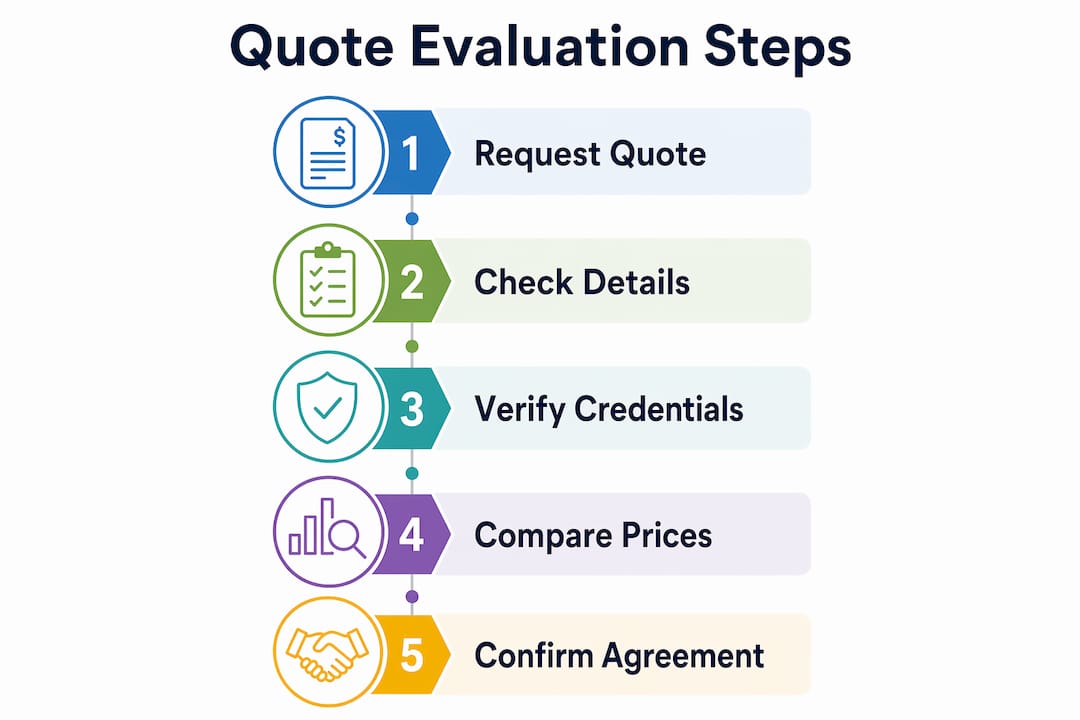
A detailed, itemised quote is the foundation of a trustworthy contractor relationship. It should break down labour, materials, plant hire, and any provisional sums for items not yet fully specified. A vague quote that lists only a total figure gives you no basis for comparison and no protection if the scope expands.
Quote type | What it includes | Risk level |
Detailed itemised quote | Labour, materials, exclusions, provisional sums | Low |
Summary quote | Total figure with brief description | Medium |
Verbal estimate | No written record | High |
Locking scope and variation rules into a written contract before work starts is the most effective way to prevent budget surprises. A quality contractor will define exactly what is included, what is excluded, and how any changes will be priced. This is standard practice, not a negotiating tactic.
Watch for these common exclusions in quotes:
Removal and disposal of existing materials
Making good after first-fix trades (plastering after electrical, for example)
Scaffolding and access equipment
Planning application or building regulation fees
Specialist subcontractor costs
A contractor who resists putting these details in writing is signalling that flexibility in their favour is built into the price. That is not a relationship worth entering.
What are the practical benefits for West London homeowners?
Hiring skilled contractors delivers benefits that go well beyond a finished room. The advantages of skilled contractors are most visible in three areas: compliance, workmanship quality, and long-term property value.
West London properties, particularly in areas such as Kensington, Chelsea, Fulham, and Chiswick, are subject to specific planning constraints. Conservation area rules, permitted development limits, and party wall requirements all affect what you can build and how. A quality contractor who works regularly in these areas understands the local planning environment and coordinates with the relevant authorities as a matter of course.
The practical benefits of hiring professional contractors include:
Compliance assurance. Work is completed to building regulation standards, which protects your property’s value and avoids issues when you sell.
Reduced homeowner stress. A single point of contact manages all trades, deliveries, and inspections, so you do not have to.
Access to trusted trade networks. Established contractors have relationships with reliable subcontractors and suppliers, which means better pricing and faster problem-solving.
Durability of workmanship. Quality materials installed correctly last significantly longer than budget alternatives, reducing maintenance costs over time.
Return on investment. Well-executed extensions and loft conversions in London consistently add measurable value to West London properties.
Regular site visits to observe contractor behaviour reveal discipline and quality that paperwork alone cannot capture. A tidy, organised site with consistent workmanship is a reliable indicator of fewer defects and fewer billing surprises at the end of the project.
Key takeaways
Hiring quality contractors is the most reliable way to protect your budget, your property, and your peace of mind on any home improvement project in West London.
Point | Details |
Verify credentials first | Check insurance certificates and trade registrations with FMB, TrustMark, NICEIC, or Gas Safe before agreeing to any work. |
Demand itemised quotes | A detailed written quote with exclusions listed is the only basis for fair comparison between contractors. |
Use milestone payments | Tie payments to completed stages and keep upfront deposits to no more than 10–15% of the total contract value. |
Lock scope in writing | A signed contract with defined scope and change order rules prevents budget surprises after work begins. |
Assess site conduct | A well-organised, clean site predicts fewer defects and a smoother handover. |
What I have learned from watching homeowners choose contractors
I have seen the same pattern repeat itself more times than I care to count. A homeowner in Hammersmith or Notting Hill receives three quotes. Two are detailed and thorough. One is noticeably cheaper. They choose the cheaper one, reasoning that the savings can go towards finishes or furniture. Six months later, they are back on the phone with a list of problems: a variation invoice that has added 20% to the original price, a bathroom that failed its building control inspection, or a loft conversion that a surveyor has flagged as non-compliant.
The uncomfortable truth is that the cheapest quote is almost never the cheapest project. What looks like a saving at the quote stage is usually a transfer of risk from the contractor to you. The contractor who cannot explain their pricing in detail is the contractor who will find reasons to charge more once they are on site.
The behaviour that I have found most predictive of a good outcome is simple: does the contractor answer questions clearly, produce documents promptly, and communicate proactively when something changes? Those three habits, more than any portfolio or testimonial, tell you whether a contractor runs a disciplined operation. A contractor who manages projects well in West London will show you evidence of that before you sign anything.
The homeowners who get the best results are not necessarily the ones with the largest budgets. They are the ones who vet thoroughly, ask direct questions, and do not let price alone make the decision for them.
— Mateja
Tenenltd’s approach to quality home improvement in West London
Tenenltd has been working with West London homeowners since 2006, delivering extensions, loft conversions, full refurbishments, bathroom renovations, and kitchen renovations across Fulham, Chelsea, Kensington, Chiswick, Hammersmith, and Notting Hill.

Every project begins with a detailed written quote, a clear programme, and full documentation of insurance and trade credentials. Tenenltd operates with milestone-based payment schedules and a single point of contact throughout, so you always know where your project stands. Whether you are planning a rear home extension or a complete property refurbishment, the team brings the same standard of workmanship and accountability to every job. Get in touch to discuss your project and receive a detailed, itemised quote with no obligation.
FAQ
What insurance should a quality contractor carry?
Quality contractors carry public liability insurance of at least £2 million. Always ask for the certificate before work begins.
How much should I pay upfront to a contractor?
Upfront deposits should not exceed 10–15% of the total contract value. Payments tied to completed milestones protect you if the project stalls or the contractor fails to deliver.
How do I verify a contractor’s credentials in the UK?
Check FMB or TrustMark membership online, verify electrical contractors on the NICEIC or NAPIT registers, and confirm gas engineers on the Gas Safe Register. All three checks take minutes and are free.
Why are detailed written quotes so important?
A detailed itemised quote lets you compare like for like across contractors and identifies exclusions that could inflate the final cost. Vague quotes leave room for disputes once work is underway.
What does a quality contractor’s site tell you about their work?
A well-managed construction site with consistent workmanship and clear organisation is a reliable indicator of process discipline and fewer defects at completion.
Recommended
Comments