
The role of design consultations in London home projects
- luka bursac
- Jun 20
- 7 min read
TL;DR:
A design consultation helps London homeowners clarify project goals, budget, and scope before building begins. It produces a written project brief that prevents costly mistakes and scope creep during renovations. In-home consultations are essential for structural projects, while digital sessions suit early planning ideas.
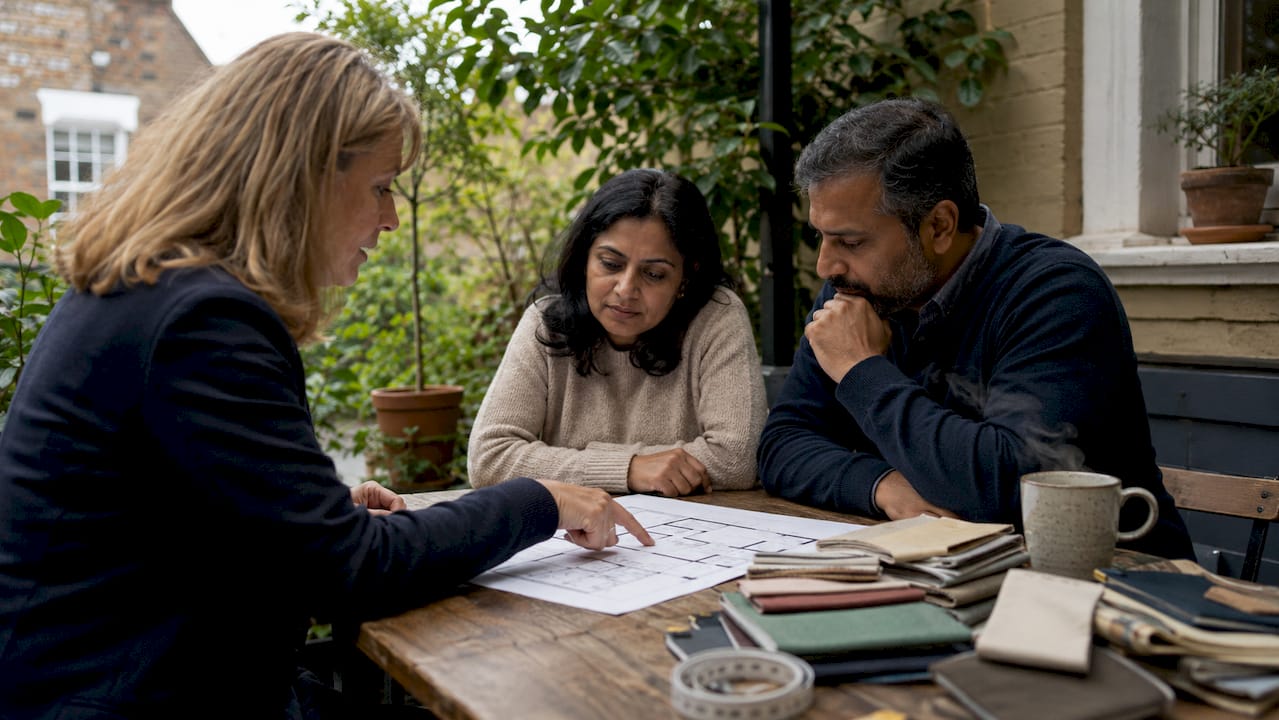
A design consultation is a structured planning session in which a professional designer aligns your goals, budget, and project scope before a single wall is touched. For London homeowners considering extensions, loft conversions, or full refurbishments, the role of design consultations is to create clarity upfront and prevent the costly errors that derail projects mid-build. These sessions typically last 1 to 2 hours and produce a written project brief that becomes the foundation for every decision that follows. Without one, you are essentially asking a builder to start a journey without a map.
How do design consultations prevent costly mistakes and scope creep?
The primary output of a design consultation is a documented project brief that defines scope, investment, and timeline. That brief is not a formality. It is the single document that stops a kitchen renovation from quietly expanding into a structural overhaul you never budgeted for.
Scope creep is one of the most common reasons London home improvement projects run over budget. It happens when expectations between homeowner and contractor are never formally aligned. A consultation closes that gap before work begins, not after the first invoice arrives.
In-person consultations add another layer of protection. A designer visiting your Fulham terrace or Kensington flat can assess lighting conditions, ceiling heights, load-bearing walls, and spatial flow. None of those details translate accurately through photographs. Physical constraints assessment during an in-home visit produces a project roadmap grounded in the actual conditions of your property, not assumptions.
Scope definition: The brief specifies exactly what is included and what is not, removing ambiguity for both you and your contractor.
Budget boundaries: Agreed investment limits are recorded in writing, giving you a reference point if costs begin to drift.
Timeline clarity: A realistic schedule prevents the frustration of open-ended projects that stretch for months beyond expectation.
Material decisions: Early guidance on finishes and fittings prevents expensive last-minute substitutions when original choices prove impractical.
Pro Tip: Bring a written list of your non-negotiables to the consultation. Separating your must-haves from your nice-to-haves before the session saves significant time and sharpens the brief.
What should London homeowners expect during a typical design consultation?
Many homeowners arrive at a consultation expecting to leave with mood boards or floor plans. That is a common misconception. Consultations are diagnostic sessions, not design deliverables. Their purpose is to establish shared understanding, not to produce finished concepts on the spot.
A well-structured consultation moves through three clear phases. Understanding those phases helps you prepare properly and extract maximum value from the time.
Discovery. The designer asks detailed questions about how you use your home, what is not working, and what you want to achieve. For a Chiswick homeowner considering a rear extension, this might cover how the family moves through the ground floor, where natural light is lacking, and whether the priority is entertaining space or a larger kitchen.
Preference assessment. You share visual references, lifestyle priorities, and any constraints such as listed building status or permitted development limits. The designer uses this to understand your aesthetic direction and practical requirements.
Expert direction. The designer offers professional observations on feasibility, potential challenges, and recommended approaches. This is where you receive genuine guidance, not a sales pitch.
The session closes with a written summary or project roadmap produced by the designer within days. That document becomes the basis for accurate proposals from contractors.
Pro Tip: Prepare three specific questions before your consultation. Vague conversations produce vague briefs. Specific questions about layout, budget allocation, or planning constraints produce specific, useful answers.

You can read more about how design and build services work in London to understand how the consultation feeds into the broader project process.
In-home vs digital consultations: which is right for your project?
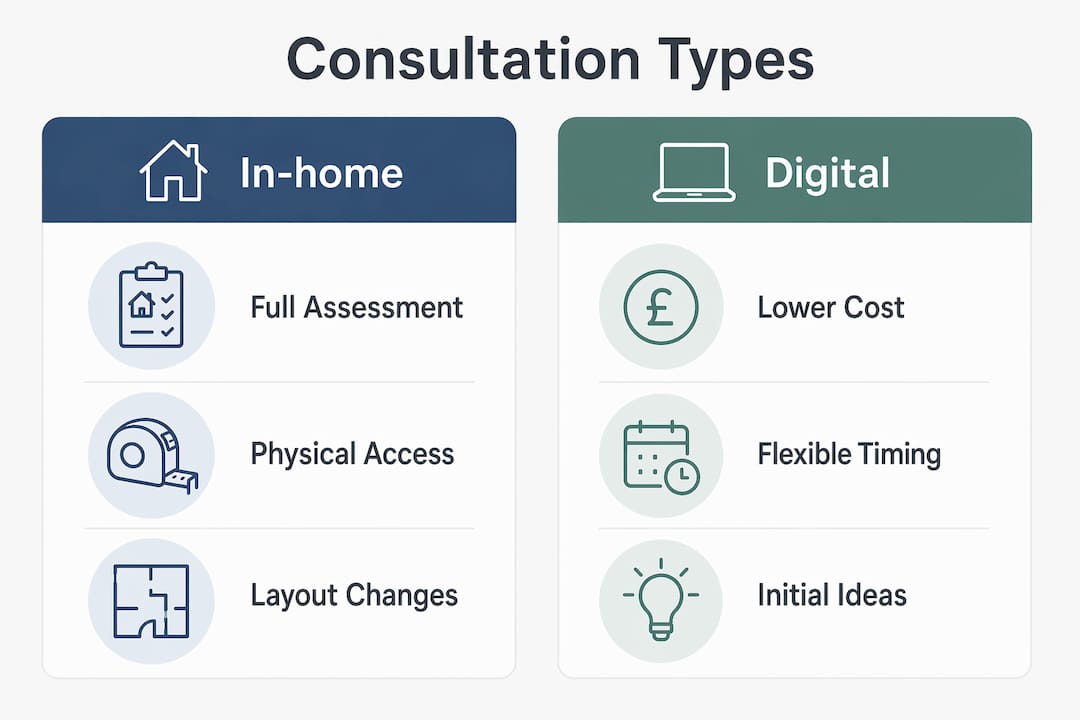
Digital consultations have grown in popularity, and for good reason. They offer flexibility, lower cost, and a convenient starting point for homeowners in the early ideation stage. However, they carry real limitations for projects involving structural or spatial changes.
The table below compares both formats across the criteria that matter most to London homeowners.
Criterion | In-home consultation | Digital consultation |
Spatial assessment | Full assessment of layout, light, and flow | Limited to photos and descriptions |
Physical constraints | Identifies structural and access issues on site | Cannot detect hidden constraints |
Best suited for | Extensions, loft conversions, full refurbishments | Early ideation, styling, colour schemes |
Accuracy of brief | High, grounded in real conditions | Moderate, based on client-supplied information |
Cost | Higher, reflects travel and time | Lower, accessible entry point |
Recommended for custom joinery | Yes | No |
In-home visits are the right choice for any project involving layout changes, custom joinery, or structural alterations. If you are planning a loft conversion in Hammersmith or a rear extension in Notting Hill, a designer needs to stand in the space to give you reliable advice. A digital session simply cannot replicate that.
Digital consultations work well as a first step. Use them to test compatibility with a designer, explore broad ideas, or get initial direction on a styling question. Then follow up with an in-home visit before committing to a full project brief.
How design consultations add value to aesthetics, functionality, and resale
A consultation is the most cost-effective moment to make decisions that affect your property’s long-term value. Upgrades with the highest return on investment, such as lighting quality and finishing choices, are far cheaper to specify at the planning stage than to retrofit after completion.
London property values are sensitive to design quality. A poorly planned kitchen extension in Chelsea that ignores natural light or disrupts the flow between rooms can actually reduce buyer appeal, regardless of the money spent. A consultation steers you away from those traps before they are built in.
Consultations also address what designers call design paralysis. Faced with hundreds of tile options, paint colours, and layout configurations, many homeowners freeze or make reactive choices they later regret. Consultations resolve design paralysis by narrowing infinite choices to a clear, achievable plan. That confidence translates directly into better decisions and fewer expensive changes during the build.
Functionality: A designer identifies how your household actually uses each space and plans accordingly, rather than defaulting to generic layouts.
Aesthetics: Professional guidance produces a coherent visual scheme rather than a collection of individual choices that do not work together.
Resale value: Consultants steer investment toward features buyers in your area actively seek, such as open-plan ground floors or well-specified bathrooms.
Budget efficiency: Strategic allocation of your budget means money goes to the changes with the greatest impact, not the most obvious ones.
For guidance on allocating your budget before the consultation, the refurbishment budgeting guide from Tenenltd is a practical starting point.
Key takeaways
Design consultations are the single most cost-effective investment a London homeowner can make before starting any extension, conversion, or refurbishment project.
Point | Details |
Consultations produce a project brief | A written brief defines scope, budget, and timeline, preventing costly scope creep. |
In-home visits outperform digital sessions | Physical assessment captures spatial constraints that photos and video calls cannot replicate. |
Book early to avoid embedded errors | Delaying a consultation leads to layout or structural mistakes that are expensive to correct later. |
Consultations resolve design paralysis | Expert direction narrows choices and builds confidence, reducing reactive decisions during the build. |
ROI decisions happen at the consultation stage | Lighting, finishes, and layout choices made early deliver the highest return on your investment. |
Why I always tell homeowners to treat the consultation as the most important meeting of the project
After working on home improvement projects across West and Central London for many years, the pattern I see most often is this: homeowners who skip or rush the consultation spend the most money fixing problems that were entirely avoidable.
The misconception I encounter regularly is that a consultation is a preliminary chat before the real work starts. It is not. It is the real work. Everything that follows, the drawings, the quotes, the build programme, depends on the quality of what gets agreed in that room. A vague consultation produces a vague brief, and a vague brief produces a project that drifts.
My strongest advice is to treat the consultation as an interview. Come with specific questions. Ask the designer how they have handled projects similar to yours. Ask what the most common mistakes are for your type of project. Ask what you should avoid spending money on. A good designer will give you direct, honest answers. If they cannot, that tells you something important before you commit.
The other thing I would stress is timing. Booking a consultation late in the planning process, after you have already made structural or layout decisions, dramatically reduces its value. The earlier you bring in expert guidance, the more options remain open to you. Once walls are moved and floors are laid, the consultation becomes a damage-limitation exercise rather than a planning tool.
The role of interior designers in the broader renovation process is worth understanding before you book your first session. It will help you arrive with the right expectations and the right questions.
— Mateja
Start your London project with expert design guidance from Tenenltd
Tenenltd has been working with London homeowners since 2006, delivering extensions, loft conversions, and full refurbishments across Fulham, Chelsea, Kensington, Chiswick, Hammersmith, and Notting Hill. Every successful project begins with a clear brief, and that brief begins with a professional consultation. Whether you are planning a rear or side extension or considering a loft conversion, Tenenltd’s team brings the expertise to align your vision with your budget and London’s planning requirements from day one. Speak to us about your project and take the first confident step towards a home that genuinely works for you.
FAQ
What is the role of design consultations in home improvement?
A design consultation is a structured planning session that aligns your goals, budget, and project scope before work begins. Its primary role is to produce a written project brief that prevents costly mistakes and scope creep throughout the build.
How long does a design consultation typically last?
Most design consultations last between 1 and 2 hours. Senior designers typically provide a written brief summary for client approval within days of the session.
When should I book a design consultation for my London project?
Book as early as possible, ideally before making any structural or layout decisions. Delaying the consultation often leads to embedded errors that are expensive to correct once work is underway.
What questions should I ask during a design consultation?
Ask about the most common mistakes for your project type, which upgrades offer the best return on investment, and how the designer has handled similar projects in your area. Specific questions produce specific, useful answers.
Is an in-home consultation better than a digital one?
For projects involving layout changes, structural alterations, or custom joinery, an in-home consultation is the right choice. Digital sessions work well for early ideation but cannot assess the physical constraints that determine whether a design is actually feasible.
Recommended
Comments