
How to avoid renovation delays: your 2026 guide

Most renovation delays are preventable. The projects that finish on time share one thing: the hard work happened before demolition began, not after. Here is what that looks like in practice.
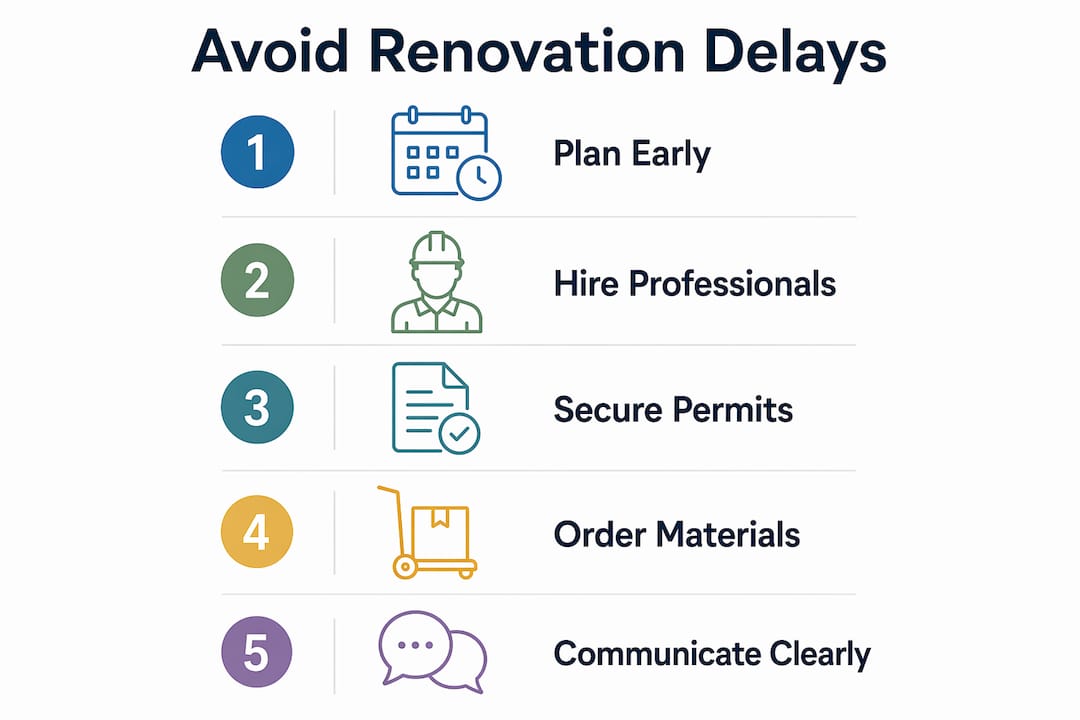
The five moves that protect your schedule from the start:
Lock in a complete, signed-off design before any work begins, covering layouts, finishes, fixtures, and utility locations
Build a Critical Path schedule that sequences every key dependency, from structural steel to specialist trades
Apply for planning permission and building regulations approval before you set a start date
Order all long-lead materials, cabinetry, windows, appliances, and specialist tiles, before demolition starts
Set weekly check-ins with your project lead to catch emerging risks while they are still small
Each of these steps addresses a different category of delay. The sections below go deeper on every one.
Why planning permission matters more than most homeowners expect
Permit delays are one of the most common reasons a renovation stalls, and one of the easiest to prevent with early action. Many homeowners underestimate how many permits a project actually needs. Structural changes, electrical upgrades, plumbing relocations, and loft conversions all typically require separate approvals under UK building regulations, and each has its own review timeline.
Skipping permits to save time is one of the most damaging decisions a homeowner can make. A stop-work order mid-build costs far more in disruption and rework than the permit process ever would. Choosing a contractor who is familiar with your local authority’s requirements, and who manages the permit application on your behalf, removes most of this risk.
Submit your planning application before you fix a construction start date
Confirm which specific works require building regulations sign-off, not just planning consent
Keep all permit documentation accessible to every party on site
Budget for permit fees and any local surcharges in your overall project cost
Track application status actively rather than assuming approval will arrive on schedule
If your project involves a home extension or loft conversion in West London, preparing early for the local authority process can save weeks.
How poor initial planning causes the most expensive delays
Vague plans at the start of a project create a cascade of problems during construction. When layouts, appliance specifications, and utility locations are still undecided once the rough-in trades arrive, work pauses while decisions catch up. Those pauses are costly.
Separating design decisions from technical ones early is one of the most effective things you can do. Confirm where your plumbing points will sit, where circuits need to run, and what your appliance dimensions require before framing closes. Aesthetic choices like tile colour and paint finish can follow, but structural and service decisions cannot wait.
Finalise your cabinetry layout and full appliance schedule, with exact model numbers and utility requirements, before rough-in work begins
Confirm electrical outlet positions, dedicated circuits, and lighting locations before drywall goes up
Lock in all finish selections, including tiles, taps, and door hardware, before demolition starts
Review your floor plan for any utility conflicts that would require expensive mid-build rerouting
Use your choosing renovation materials checklist to confirm technical requirements alongside aesthetic choices
Pro Tip: Schedule a full design review session at least three weeks before demo day. Walk through every room, every fixture, and every utility connection point. Gaps caught on paper cost nothing to fix; gaps caught on site cost days.

How contractor availability affects your timeline
A contractor who is overbooked or poorly organised will create delays regardless of how well you have planned. Choosing the right team is as much a scheduling decision as it is a quality one. Confirm that your contractor has the crew capacity to carry your project through without gaps between phases.
Subcontractor coordination is where many projects lose time quietly. The electrician, plumber, and plasterer each need the previous phase to be complete before they can start. A contractor who manages this sequencing well keeps the project moving; one who does not will leave you with idle days that compound into weeks.
Verify that your contractor has reliable subcontractors confirmed before you sign a contract
Establish a phased timeline with clear milestones for each trade handoff
Ask your contractor what their backup plan is if a crew member is unavailable
Document expected progress intervals in writing so both parties share the same expectations
Set a regular communication rhythm to catch scheduling conflicts before they cause stoppages
For guidance on why professional builders manage these logistics more reliably, the case for professional builders is worth reading before you commit to a team.
How to protect your project from supply chain disruptions
Material lead times for critical items like cabinetry, windows, and appliances often exceed the active construction period itself. Ordering too late is one of the three most common delay drivers in residential renovation, and it is entirely avoidable.
Custom cabinetry, windows, and appliances commonly have long lead times that require ordering before demolition starts to avoid delays. None of these can be rushed at the installation stage, which means the order must go in the week you submit your permit application, not when demolition is already underway.
Identify every long-lead item at the design stage and assign an order date to each
Place orders before demolition begins, not after
Use local storage or staging to hold materials on site before they are needed, reducing last-minute delivery risk
Confirm delivery timelines in writing with your supplier and build those dates into your schedule
Have a contingency plan for each critical item in case a supplier cannot meet their original date
The role of plumbing in your renovation is a useful reference for understanding which specialist fixtures carry the longest lead times and need the earliest attention.

Planning around weather and seasonal conditions
External works are the most weather-dependent phase of any renovation. Groundworks, roofing, and structural additions are all vulnerable to wet conditions, and a poorly timed start can push an entire project back by weeks if the site becomes unworkable.
The UK’s autumn and winter months bring the highest risk of moisture-related delays for external phases. Planning these works during stable weather windows, typically late spring through early autumn, gives you the best chance of uninterrupted progress. That said, internal works can proceed year-round, so sequencing matters as much as timing.
Schedule external groundworks, roofing, and structural additions during stable weather periods
Monitor forecasts actively during external phases and adjust the sequence if conditions deteriorate
Use protective coverings for weather-sensitive work when a phase cannot be rescheduled
Factor local climate patterns into your overall project timeline from the planning stage
Avoid scheduling heavy external works during periods when adverse weather is historically likely in your area
An outdoor renovation checklist can help you plan the timing and preparation of external phases with the right seasonal buffers built in.
What to do when hidden structural problems emerge
Hidden conditions are the wildcard of any renovation. Outdated wiring, water damage, rotted timbers, and undocumented pipework are all common discoveries once walls come down, particularly in older London properties. General contractors consistently report that hidden conditions like these can add 10–21 days to a project schedule when discovered mid-build rather than during pre-construction diagnostics.
The best defence is a thorough pre-construction inspection before demolition begins. A qualified surveyor or experienced contractor can identify many of these issues in advance, giving you time to plan remediation without disrupting the live build.
Commission a pre-construction diagnostic inspection covering wiring, plumbing, damp, and structural integrity
Allocate time in your schedule for remediation of any discovered issues, not just budget
Engage professionals with experience in older properties, where hidden conditions are most common
Add a time buffer to your overall schedule to absorb unexpected structural work
Communicate any pre-construction findings to your contractor before work begins so the schedule reflects reality
Why mid-project design changes cost more than you expect
Change orders during construction are the second-largest source of avoidable delays. A decision that takes five minutes to make in the planning phase can take five days to implement once walls are up and trades are on site. Rerouting a circuit through a finished wall, for example, typically costs £800–£2,000 per circuit before drywall repair and repainting.
The solution is not to eliminate flexibility entirely. It is to front-load decisions so that changes during construction are deliberate choices rather than reactions to things that should have been resolved earlier.
Finalise your full scope of work before signing a construction contract
Establish a formal change control process: any modification must be assessed for cost and schedule impact before approval
Hold regular update meetings during the planning phase to surface and resolve outstanding decisions
Set clear expectations with yourself and your contractor about what “locked in” means once construction starts
Treat every change order as a schedule change first and a cost change second
How budget shortfalls stop projects in their tracks
Funding disruptions are a direct cause of work stoppages. When payments are delayed, crews, subcontractors, and suppliers all feel it. Construction relies on steady cash flow, and a gap in funding can pause progress just as effectively as a missing material or a failed inspection.
Tying payments to milestone completions rather than to percentage-complete claims is one of the most effective ways to maintain both financial leverage and project momentum. You pay when verifiable progress has been made, which keeps the contractor motivated and gives you clear evidence of value at each stage.
Build a detailed, itemised budget before any contractor conversations begin
Include a contingency reserve of at least 10–20% for unforeseen conditions
Link payment milestones to passed inspections and completed phases, not to time elapsed
Discuss payment schedules openly with your contractor before work starts
Anticipate your cash flow requirements across the full project duration so funding gaps do not catch you off guard
How miscommunication between you and your contractor causes delays
Renovation delays are more often caused by decision latency than by slow labour. When a homeowner takes several days to confirm a tile choice or approve a layout change, the crew waits. Those waits accumulate. The project that felt on track in week two is suddenly two weeks behind by week six.
Clear communication protocols prevent this. A single point of contact, a regular meeting rhythm, and a written record of every decision are the three habits that keep projects moving.
Schedule a short, structured progress meeting at the same time each week
Use one communication channel for all project decisions, whether that is email, a shared document, or a project management app
Document every decision and change in writing on the day it is made
Encourage your contractor to flag risks as soon as they appear, not after they have already caused a delay
Confirm roles and responsibilities at the start of the project so there is no ambiguity about who approves what
Understanding how to build a timeline helps you see where decision points fall in the schedule so you can prepare answers in advance rather than being caught out.
How inspection delays stall projects and how to prevent them
Inspections are fixed gates in the construction sequence. Drywall cannot go up until the rough-in inspection is passed. Flooring cannot be laid until the relevant sign-offs are complete. A missed or delayed inspection does not just pause one phase; it pushes every subsequent phase back with it.
Scheduling inspections weeks in advance and anticipating local authority backlogs, which are common during peak spring and summer renovation seasons, keeps your project moving while others wait for an available slot.
Book inspections as soon as the preceding phase of work is approaching completion, not after it finishes
Prepare all documentation meticulously to avoid rejections that trigger a correction-plus-re-inspection loop
Build time buffers around every inspection point in your schedule
Assign one person, typically your contractor, to track permit and inspection status throughout the project
Choose a contractor with established relationships with local building control officers, who can anticipate what inspectors will look for
Expert insights for UK homeowners planning a renovation in 2026
Pre-construction effort accounts for the vast majority of delay prevention. The projects that run smoothly are not the ones with the most experienced crews on site; they are the ones where the most thorough preparation happened before the first wall came down.
A formal Selection Lockdown, finalising every finish and ordering it before demolition begins, is the single most effective tool for eliminating decision bottlenecks during the build. Pair that with a Critical Path schedule that identifies which tasks are non-negotiable dependencies, and you have a project structure that can absorb small disruptions without losing weeks.
For UK homeowners in 2026, permit timelines and material costs deserve particular attention. Local authority processing times vary considerably, and scheduling inspections proactively rather than reactively is the difference between a project that moves and one that stalls. The design-build model reduces total project duration by 20–30% compared to traditional contracting by unifying design and construction accountability, which eliminates the scheduling gaps that occur when architects and builders work separately.
Complete 80% of your delay-prevention work during pre-construction, before any physical work begins
Implement a Selection Lockdown: every fixture, tile, and appliance chosen and ordered before demo day
Use a Critical Path schedule with named milestones and clear dependencies, not a single vague completion date
Anticipate local authority permit timelines and book inspections in advance of phase completions
Consider a design-build approach for complex projects where unified accountability reduces coordination delays
Pro Tip: Weekly 15-minute check-ins between you and your project lead, covering what was completed, what is planned, and what is at risk, are the single most reliable habit of on-time renovations. Keep them short, keep them consistent.
Staying proactive keeps your renovation on track
A renovation that finishes on time is not the result of luck. It is the result of decisions made early, materials ordered ahead of schedule, permits managed proactively, and communication kept consistent throughout. Every delay category covered in this guide has a prevention strategy that begins before construction starts.
The homeowners who experience the smoothest renovations are the ones who treat planning as the project itself, not as the preamble to it. Lock your designs early, build your schedule with real buffers, and stay engaged with your project lead every week.
Finalise and lock your design before any work begins, covering every room, finish, and utility requirement to help prevent mid-build delays
Submit permit applications early and track their progress actively
Order all long-lead materials before demolition starts
Keep communication open, consistent, and documented throughout the project
Monitor progress against your Critical Path schedule and act quickly when a phase falls behind
Ready to start your renovation the right way?

Tenenltd has been delivering high-quality refurbishments, extensions, and conversions across West and Central London since 2006. From Fulham to Kensington, our team manages every phase of your project with the planning rigour and communication discipline that keeps renovations on schedule.
Whether you are planning a home extension, a loft conversion, or a full property refurbishment, Tenenltd brings the expertise and local knowledge to make your project run smoothly from day one. Get in touch to discuss your plans and find out how we can help you avoid the delays that catch so many homeowners off guard.
Key takeaways
Avoiding renovation delays comes down to thorough pre-construction planning, early material procurement, proactive permit management, and consistent weekly communication throughout the build.
Point | Details |
Lock designs before demolition | Finalise every layout, finish, and utility location before work begins to prevent costly mid-build changes. |
Order materials early | Lead times for cabinetry and windows mean orders must go in at permit stage to avoid installation delays. |
Build in a time buffer | Add a 10–15% time buffer to your overall schedule to absorb hidden conditions and inspection delays. |
Tie payments to milestones | Link payments to passed inspections and completed phases, not to percentage-complete claims. |
Meet weekly with your project lead | A 15-minute structured check-in each week catches most risks while they are still small enough to fix. |
Recommended
Comments