
£15k–£80k+: Extension Finance Mapped to Cost Bands + Lender Docs UK
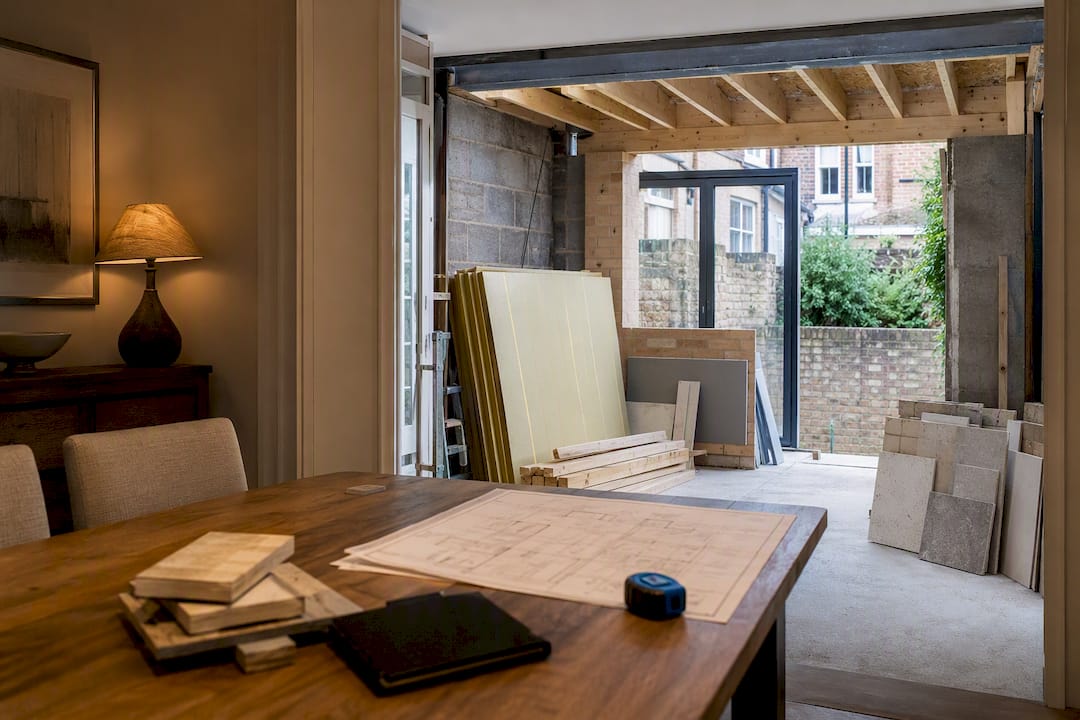
Six routes cover almost every extension project: savings, a further advance from your existing lender, a remortgage, a second‑charge mortgage, an unsecured personal loan, or specialist construction and bridging finance for bigger builds. Small jobs usually suit savings or a personal loan; mid‑sized projects tend to work best as a further advance or remortgage; anything larger or staged often needs construction finance or a bridging facility with a clear exit plan. Whichever route you’re weighing, line up your borrowing with your planning permission timeline and a fixed builder quote before you apply.
TL;DR:
A further advance from your current mortgage lender is often the fastest and cheapest secured option for mid-sized projects, especially if your fixed deal is due to end soon.
Small projects under £15,000 are best financed through savings or a personal loan, with the latter offering quick access and no valuation needed.
Construction or bridging finance are suitable for large, staged projects that require multiple payments aligned with work progress, but they involve higher fees and stricter approval conditions.
Remortgaging makes sense when your current deal is ending and you need more money, but upfront fees and early repayment penalties can outweigh rate savings.
Timing your application and having a contractor prepared with fixed quotes and staged work plans significantly reduces delays and total project costs.
Table of Contents
Practical tactics to lower finance cost and reduce project risk
Eligibility criteria and credit requirements for each financing option
Impact of homeowner equity and credit score on financing approval
Alternative financing options and grants for UK home extensions
Consider a contractor who arrives with finance-ready paperwork
Extension financing options UK homeowners should know about
Every route above has a distinct cost profile, speed, and risk attached, so the right choice depends on how much you need and how soon you need it.
Savings remain the cheapest form of finance because there’s no interest and no fees. The catch is obvious but often ignored: draining an emergency fund to pay a builder leaves you exposed if the project overruns or a boiler dies mid‑build. Most financial advisers suggest keeping at least three months of essential costs untouched, even when the extension budget is tempting to raid.
A further advance from your current mortgage lender is often the fastest secured option, because the lender already holds your data and your property valuation on file. It can be arranged in a matter of weeks and, critically, it avoids the solicitor and arrangement fees that come with switching lenders entirely, which makes it cheaper for mid‑sized raises than a full remortgage in many cases.
Remortgaging with capital raising replaces your whole mortgage with a new, larger one, often at a different rate. It suits homeowners who need a larger sum and whose current deal is close to ending anyway, but early repayment charges on an existing fixed rate can wipe out any saving if you switch mid‑term.
Second‑charge mortgages sit behind your existing mortgage as a separate loan secured on the same property. They’re worth considering when your first mortgage has an unusually good rate you don’t want to disturb, but you still need to borrow a meaningful sum against your equity.
Unsecured personal loans, often marketed as home‑improvement loans, suit smaller projects where you don’t want to touch your mortgage at all. NatWest’s home improvement loans cover roughly £1,000 to £50,000, with representative APRs starting around 6.4% for larger amounts and many lenders running a soft credit check for an initial quote.
Credit cards and overdrafts have a limited but genuine place: bridging a short gap between an invoice and a drawdown, or covering a small final snag list. They’re expensive for anything beyond a few weeks and shouldn’t fund the core build.
Bridging loans solve short‑term cashflow problems, typically when you’re buying before selling or need funds released faster than a standard mortgage process allows. Lenders insist on a compulsory exit strategy, usually a sale or a remortgage, before they’ll agree terms.
Construction and self‑build finance releases money in stages as work completes, rather than as one lump sum. It’s built for larger or more complex extensions and costs more than a standard mortgage, but it matches how builders actually get paid.
The practical shortlist for most readers:
Savings or a personal loan for anything under roughly £15,000
A further advance for speed and lower fees on mid‑range sums
A remortgage when your existing deal is ending anyway and you need a larger amount
A second charge if your current rate is too good to disturb
Construction finance or bridging when the project is large, staged, or time‑pressured
Which route suits which project size and homeowner profile
Matching the finance to the job matters more than chasing the lowest headline rate, because fees and timing often decide the real cost.
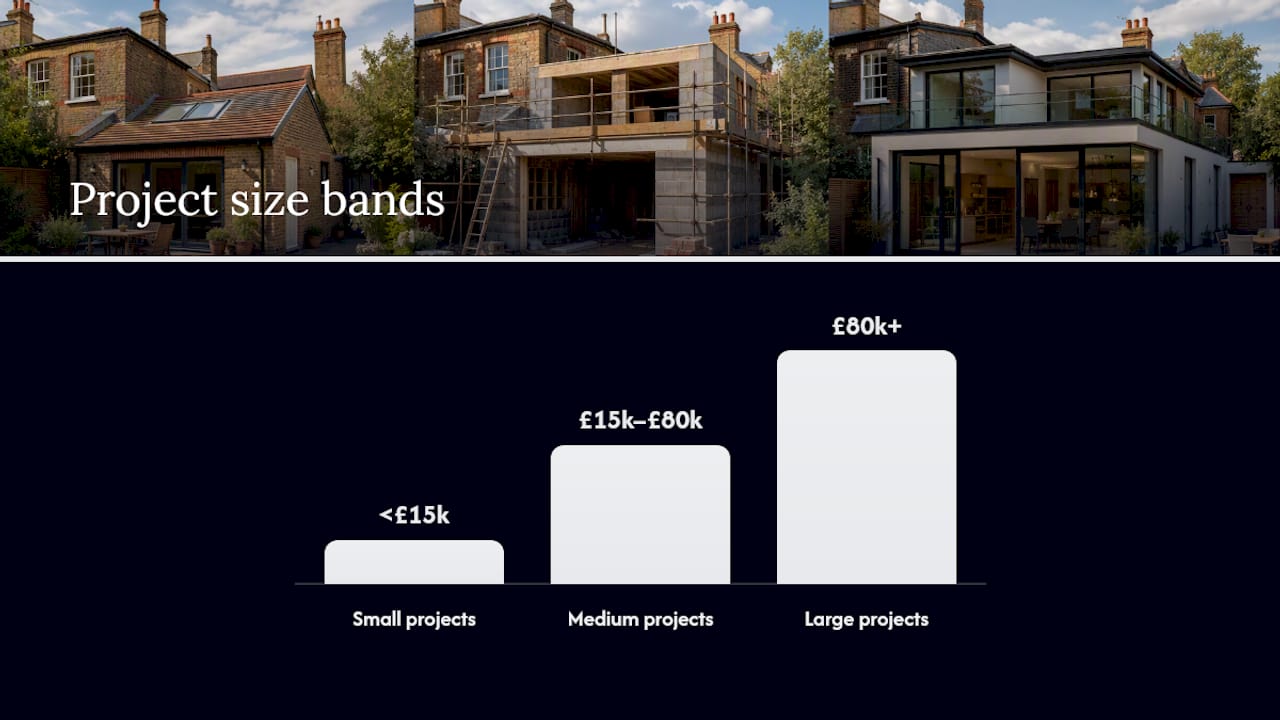
Small projects, under £15,000 (a modest kitchen extension, a porch, internal reconfiguration): savings first, a personal loan second. The application is quick, there’s no valuation needed, and you avoid the legal costs that come with touching your mortgage.
Medium projects, £15,000 to £80,000 (a single‑storey rear extension, a side return, a loft‑and‑extension combination): a further advance is usually the first call, especially if your current lender offers a competitive rate and you’re not near a deal renewal. A remortgage becomes more attractive if your fixed term is ending within six to twelve months anyway.
Large or staged projects, £80,000 and above (double‑storey wraparounds, basement digs, full reconfiguration): construction finance or a specialist bridging facility, because standard mortgage lending rarely matches how these builds draw down cash.
Your existing mortgage’s loan‑to‑value ratio and any early repayment charge shape the decision as much as the project size does. A homeowner two years into a five‑year fix with a hefty exit penalty will almost always find a further advance or second charge cheaper than breaking the deal to remortgage.
Two realistic scenarios illustrate the split, reflecting property investor financing options that cover a range of borrowing strategies for projects of varying size. A homeowner in Chiswick wanting a £35,000 side‑return extension, with eighteen months left on a competitive fixed rate, took a further advance from their existing lender rather than break the fix, saving several thousand pounds in exit fees against a marginal rate difference. A second household planning a £150,000 double‑storey extension with a basement, whose mortgage was due for renewal anyway, used a construction finance facility with staged drawdowns tied to build milestones, then remortgaged onto a standard deal once the work completed and the property was revalued.
Pro Tip: Call your existing lender before you approach anyone else. Ask what a further advance would cost and how quickly they can arrange it. It’s often the fastest and cheapest comparison point against which every other option should be measured.
Costs, fees and how to compare offers accurately
The headline interest rate is the least reliable number on any offer, because fees and term length change the real cost more than a fraction of a percentage point ever will.
Representative APRs on mainstream home‑improvement loans commonly start around 6.4% for larger sums, according to both NatWest and Santander which both publish example rates and loan bands with terms running up to ten years. Remortgaging typically brings arrangement fees, a valuation charge, and solicitor’s costs that can run into a few thousand pounds combined, figures that a further advance usually sidesteps almost entirely.
Take a typical mid-sized raise as a worked example. A further advance might carry no solicitor fee and a modest arrangement charge, because you’re simply extending existing borrowing with the same lender. A full remortgage for the same amount, even at a marginally lower headline rate, could cost several thousand pounds in combined arrangement, valuation and legal fees, which can easily outweigh the rate saving over a short mortgage term. That’s why Fox Davidson’s guidance points many mid‑sized borrowers towards the further advance route once fees are modelled properly.
Construction finance adds another layer: arrangement fees, monitoring surveyor visits at each drawdown stage, and sometimes an exit fee when the facility converts to a standard mortgage. These charges reflect the extra underwriting work involved in staged lending, not padding.
Always ask lenders for the total cost over your expected term, not just the rate, and get at least three quotes before committing to any secured borrowing.
Timing and a lender‑ready application checklist
Get an agreement in principle before you commit to a builder’s start date. It tells you what you can realistically borrow and flags any credit issues while there’s still time to fix them, rather than after you’ve signed a contract.
Lenders assessing extension finance typically want to see:
A fixed, itemised builder quote (not a rough estimate)
Plans and structural drawings, especially where steel or foundation work is involved
Evidence of planning permission or confirmation the work falls under permitted development
Your most recent mortgage statement
Proof of income, whether payslips or self‑employed accounts
Timescales vary by route. A further advance can complete in two to four weeks. A remortgage typically takes six to eight weeks once you factor in valuation and legal work. Bridging finance can move in as little as one to two weeks when the exit strategy is straightforward. Construction finance takes longer to arrange upfront, often four to six weeks, because the lender needs to assess the full build programme before releasing the first tranche.
Borrow the contingency‑inclusive total, not the bare quote figure, and keep a separate cash buffer outside the loan for anything the builder’s quote didn’t anticipate.
Specialist finance for large or staged projects
Construction and self‑build finance releases money in tranches, each triggered once a monitoring surveyor confirms the previous stage of work is genuinely complete. This protects the lender from paying for work that hasn’t happened, and it’s standard practice across the sector.
Lenders assess these facilities using loan‑to‑cost (LTC) or loan‑to‑gross‑development‑value (LTGDV) metrics rather than the straightforward loan‑to‑value calculation used on a standard mortgage, and they expect a credible exit strategy from day one, usually a remortgage onto a standard deal or a sale once the works finish. Construction Capital’s guide sets out how arrangement and monitoring fees factor into the overall cost of these staged facilities.
Expect to pay noticeably more than a standard residential mortgage rate, plus arrangement fees and the cost of each monitoring visit, which typically happens at every drawdown stage. That premium reflects genuine extra underwriting and risk management, not an opportunistic markup.
For most homeowners extending rather than building from scratch, a dedicated self‑build mortgage product, where one exists for the project type, is usually a better fit than a commercial development finance facility designed for professional developers. The paperwork is lighter and the product is built around household rather than business borrowing needs.
Practical tactics to lower finance cost and reduce project risk
Phasing the build to match your cashflow reduces how much you need to borrow upfront, and it gives you room to adjust later stages if costs shift.
Negotiate the builder’s payment schedule before signing anything. A reasonable deposit followed by milestone‑linked payments, checked against completed work rather than time elapsed, protects you from paying ahead of progress.
For larger capital raises, use a whole‑of‑market mortgage broker to weigh a further advance against a full remortgage side by side, because the cheaper option shifts depending on your existing deal, your loan‑to‑value, and how much you need.
Keep contingency at 12 to 18% of the build cost, held separately from your day‑to‑day emergency fund. This single habit, more than any other budgeting step, prevents the mid‑build funding gaps that stall projects and force expensive short‑term borrowing.
Pro Tip: Ask your architect or contractor early whether any part of the extension, particularly insulation or heating upgrades, might qualify for reduced VAT treatment. It won’t change your finance route, but it can shrink the total you need to borrow.
How a contractor prepares lender‑ready packs
Lenders assessing a further advance or construction finance facility want the same core documents every time: a fixed‑price quote broken down by trade, a works programme showing sequencing and duration, evidence of the contractor’s track record, and a staged invoicing schedule that matches how the lender plans to release funds.
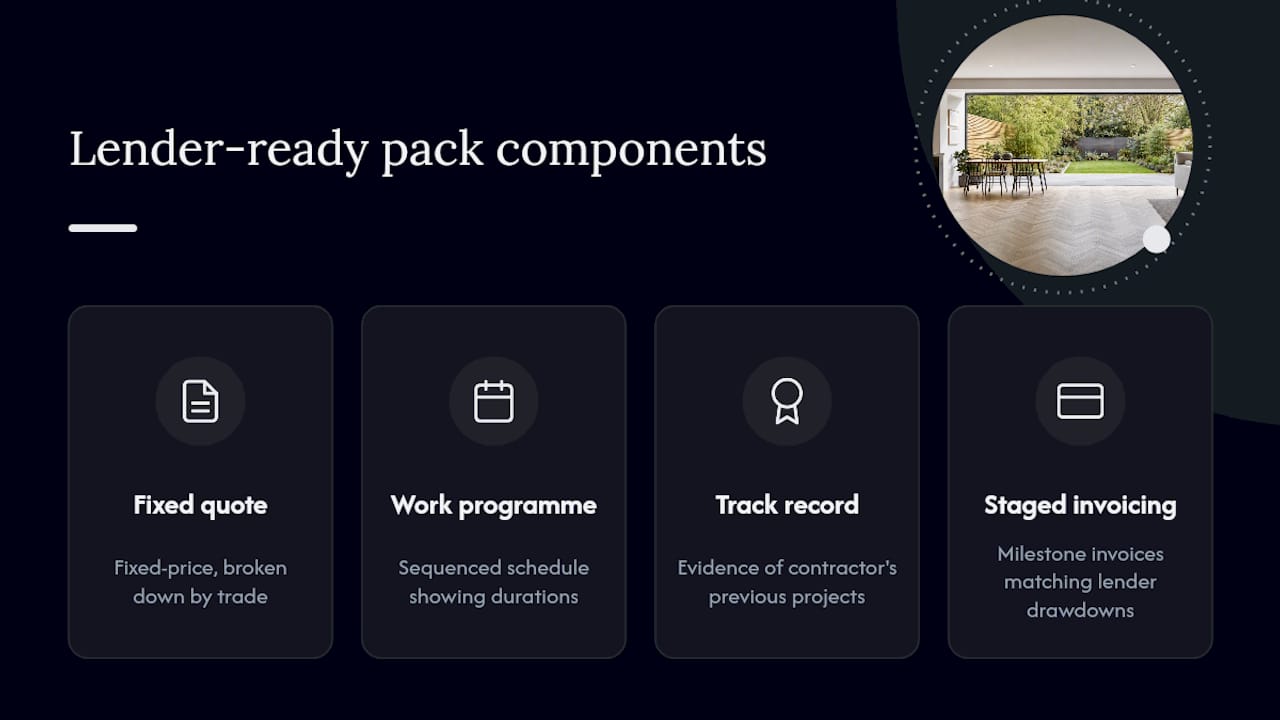
A reputable contractor builds these elements into every extension quotation from the outset, coordinating a detailed site survey with a fixed‑price breakdown and a realistic work programme that maps directly onto typical drawdown stages. Milestone invoicing is structured to align with how lenders actually release money at each build phase, which removes one of the most common causes of mid‑project payment friction.
For a homeowner approaching a lender, having this documentation ready before the application, rather than assembled under pressure once approval is pending, tends to shorten the decision time and reduce the back‑and‑forth that often delays staged facilities.
Eligibility criteria and credit requirements for each financing option
Each route carries its own bar for approval, and understanding it early saves wasted applications.
Personal and home‑improvement loans generally require a reasonable credit score, proof of stable income, and UK residency, with lenders like NatWest running a soft check first so you can see likely eligibility without harming your credit file.
A further advance depends heavily on your existing relationship with your lender: consistent repayment history, sufficient equity, and confirmation your income still supports the additional borrowing. Because the lender already holds most of this data, checks are often lighter than a fresh mortgage application.
Remortgaging and second‑charge mortgages both require a full affordability assessment, a property valuation, and satisfactory credit history, since a new lender is underwriting the loan from scratch. Second‑charge lenders in particular scrutinise your ability to service two secured loans simultaneously.
Construction and bridging finance sit at the stricter end. Lenders want a detailed build programme, contractor credentials, planning evidence, and a credible exit strategy before they’ll release a single tranche, because the risk profile is higher and the loan is larger relative to the property’s current value.
Impact of homeowner equity and credit score on financing approval
Equity is often the single biggest factor determining not just whether you’re approved, but which routes are even available to you. A further advance or remortgage depends on how much headroom exists between your current mortgage balance and your property’s value; lenders typically want to keep total borrowing within a set loan‑to‑value ceiling, commonly around 80 to 85% depending on the lender and product.
Crucially, mainstream lenders generally base that valuation on the property’s current condition, not its projected value once the extension is finished. This catches out homeowners who assume the extension will “pay for itself” in the lender’s eyes before it’s built. Specialist brokers can sometimes arrange lending that factors in the post‑works value, which increases how much you can borrow, but this isn’t standard across high‑street products.
Credit score affects both approval and the rate you’re offered. A stronger score typically unlocks the better end of the representative APR range advertised by lenders, while a patchier history might mean approval at a higher rate or a request for a larger deposit on unsecured lending. For secured borrowing against your home, lenders also weigh your existing repayment history more heavily than they would for a smaller unsecured loan.
Pros and cons comparison of each financing route
No single route wins on every measure, which is exactly why matching the option to your situation matters more than chasing the cheapest headline rate.
Savings cost nothing in interest and involve no approval process, but they remove your financial safety net and aren’t available to most homeowners in the sums an extension needs.
A further advance is fast and typically fee‑light, though it depends on your existing lender offering a competitive rate, and it adds to your overall mortgage debt against the same property.
Remortgaging can secure a genuinely better rate on a larger sum, but arrangement, valuation and solicitor fees add up, and breaking an existing fixed deal early can trigger a costly penalty.
A second charge protects a good existing mortgage rate but usually costs more in interest than a further advance would, since second‑charge lenders take on more risk.
Personal loans avoid touching your mortgage entirely and complete quickly, but the APR is typically higher than secured borrowing and the maximum amount, often up to £50,000, limits their use to smaller projects.
Construction finance matches how staged builds actually get paid and reduces the risk of over‑borrowing early, but it costs more overall once arrangement and monitoring fees are included.
Alternative financing options and grants for UK home extensions
Direct grants specifically for private home extensions are rare in the UK, since most government support targets energy efficiency, accessibility, or specific renovation categories rather than general extension costs.
Where a genuine gap exists is VAT treatment. Certain energy‑efficiency measures incorporated into a wider building project, such as insulation or specific heating technology, can sometimes qualify for reduced VAT rates, which lowers the overall project cost rather than providing new borrowing. It’s worth raising with your contractor and accountant before finalising the specification, since eligibility depends on the exact works involved.
Local authority disabled facilities grants exist for extensions that are needed to accommodate a disability, such as a ground‑floor bedroom or accessible bathroom addition, though these are means‑tested and administered locally rather than nationally.
Beyond these narrow categories, most homeowners are working with the mainstream routes already covered: savings, borrowing against equity, unsecured credit, or staged construction finance. Treat any scheme promising broad extension grants with scepticism and verify directly with your local council before assuming eligibility.
What actually matters when you’re choosing how to pay
The conventional advice on extension finance spends too much time comparing headline rates and not enough time on sequencing. Reading enough lender guidance shows the same pattern repeatedly: projects don’t stall because someone chose a 6.9% loan over a 6.4% one, they stall because the finance wasn’t in place when the builder was ready to start, or because the loan amount didn’t include contingency and the homeowner had to pause work mid‑build to find another few thousand pounds.
That’s the gap most guides skip. Getting an agreement in principle early, matching your borrowing to a fixed builder quote rather than a rough estimate, and building in 12 to 18% contingency from the outset will save more money and stress than shaving half a percentage point off an APR. If there’s one priority to take from all of this, it’s sequencing: talk to your lender before you talk to your builder about a start date, not after.
— Mateja
Consider a contractor who arrives with finance-ready paperwork
Comparing loans and remortgage rates only gets you halfway there. The other half is having a fixed, itemised quote and a realistic works programme ready the moment a lender asks for one, and that’s where Tenen Ltd earns its place in the process for West and Central London homeowners.

Tenen Ltd surveys your property, produces a fixed‑price quotation broken down by trade, and builds a staged works programme with milestone invoicing designed to line up with how lenders release construction finance in tranches. For homeowners weighing a further advance against staged drawdowns, having that documentation ready before you approach a lender removes one of the biggest sources of delay in the whole process. If you’re at the stage of costing out a rear, side, or full wraparound extension, request a site survey through the Tenen Ltd extensions page and get a fixed quote you can take straight to your lender.
Sources
FAQ
How do people afford house extensions in the UK?
Most homeowners fund extensions through a mix of savings and borrowing, typically a further advance or remortgage for mid‑to‑large projects, or a personal loan for smaller ones, with borrowing sized to include a contingency buffer rather than just the builder’s quote.
Can you pay for an extension on finance?
Yes. Common finance routes include unsecured personal loans, a further advance from your existing mortgage lender, remortgaging, second‑charge mortgages, and staged construction finance for larger builds, each suited to different project sizes and equity positions.
What is the cheapest way to extend a house in the UK?
Paying from savings is cheapest when you have the funds without depleting your emergency buffer; where borrowing is needed, a further advance is usually the lowest‑cost route for mid‑sized projects because it typically avoids the solicitor and arrangement fees that come with a full remortgage.
Recommended
Comments