
30 mA RCDs and Certification: Fuse Box Regulations UK for Homeowners
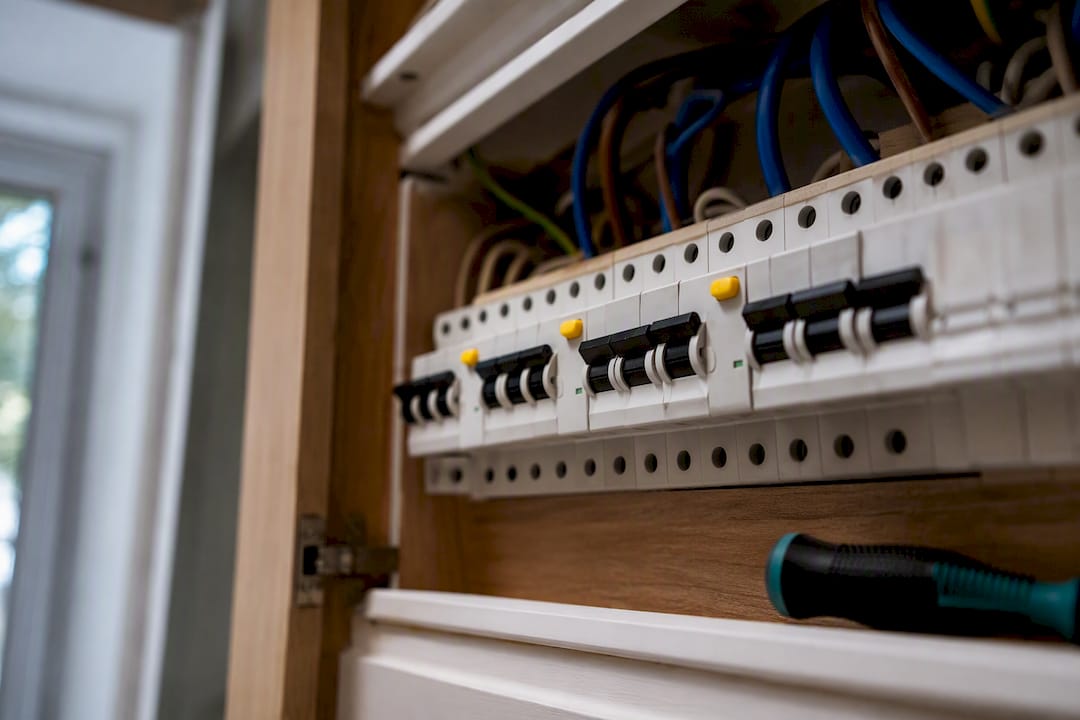
Old fuse boxes are not illegal to own, but they must meet BS 7671 and Building Regulations standards from the moment you carry out notifiable electrical work on them. If your consumer unit shows scorch marks, trips constantly, or lacks RCD protection, stop opening the enclosure yourself and call a registered electrician. Test your RCDs today using the button on the unit itself.
TL;DR:
Old fuse boxes can remain legally owned but must meet current BS 7671 standards if any notifiable electrical work is performed.
Modern consumer units generally include RCDs and RCBOs that trip within milliseconds for safety, unlike older fuse boxes with rewireable or cartridge fuses.
Replacing a consumer unit requires certification, notification to authorities, and is advised only if safety issues or loads surpass existing capacity.
Proper placement and ongoing maintenance of consumer units are crucial for safety and compliance, with inspection and testing recommended every six months.
Disposal of old fuse boxes should be handled through registered waste carriers, as they contain materials requiring environmentally responsible disposal.
Table of Contents
What is a consumer unit and how does it differ from an old fuse box?
What are the core UK fuse box regulations and legal requirements?
Which safety devices does BS 7671 require in a consumer unit?
Do I need to replace my consumer unit, and what will it cost?
Who is allowed to carry out fuse box work and what paperwork should you receive?
What warning signs mean your fuse box needs urgent attention?
What happens during a consumer unit replacement, step by step?
How does consumer unit work fit into a wider home renovation?
Why the safest approach is treating compliance as ongoing, not one-off
What is a consumer unit and how does it differ from an old fuse box?
A consumer unit is the modern replacement for what most homeowners still call a fuse box. Both sit at the point where mains electricity enters your home and distribute power to individual circuits, but the technology inside has changed dramatically. Older fuse boards used rewireable or cartridge fuses, which meant physically replacing a wire or cartridge every time a circuit failed, often in the dark, often with the wrong fuse wire to hand.
Modern consumer units use miniature circuit breakers (MCBs) and residual current circuit breakers with overcurrent protection (RCBOs) instead. You flip a switch back on rather than fiddling with fuse wire, and each circuit gets clearer labelling and more sensitive protection against electric shock.
A few terms get used interchangeably, and it’s worth knowing them:
Fuse box or fuse board: the older, generic term, often still used even when the unit inside is a modern consumer unit.
Consumer unit: the current technical term under BS 7671, referring to the enclosure housing modern protective devices.
Distribution board: sometimes used for larger domestic or commercial installations with multiple circuits.
The practical upshot is that a modular consumer unit lets an electrician replace a single faulty device without disturbing the rest of the board, something a 1970s fuse box simply cannot offer.
What are the core UK fuse box regulations and legal requirements?
BS 7671, published by the IET, is the wiring standard that governs how consumer units and circuits must be designed, protected, and installed across the UK. It doesn’t ban old fuse boxes outright, but it sets the bar that any new or altered installation must clear, and it’s updated periodically to reflect new risks like electric vehicle charging loads and arc faults.
Building Regulations sit alongside BS 7671 and add a legal layer specific to England and Wales. Replacing a consumer unit is treated as notifiable electrical work, meaning it must either be carried out by a registered competent person or notified to local authority building control before or after the work begins.
Here’s what that means in practice:
A registered installer under a competent person scheme can self-certify the work and notify building control on your behalf.
If you use someone outside a scheme, you (or they) must notify the local authority directly, which usually involves a fee and an inspection.
Either route should end with an Electrical Installation Certificate confirming the work meets BS 7671.
Skipping notification altogether can cause problems later, particularly at the point of sale.
Competent person schemes exist precisely so homeowners don’t need to deal with council paperwork directly. Ask any electrician quoting for consumer unit work which scheme they belong to before you agree to anything.
Which safety devices does BS 7671 require in a consumer unit?
BS 7671 requires RCD protection designed to disconnect power promptly for most domestic circuits, including socket outlets up to 32 A, bathroom circuits, and cables buried in walls where mechanical damage is a risk. That 30 mA figure isn’t arbitrary.
30 mA is the internationally accepted sensitivity threshold for RCDs designed to prevent lethal electric shock, because it disconnects a faulty circuit within milliseconds, before earth-fault current reaches levels that can trigger ventricular fibrillation. It’s the single figure that does more life-saving work than almost anything else in the consumer unit.
There are a few exceptions where risk assessment allows a different approach, such as certain fire alarm circuits where nuisance tripping would itself create a hazard, but these are the exception rather than the rule.
You’ll typically see one of two arrangements protecting your circuits:
Dual-RCD boards, splitting circuits across two RCDs so a fault on one doesn’t kill power to the entire house.
RCBOs on every circuit, giving individual overcurrent and shock protection per circuit, which costs more but avoids the nuisance of losing multiple circuits to one fault.
Newer boards increasingly include Arc Fault Detection Devices (AFDDs), which catch dangerous arcing faults that standard RCDs miss, and Surge Protection Devices (SPDs) for homes with sensitive electronics. Since January 2016, consumer units in domestic premises must also be made from non-combustible material rather than the plastic enclosures common before that date. RCD type matters too. BS 7671:2018 requires installers to select Type AC, A, F, or B based on what’s actually connected, since the wrong type can either fail to protect properly or trip constantly with no fault present.
Do I need to replace my consumer unit, and what will it cost?
There’s no blanket law forcing you to rip out an old fuse board simply because it’s old. Replacement becomes necessary when specific triggers appear, and recognising them early saves you from an emergency call at the worst possible moment.
The clearest triggers are:
A C1 or C2 code on an Electrical Installation Condition Report (EICR), flagging danger present or potentially dangerous conditions.
Adding a high-load circuit such as an EV charger or induction hob that the existing board can’t safely support.
Your mortgage lender or insurer requesting an upgrade following a survey.
Visible fire damage, scorching, or suspected asbestos in an older fuse board’s components.
No RCD protection at all on a board that predates modern requirements.
None of these force an upgrade by default in isolation, but once you do carry out the notifiable work, the finished job must meet current Building Regulations, not the standard your old board was installed under.
On cost, a straightforward domestic consumer unit swap typically falls in a moderate range, but the final figure depends heavily on what’s behind the front cover. Expect the price to climb if meter tails need renewing, if earthing and bonding are inadequate and need upgrading, or if the number of circuits has grown since the original installation. Get a detailed, itemised quote after a site survey rather than a phone estimate, because hidden issues behind an old board are the norm, not the exception.
Where should a consumer unit be positioned in your home?
Siting a consumer unit correctly is as much about BS 7671 compliance as it is about common sense. Get it wrong and you create either an access problem for future maintenance or a genuine fire risk.
Mounting height: position the unit so the main switch sits within easy reach, generally between 1350mm and 1450mm from the floor, keeping it accessible without a step stool in an emergency.
Clearance from hazards: keep the unit well clear of sinks, gas meters, and other appliances where water or gas leaks could create a compound hazard.
Escape routes: never site a board directly on an escape route such as a hallway leading to the only exit, since a fault here could block your way out during a fire.
IP rating: choose an enclosure rated appropriately for its location, particularly in garages, outbuildings, or anywhere damp or dusty conditions are likely.
Cable entry and support: ensure meter tails and circuit cables are properly clamped, with fire stopping used at any point cables pass through a fire compartment wall or floor.
Get these right and the board stays both safe and serviceable for the next twenty years.
Who is allowed to carry out fuse box work and what paperwork should you receive?
Replacing or altering a consumer unit is notifiable work under Building Regulations, which means it has to be either carried out by a registered competent person or formally notified to your local authority. This isn’t bureaucratic box ticking. It exists because unsafe consumer unit work is one of the more common causes of domestic electrical fires, and the certification trail proves the job was done properly.
You should come away from the work with two documents: an Electrical Installation Certificate confirming the installation meets BS 7671, and a Building Regulations compliance certificate confirming the local authority or competent person scheme has signed the work off. Keep both. They’re frequently requested during a house sale, and letting agents increasingly ask landlords for them too.
Before booking anyone, check the following:
Are they registered with a recognised competent person scheme, and can they show you their registration number?
Do they carry adequate public liability insurance?
Will they confirm in writing that they’ll provide an EIC and handle Building Regulations notification?
Do they intend to use devices approved by the consumer unit’s manufacturer, rather than mixing brands, which can compromise the unit’s tested performance?
Pro Tip: Ask to see a sample EIC from a previous job before work starts. A hesitant answer, or one that sounds like they’ve never issued one, is a red flag worth walking away from.
What warning signs mean your fuse box needs urgent attention?
Some faults are obvious the moment you open the cupboard door, others only show up as a pattern of odd behaviour over weeks. Both matter.
Look for burn marks or discolouration around switches, any cover that’s loose, cracked, or missing, and any point where you can see bare live parts through a gap. These are stop-and-call-an-electrician signs, not wait-and-see ones.
On the operational side, watch for circuits that trip repeatedly for no obvious reason, any burning smell near the unit, or an RCD that won’t reset. A board that trips constantly isn’t being oversensitive. It’s telling you something.
Two simple habits keep you ahead of trouble:
Press the RCD test button every six months, exactly as IET guidance recommends, and confirm the switch trips cleanly.
Check circuit labelling is still legible and accurate, particularly after any renovation work that may have added or moved circuits.
Never open a live enclosure yourself. That’s the one line homeowners should never cross.
What happens during a consumer unit replacement, step by step?
A proper replacement follows a fairly consistent sequence, and knowing it helps you judge whether the electrician quoting you is doing the job thoroughly or cutting corners.
Survey first: the electrician checks earthing arrangements, measures earth fault loop impedance (Ze), inspects meter tail condition, and documents your existing circuits before touching anything.
Safe isolation: power is isolated at the supply, which sometimes requires contacting your Distribution Network Operator (DNO) if the meter tails themselves need work, since these belong to the network operator, not you.
Installation: the old board comes out, the new consumer unit goes in, and circuits are reconnected, relabelled, and checked against the original survey notes.
Commissioning tests: insulation resistance, earth continuity, and RCD trip times are all tested and recorded before the job is signed off.
Certification: you receive the Electrical Installation Certificate and the paperwork needed for Building Regulations notification, ideally within a few days of completion.
Most straightforward domestic swaps take a single day, though older properties with poor earthing or damaged meter tails can stretch that to two.
How does consumer unit work fit into a wider home renovation?
At Tenenltd, we’ve learned that consumer unit upgrades work best planned alongside the rest of a refurbishment, not bolted on afterwards. Cable routing, wall finishes, and access all get easier when electricians and other trades coordinate from the outset rather than chasing each other room by room.
Fire safety shapes where we position every board: never on an escape route, always in a non-combustible enclosure, with proper fire-stopping at cable entries through compartment walls. If you’re hiring a contractor for electrical work during renovation, ask specifically how they’ll coordinate consumer unit positioning with your fire safety strategy and who takes overall responsibility for sign off.
If you’re planning a property extension that adds circuits or load, factor the consumer unit into that conversation from day one, not as an afterthought once walls are already closed up.
What types of fuses and breakers appear in UK fuse boxes?
Even in 2026, plenty of UK homes still run on genuinely old-style fuses, and understanding what each type does helps you judge how urgently yours needs attention.
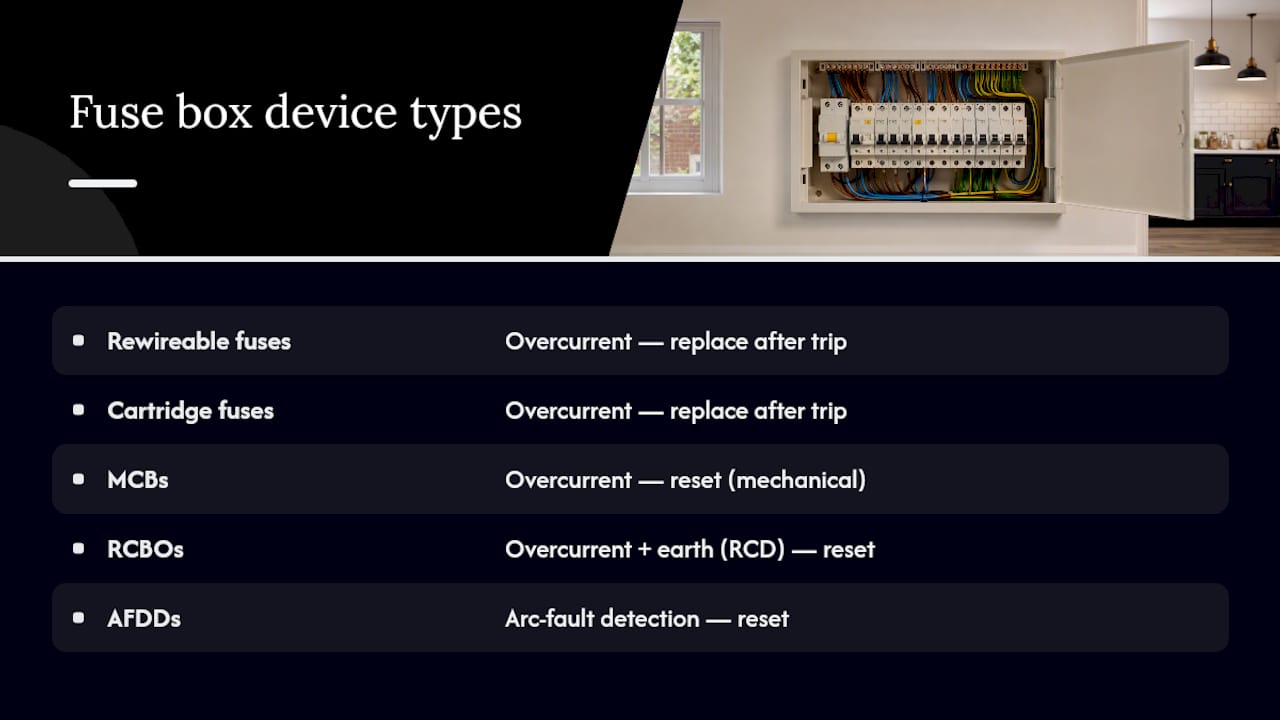
Rewireable fuses are the oldest type still found in service: a ceramic holder with a length of fuse wire that melts and breaks the circuit when current exceeds a safe level. They’re cheap but slow to react and easy to rewire incorrectly with the wrong-rated wire, which defeats the protection entirely.
Cartridge fuses improved on this by sealing the fuse element inside a replaceable cartridge, giving more consistent breaking performance but still requiring a physical replacement after every trip.
MCBs (miniature circuit breakers) replaced both fuse types in modern consumer units. Rather than burning out, an MCB trips a mechanical switch, so resetting a tripped circuit is as simple as flicking it back on, and its rated current is far more precise and repeatable than fuse wire ever was.
RCBOs combine an MCB’s overcurrent protection with an RCD’s shock protection in a single device, protecting one circuit against both overload and earth faults without affecting any other circuit on the board.
AFDDs, increasingly specified in higher-risk installations, detect the electrical signature of arcing faults inside cables and connections, a fire risk that neither an MCB nor a standard RCD is designed to catch.
If your board still relies on rewireable fuses, that alone is a strong signal it predates almost every safety improvement BS 7671 now expects.
How should you dispose of an old fuse box responsibly?
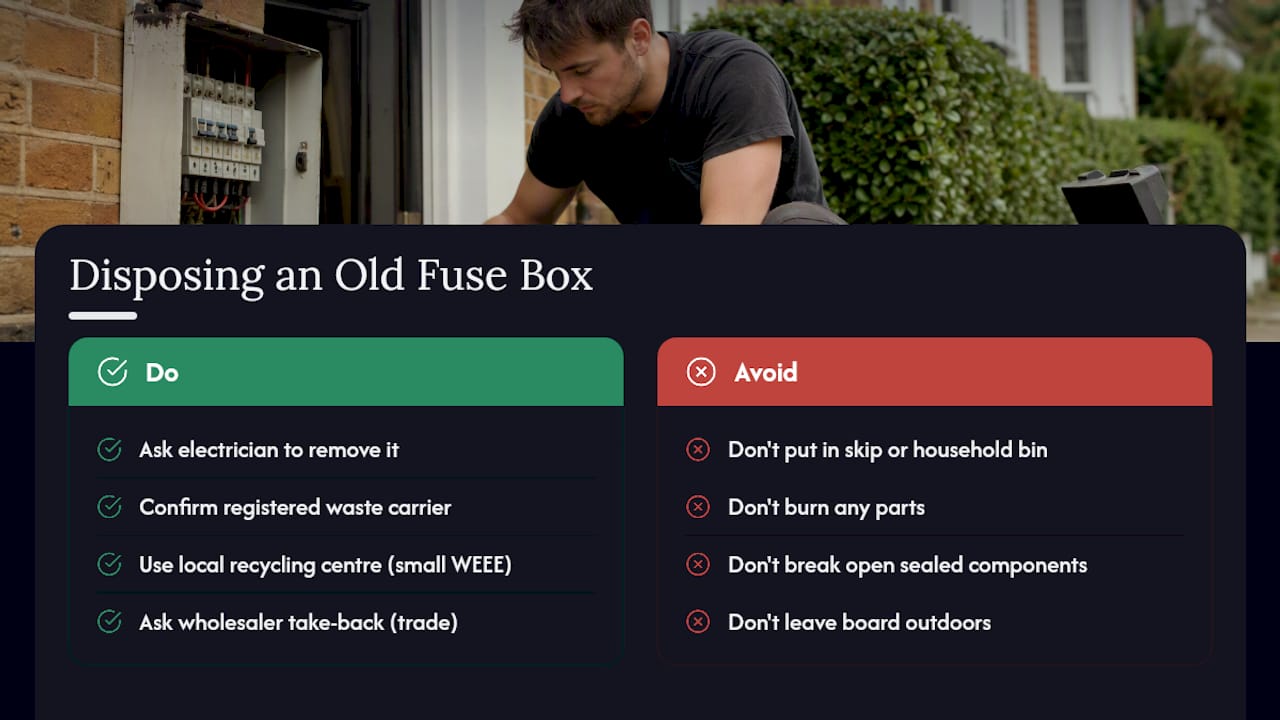
Old consumer units and fuse boxes count as Waste Electrical and Electronic Equipment (WEEE), and they shouldn’t go in a general skip or household bin. The enclosures often contain plastics, metals, and in older units, components that need proper separation rather than landfill disposal.
Your electrician should remove the old unit as part of the replacement job and arrange disposal through a registered waste carrier, which is worth confirming before work starts rather than discovering afterwards that it’s been left in your garden. Reputable competent person scheme members typically build this into their service as standard.
If you’re managing removal yourself, most local authority recycling centres accept small WEEE items free of charge, and many electrical wholesalers operate take-back schemes for trade customers. Avoid burning any part of an old fuse board or breaking open sealed components yourself. Older units, particularly those manufactured before the 1990s, can contain materials that require careful handling.
Beyond the legal disposal angle, there’s a genuine environmental case for replacement over indefinite patching. Modern consumer units draw negligible standby power and eliminate the material waste of repeatedly buying fuse wire or cartridge fuses, a small but real difference over a board’s typical fifteen to twenty-five year service life.
Why the safest approach is treating compliance as ongoing, not one-off
The mistake homeowners make most often is treating consumer unit compliance as a single event: replace it once, forget about it for twenty years. BS 7671 doesn’t work that way. It’s amended periodically, and a board that met every requirement in 2016 can fall short of what a lender or buyer’s solicitor expects in 2026, particularly around AFDD provision and RCD type selection for homes with EV chargers or solar inverters.
Conventional advice tends to fixate on the replace or don’t replace question, when the more useful question is whether your installation still matches how you actually use electricity. A household that’s added an EV charger, a heat pump, and a home office since the original board was fitted has changed the load profile entirely, regardless of whether the board itself still “works.”
Prioritise the EICR over guesswork. It’s the one document that turns a vague worry into a specific, actionable finding, and it’s what every lender, buyer, and insurer will eventually ask for anyway. Everything else, cost, timing, aesthetics, is secondary to getting an honest professional assessment first.
— Mateja
This article is general information, not a substitute for advice from a qualified lawyer. Consult a qualified legal professional about your own circumstances before acting on anything here.
Sources
Recommended
Comments