
External Painting in London: What Your Home Needs
A good exterior repaint does more than freshen the front of your house. It seals the masonry and joinery against London’s rain, lifts kerb appeal and protects your property value. The result depends on three things: how well the surfaces are prepared, whether the paint suits the material, and whether the rules for your street have been checked first. At Tenen Ltd, our painting and decorating work is handled in-house, with director oversight and a fixed quote after a site survey, so you know what the job involves before it starts.
This guide is written for homeowners in Fulham, Chelsea, Kensington, Chiswick, Hammersmith, Notting Hill and across West and Central London. It covers what exterior painting involves, which paints suit which walls, when to schedule it, when you need permission, and what a proper quote should contain.
TL;DR
Preparation decides how long an exterior finish lasts: cleaning, repairs to render and woodwork, and the right primer come before any colour.
Match the paint to the wall. Standard masonry paint suits sound modern brick and render, while lime-based or breathable finishes suit older stucco and lime render.
Painting is generally permitted without planning permission, but conservation areas, Article 4 Directions and listed buildings add rules, especially for colour changes.
Plan the work for a dry, mild spell. Spring and early autumn are the usual favourites in the UK.
Ask for an itemised, fixed quote after a site survey. We offer that with director-led oversight and in-house teams.
Table of Contents
What exterior painting actually involves
External painting covers more than the walls. On a typical West London terrace or mansion block it can include rendered or painted brickwork, stucco, window frames, sills, doors, fascias, railings and porches. Each surface weathers differently, so each needs its own preparation and paint system.
Regular redecoration is also maintenance. Historic England notes that keeping external paintwork in good order prevents decay, especially in woodwork. A cracked paint film lets water into timber and render, and by the time you see rot the repair bill has grown well beyond the cost of repainting.
A complete exterior job usually runs in this order:
Survey and access planning (scaffolding or tower access for upper floors).
Cleaning and removal of loose, flaking or failing paint.
Repairs to render, pointing, timber and sealant joints.
Priming where the surface needs it.
Two finish coats, with drying time between them.
Final inspection and snagging.
The repair stage is where many repaints succeed or fail. Painting over a damp, crumbling or unsound surface hides the problem for a season at best. Our team assesses repair needs during the survey, so they appear in the quote rather than as a surprise halfway through.
How to tell whether your house needs repainting or repairs first
Walk round the house on a dry day and look closely at the following:
Flaking or peeling paint, which means the film has lost its grip, often because of moisture behind it.
Chalky, powdery surfaces, which show the old paint has broken down and needs sealing before it is recoated.
Hairline cracks in render that let water in, particularly around windows and below parapets.
Soft or spongy timber on sills, bottom rails and door thresholds.
Green or black growth on north-facing walls and below leaking gutters. The gutter is the cause, and it should be fixed before painting.
Failed mastic where frames meet the wall.
If you find more than cosmetic fading, treat the job as repairs plus repainting. A surface that is flaky or powdery needs a stabilising primer, as Ronseal’s exterior painting guide explains, before the topcoat goes on. Skipping that step is one of the commonest reasons a new finish fails early.
For houses that also need structural, plumbing or electrical work, it makes sense to combine the jobs. Scaffolding put up once serves the roofline, the repairs and the paint. Our full property refurbishment service brings those trades under one project.
Choosing paint for London brick, render and stucco
London housing stock is varied: yellow London stock brick, white stucco in Kensington and Notting Hill, pebbledash and render on interwar semis in Chiswick and Hammersmith, painted timber sashes everywhere. No single paint suits them all.
The main masonry paint types
A guide to external paintwork from Edinburgh World Heritage describes three main families of masonry paint:
Paint type | Character | Typical use |
Water-borne acrylic emulsion | Easy to apply by brush, roller or spray | Sound modern masonry and render |
Solvent-borne synthetic rubber resin | Durable, but high in volatile organic compounds | Specific situations needing a tough film |
Silicate paint | Mineral-based, long used in Europe | Mineral surfaces needing a breathable finish |
The same guide points to limewash and lime-based finishes for traditional construction, with specialist advice. That matters in London, where many Victorian and Georgian houses were built with lime mortar and lime render that need to let moisture escape.
Breathable finishes for older buildings
Older walls absorb and release moisture. A film that seals them in can push damp into the fabric of the building. Southwark Council’s Householder Development SPD, published in July 2025, advises that breathable paint such as limewash should be used on stucco and lime render so moisture can evaporate. It also advises avoiding the painting of brick, stone or concrete on listed buildings, because it can cause damp and harm historic fabric.
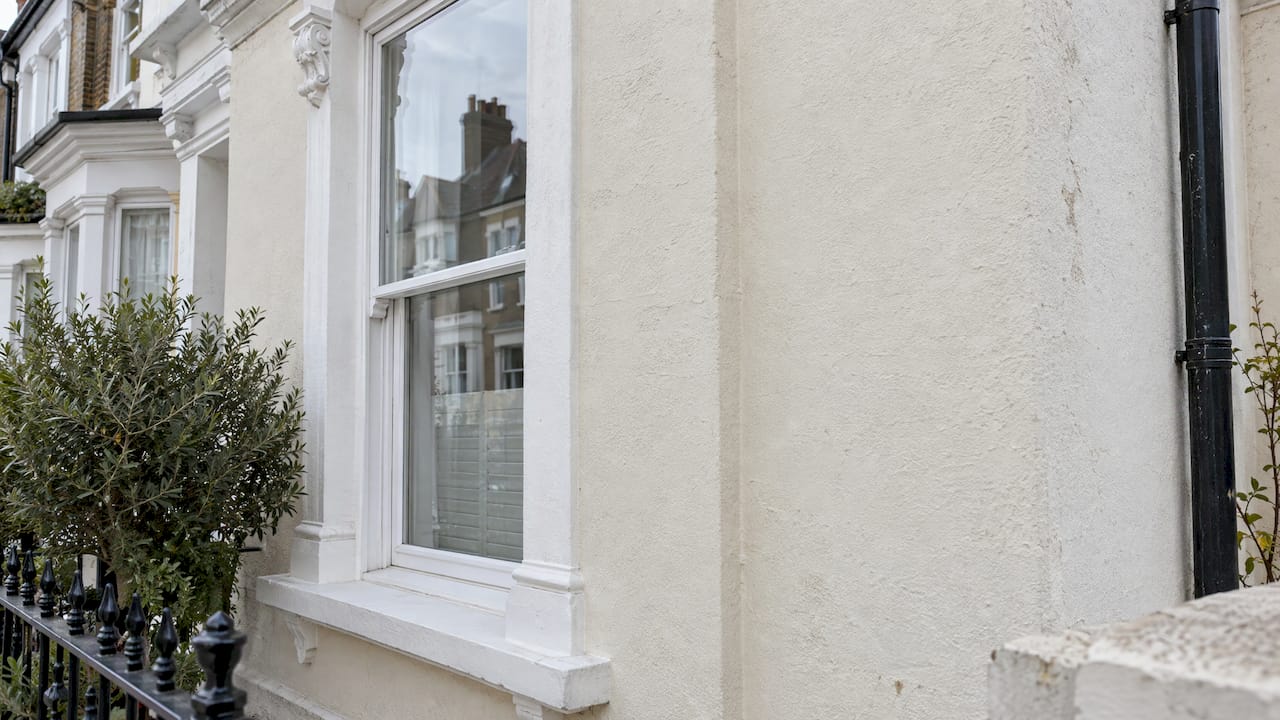
This is why the colour and the product are chosen together at survey stage. For a Victorian property in particular, our Victorian house refurbishment guide shows how the whole building, not just the paint, is handled.
Timber and joinery
Historic England points out that old hardwoods such as oak are best left unpainted and oiled instead. It also notes that modern whites are much brighter and colder than historic ones, and that joinery in older houses was often painted a deep brown rather than white. If your house has period windows, the right shade can be as important as the product. Our guide to paint brands for London homes helps you compare finishes.
How much paint does a house need?
Dulux’s exterior walls guide suggests measuring the width and height of the whole house, then subtracting windows and doors. It says two coats of masonry paint are usually enough, with a third over strong shades, and warns that a rough surface can double the paint needed. This is why two quotes for the “same” house can differ: the surface texture and the colour change both alter the quantity and the labour.
When to paint: weather and season
Exterior paint needs a dry surface and stable conditions to cure. Ronseal’s guide says the best day is dry, mild and cloudy. Direct hot sun can make paint dry too fast, and rain on a fresh coat can wash it off or leave streaks.
In practice for London:
Spring and early autumn usually give the most reliable windows of mild, dry weather.
Summer works too, but south-facing elevations in full sun need careful scheduling.
Winter is the hardest period, because low temperatures, damp and short days slow curing.
Because a rainy week can push a job back, a realistic programme includes spare days. Exterior projects are weather-dependent, and our project management plans sequencing so that repairs and priming are done in good conditions and the finish coats follow. If you want a spring start, the sensible time to ask for a survey is the winter before, when diaries are more flexible.
A typical terraced house front is a matter of days once access is up. A whole detached house with repairs, joinery and several elevations takes longer. The survey gives you the actual programme for your property.
Do you need permission to paint your house exterior?
For most homes the answer is no. The HomeOwners Alliance advises that planning permission is generally not needed for repairs, maintenance or minor improvements such as painting the outside of a house, and that people in conservation areas should speak to their local planning office first.
London has plenty of exceptions. Many of the areas we work in, including large parts of Kensington, Chelsea and Notting Hill, are conservation areas, and many streets contain listed buildings.
Conservation areas and Article 4 Directions
An Article 4 Direction is a council order that removes certain permitted development rights, so work that normally needs no permission may need it. Southwark’s 2025 SPD says permission may be required where such a direction applies in a conservation area. Ronseal’s guide also warns that planning restrictions in a conservation area may limit your choice of colour, so check before you start. Your own borough’s planning pages will say which rules apply to your street.
Our article on checking Article 4 and using the conservation area appraisal explains how to find out.
Listed buildings
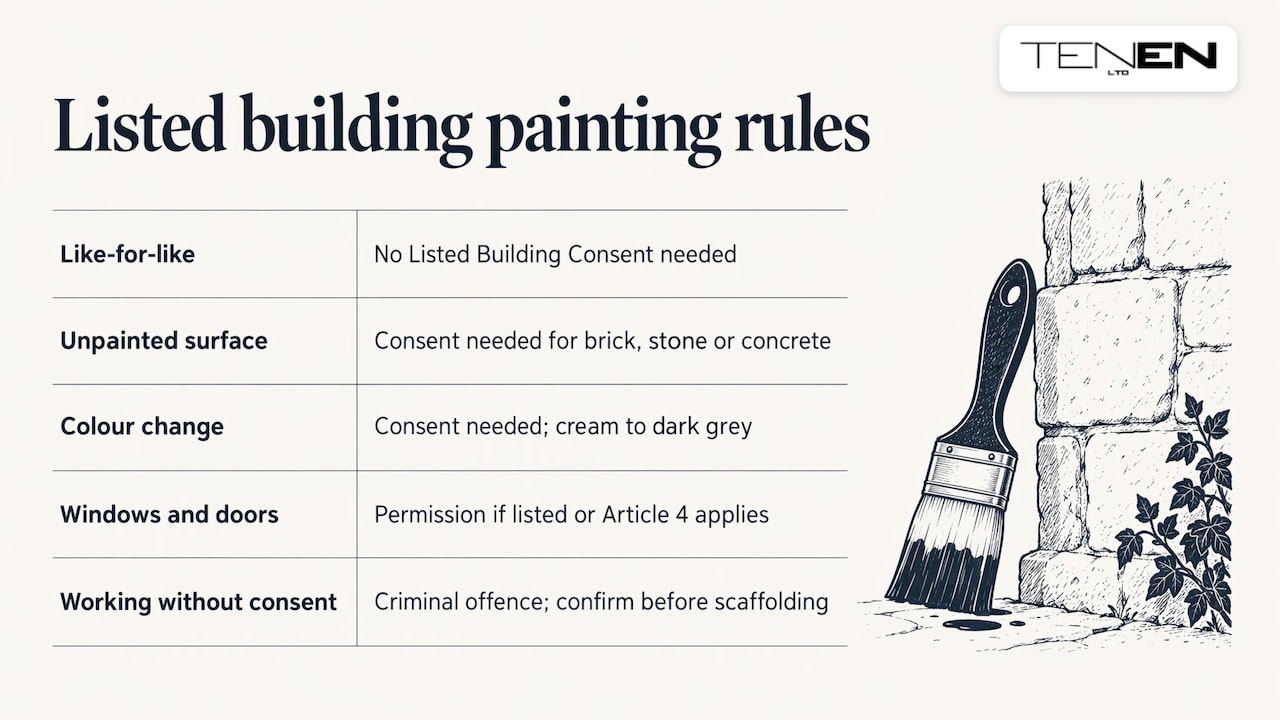
Listed buildings are controlled under the Planning (Listed Buildings and Conservation Areas) Act 1990. Southwark’s guidance indicates that like-for-like repainting does not need Listed Building Consent. Painting an area that was not previously painted, such as brick, stone or concrete, or changing the colour, for example from cream to dark grey, does. Rutland County Council’s 2025 guidance, summarised in our research, says colour changes to windows and doors also need permission on listed buildings or where an Article 4 Direction applies.
Working without consent on a listed building is a criminal offence, so confirm before any scaffolding goes up. Our guide to listed building consent sets out the process, and your local authority’s conservation officer is the person who decides.
What affects the cost of exterior painting
We do not publish a price list for painting, because the figure depends on the property. These are the factors that move a quote most:
Size and number of elevations, and whether you are painting the front only or the whole house.
Height and access. Scaffolding or a tower on a four-storey Kensington terrace is a different job from a ground-floor rear wall.
Surface condition. Extensive render repair, timber replacement and stripping add labour before any paint goes on.
Surface texture. As Dulux notes, rough masonry can double paint consumption.
Paint system. A breathable limewash or silicate system for older walls differs from a standard acrylic masonry paint.
Colour change. Strong shades often need a third coat.
Joinery. Sashes, doors, railings and fascias are detailed work on top of the walls.
The HomeOwners Alliance makes the same point: cost varies with size, shape, complexity and paint type, so local quotes from painting specialists matter more than generic averages. For a wider budget view, our house refurbishment cost guide puts exterior work in the context of a full project.
What a good quote should contain
A quote for exterior painting should be specific enough that you can see exactly what is and is not included. Look for:
A site survey before pricing, not a figure given over the phone.
An itemised breakdown of preparation, repairs, access, priming, coats and joinery.
Named products and the number of coats.
Which elevations and elements are covered, including sills, fascias, railings and doors.
Who does the work. A team that carries out the job directly keeps responsibility clear.
Programme and weather allowance.
Warranty and insurance details in writing.
Compliance checks for conservation area or listed status.
This is how we work. Our quotations are itemised after a site survey and fixed, with no hidden costs. The work is carried out by our own teams rather than through subcontractor chains, with a director overseeing the project, and our projects come with insurance-backed warranties. Our rapid site visit promise means you do not wait weeks to find out where you stand.
How we approach external painting
External painting sits within our painting and decorating and property maintenance work, alongside the repairs that often come with it: carpentry for rotten sills, plumbing for leaking downpipes, electrical work for external lighting. Having these trades in-house means one team can fix the cause of the damage and then paint the result, instead of you coordinating separate firms.
For a recurring programme across a block or a portfolio, our planned preventive maintenance service schedules redecoration on a cycle, so exteriors are refreshed before they deteriorate.
If you are also thinking about the inside of the house, our decorating tips for London homes and our guide to paint colours for north-facing rooms help you plan a consistent scheme from front door to back bedroom.
Our perspective
Most exterior paint failures we hear homeowners describe come down to the same thing: the colour was chosen before the wall was understood. A good repaint starts with the building, its age, its materials, its street and its rules, and only then moves to the shade. That is why we want a director involved from the survey onwards. The person who prices the job should be accountable for how it is delivered, and a fixed, itemised quote means you can plan your budget with confidence. Painting the outside of a London home is one of the most rewarding projects you can take on. Done properly, it breathes new life into the house and protects it for years. We would love to help you do it well. Mateja
Ready to refresh your exterior?
If you would like a survey and an itemised fixed quote, take a look at our property maintenance and decorating services, or see everything we offer. We cover Fulham, Chelsea, Kensington, Chiswick, Hammersmith, Notting Hill and the surrounding areas of West and Central London.
FAQ
Do I need planning permission to repaint my house in London?
Usually not, as painting is generally treated as maintenance. The exceptions are conservation areas with an Article 4 Direction and listed buildings, where changing colour or painting previously unpainted brick or stone can need consent. Check with your borough’s planning team before booking work.
What is the best time of year for exterior painting?
Spring and early autumn tend to offer the mildest, driest conditions. Choose a dry, mild, cloudy spell and avoid rain just after application. We plan the programme around the weather and include spare days.
How many coats does exterior masonry paint need?
Two coats of masonry paint are usually enough, with a third often needed over strong colours, according to Dulux. A rough or porous surface needs more paint. Flaky or chalky walls need a stabilising primer first.
Can I paint the brickwork of an older London house?
It depends on the building. On listed buildings, painting unpainted brick, stone or concrete needs consent and can cause damp. For stucco and lime render, a breathable finish such as limewash is the usual choice. We would check this at survey stage.
Sources
Recommended
Comments