
What is kitchen ventilation: a homeowner's guide

TL;DR:
Effective kitchen ventilation, including properly sized ducted systems and make-up air units, is essential for maintaining indoor air quality and safety. Proper planning from the outset ensures optimal pollutant removal, reduces fire risks, and improves thermal comfort, especially in homes with heavy cooking. Regular maintenance of filters and ductwork sustains system effectiveness and prevents health hazards over time.
Kitchen ventilation is the controlled process of removing smoke, grease, steam, and cooking fumes from your kitchen to maintain safe, healthy indoor air quality. Known in the industry as mechanical kitchen extraction, it covers everything from the range hood above your hob to the ductwork running through your walls. Without it, indoor pollution levels can reach two to five times higher than outdoor air. That figure alone explains why ventilation is one of the most consequential decisions in any kitchen refurbishment, whether you are fitting a new kitchen from scratch or upgrading an existing one.
What is kitchen ventilation and how does it work?
Kitchen ventilation is a system of components working together to capture pollutants at the source and expel them before they spread through your home. The core elements are the range hood (also called an extractor hood), the ductwork, and in many modern installations, a make-up air unit. Each plays a distinct role.
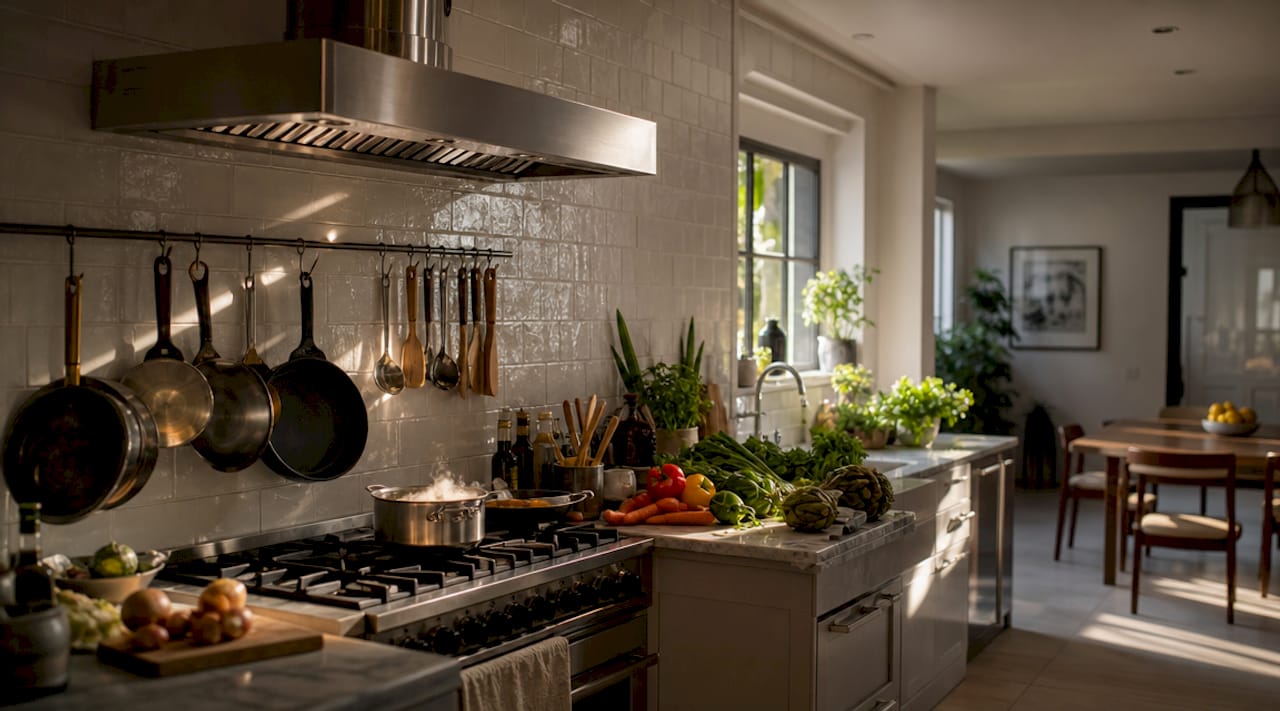
The range hood sits directly above your cooking surface and draws contaminated air upward using a motorised fan. Ductwork then channels that air outside the building. A make-up air unit replenishes the air that has been expelled, preventing the negative pressure that causes backdrafting through boilers, fireplaces, and gas appliances. Together, these components form what building professionals call an organised make-up air system, and optimised systems can achieve pollutant capture efficiency of over 90%.
There are two broad categories of kitchen ventilation:
Ducted systems exhaust air directly outside through rigid metal ductwork. These are the most effective option for heavy cooking and are the standard choice in full kitchen refurbishments.
Recirculating systems draw air through charcoal filters and return it to the room. They require no external duct but are less effective at removing heat and moisture.
Make-up air units supply fresh replacement air either passively through a vent or actively via a fan-assisted inlet. They become mandatory under building regulations once extraction power exceeds a certain threshold.
Pro Tip: If you are planning a kitchen renovation, decide on your ventilation type before finalising your layout. Retrofitting ductwork after cabinets are installed is significantly more disruptive and costly.
How to size and install kitchen ventilation correctly
Getting the sizing right is where most homeowners and even some tradespeople go wrong. A powerful fan paired with an undersized hood is like fitting a high-performance engine in a car with a blocked exhaust. The capture area matters as much as the airflow rating.
Range hoods should be at least 24 inches (approximately 61 centimetres) deep and mounted 24 to 30 inches above the cooking surface to adequately cover the front burners. Width should extend three to six inches beyond each side of the hob. Experts confirm that capture area depth and hood sizing are as important as airflow power, since a shallow hood undermines high CFM (cubic feet per minute) effectiveness regardless of motor strength.
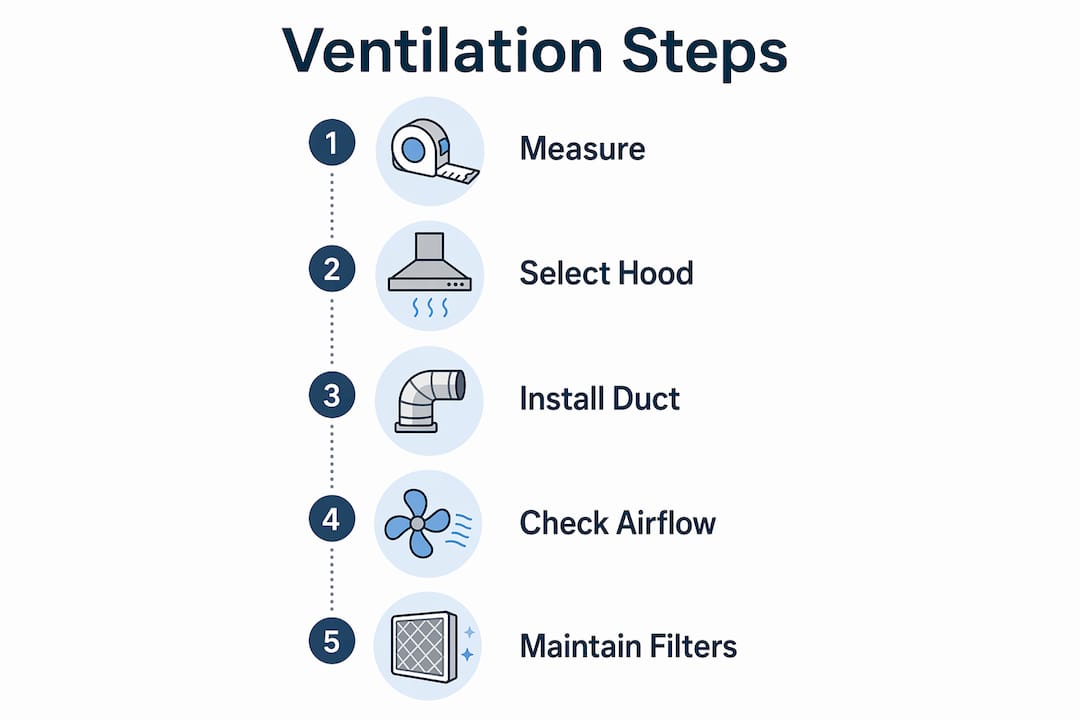
Follow these steps when planning your installation:
Measure your hob. Your hood should be wider than your cooking surface by at least six inches total, three inches on each side.
Calculate required CFM. A general rule is 100 CFM per 10,000 BTU of hob output. Gas ranges typically require more extraction power than induction or electric hobs.
Plan your duct route. Keep runs under 25 feet and minimise bends. Each 90-degree bend reduces effective airflow noticeably.
Specify rigid metal ducting. Flexible ductwork collects grease in its corrugated surfaces, increases airflow resistance, and is a recognised fire hazard. Building codes require rigid metal ducts for this reason.
Check make-up air requirements. Under IRC Section M1503.6, hoods above 400 CFM require an automatic make-up air system. Ignoring this leads to negative pressure, difficult door operation, and dangerous backdrafting.
Factor | Ducted system | Recirculating system |
Pollutant removal | Exhausts outside, highly effective | Filters and recirculates, less effective |
Heat and moisture removal | Yes | Limited |
Installation complexity | Higher, requires ductwork | Lower, no external duct needed |
Maintenance | Duct cleaning, filter replacement | Charcoal filter replacement every 3 to 6 months |
Best suited for | Heavy cooking, full refurbishments | Flats, rental properties, light cooking |
Pro Tip: Insulate any ductwork that passes through unheated spaces such as loft voids. Uninsulated ducts cause condensation, which leads to moisture damage and mould inside the duct run.
What are the benefits of proper kitchen ventilation?
Effective kitchen ventilation does far more than clear cooking smells. Mechanical ventilation can reduce kitchen PM2.5 concentrations by over 44% and PM10 by nearly 70%. PM2.5 particles are fine enough to penetrate deep into the lungs, so this reduction has a direct and measurable impact on household health.
The practical benefits extend well beyond air quality:
Moisture control. Cooking releases significant amounts of steam. Without extraction, that moisture settles on walls, ceilings, and inside cabinets, leading to condensation, peeling paint, and mould growth.
Surface and appliance protection. Grease particles that are not captured coat surfaces, worktops, and appliances over time. Proper extraction dramatically reduces cleaning frequency and extends the life of your kitchen finishes.
Thermal comfort. A working extraction system removes excess heat generated during cooking, keeping the kitchen comfortable without relying on air conditioning.
Carbon monoxide safety. Gas hobs and ovens produce carbon monoxide as a byproduct of combustion. Adequate ventilation reduces the risk of dangerous accumulation, particularly in smaller or poorly sealed kitchens.
Whole-home air quality. Cooking pollutants do not stay in the kitchen. Without extraction, they migrate into adjoining living spaces, affecting air quality throughout the home.
“Proper kitchen ventilation removes up to 70% of cooking-related particles, smoke, and steam, preventing indoor pollution levels from reaching two to five times higher than outdoor air.” Source
For homeowners in London undertaking a kitchen refurbishment, investing in a properly specified ventilation system protects both the occupants and the property itself.
What types of kitchen ventilation systems are available?
Choosing the right system depends on three factors: how intensively you cook, your kitchen’s physical layout, and whether external ducting is feasible. There is no single best answer, but there is a best answer for your specific situation.
Ducted range hoods connected to an external outlet remain the gold standard for residential kitchens where heavy cooking takes place. They remove heat, moisture, grease, and odours completely from the building. Wall-mounted models suit kitchens where the hob sits against a wall, while island hoods are designed for central cooking positions and typically require higher CFM ratings to compensate for the absence of surrounding walls to contain rising air.
Recirculating hoods with charcoal filters are the practical choice for flats, listed buildings, or any space where running external ductwork is not possible. They handle odours reasonably well but do not remove heat or moisture, so they work best in kitchens with good natural ventilation or where cooking is infrequent. Charcoal filters need replacing every three to six months depending on use.
Make-up air systems are often overlooked until problems arise. Passive systems are simple and inexpensive but can introduce cold draughts in winter. Active systems use a fan to balance pressure and can condition incoming air, making them far more comfortable in year-round use. For high-performance kitchens with extraction above 400 CFM, an active make-up air system is not optional. It is a code requirement and a safety necessity.
The principle that best ventilation solutions match cooking intensity and kitchen constraints holds true across every project. A professional kitchen designer or refurbishment specialist will assess your specific setup before recommending a system, rather than defaulting to the most powerful or most affordable option available.
For further context on how ventilation integrates with wider kitchen design, the commercial kitchen construction guide from Axenia Construction offers useful parallels between commercial and residential extraction principles.
How to maintain your kitchen ventilation system
A well-specified system that is poorly maintained quickly becomes ineffective. Grease accumulates in filters and ductwork, reducing airflow and creating a genuine fire risk. The good news is that a straightforward maintenance routine keeps everything running well.
Run the hood before and after cooking. Activating the fan five minutes before you start cooking and leaving it running for ten to fifteen minutes afterwards captures residual pollutants and preserves airflow patterns. This single habit reduces long-term grease build-up in ductwork significantly.
Clean or replace filters regularly. Mesh grease filters should be cleaned monthly in warm soapy water or a dishwasher. Charcoal filters in recirculating systems cannot be cleaned and must be replaced every three to six months.
Inspect ductwork annually. Grease accumulation inside ducts is a fire hazard. A professional duct clean every one to two years is advisable for households that cook frequently.
Test for negative pressure. Signs of negative pressure include doors that are difficult to open when the hood runs at full power, or pilot lights that flicker. Either symptom indicates your make-up air supply is inadequate.
Check motor and fan performance. Unusual noise, reduced suction, or visible smoke not being captured are all indicators that the system needs servicing or component replacement.
Pro Tip: Set a recurring reminder every three months to check your grease filters. It takes five minutes and prevents the kind of grease fire that causes thousands of pounds of damage.
Key takeaways
Effective kitchen ventilation requires correctly sized ducted extraction, rigid metal ductwork, and a make-up air system for any installation above 400 CFM to protect air quality, safety, and property condition.
Point | Details |
Size the hood correctly | Hood depth must be at least 24 inches, mounted 24 to 30 inches above the hob, extending beyond the cooktop on each side. |
Choose the right system type | Ducted hoods suit heavy cooking; recirculating hoods work for flats or light use where external ducting is not possible. |
Use rigid metal ducting | Flexible ductwork is a fire hazard and reduces airflow efficiency; building codes require rigid metal ducts throughout. |
Include make-up air above 400 CFM | Hoods exceeding 400 CFM require an automatic make-up air system to prevent negative pressure and backdrafting. |
Maintain filters and ductwork | Monthly filter cleaning and annual duct inspection keep the system effective and reduce fire risk significantly. |
Why ventilation planning is the step most homeowners leave too late
I have seen it happen on project after project across West London. Homeowners spend months selecting worktop materials, cabinet finishes, and appliance brands, then treat ventilation as an afterthought to be sorted once everything else is in place. By that point, the duct route is compromised, the hood position is dictated by where the cabinets ended up, and the make-up air requirement has been completely overlooked.
The uncomfortable truth is that ventilation is a structural decision, not a finishing detail. Once your ceiling is plastered and your cabinets are fitted, your options narrow considerably. A duct run that should travel 15 feet in a straight line ends up taking three bends to avoid a beam, losing suction at every turn. That is not a ventilation problem. It is a planning problem.
What I find most telling is the noise conversation. Many homeowners choose a lower-powered hood to avoid noise, then wonder why their kitchen still smells of last night’s dinner. The answer is almost always inadequate capture area rather than insufficient CFM. A correctly sized hood at moderate power will outperform an oversized motor in an undersized canopy every time.
My honest advice: treat ventilation as part of your kitchen design brief from day one. Specify the duct route before you finalise the layout. If you are extending your home or converting a loft to create a new kitchen space, the structural work is your opportunity to run ducting exactly where it needs to go, without compromise.
— Mateja
How Tenenltd can help with your kitchen ventilation upgrade
Getting kitchen ventilation right requires more than selecting a hood from a catalogue. It demands accurate assessment of your cooking habits, kitchen layout, duct routing options, and compliance with current building regulations. Tenenltd has been delivering high-quality kitchen refurbishments across Fulham, Chelsea, Kensington, Chiswick, Hammersmith, and Notting Hill since 2006, and ventilation specification is built into every project from the outset.
Whether you are planning a full kitchen and bathroom refurbishment or incorporating a new kitchen into a property extension, our team handles ducting, hood installation, make-up air integration, and code compliance as part of a single, managed process. You get a kitchen that performs as well as it looks.
FAQ
What does kitchen ventilation actually do?
Kitchen ventilation removes smoke, grease, steam, and cooking odours from the kitchen using mechanical extraction. Without it, indoor pollution levels can reach two to five times higher than outdoor air, according to published research.
What size range hood do I need for my hob?
Your hood should be at least as wide as your hob plus three inches on each side, at least 24 inches deep, and mounted 24 to 30 inches above the cooking surface. These dimensions are the minimum recommended for adequate pollutant capture.
Do I need a make-up air system?
Under IRC Section M1503.6, any range hood rated above 400 CFM requires an automatic make-up air system. Even below that threshold, homes with good draught-proofing benefit from a make-up air supply to prevent negative pressure.
Can I use flexible ducting for my kitchen extractor?
Flexible ducting is not recommended and is prohibited by building codes for kitchen extraction. It collects grease in its corrugated lining, restricts airflow, and presents a fire hazard. Rigid metal ducting is the required and correct choice.
How often should I clean my extractor filters?
Mesh grease filters should be cleaned monthly. Charcoal filters in recirculating hoods cannot be cleaned and need replacing every three to six months depending on how frequently you cook.
Recommended
Comments