
What is a home extension? Plan yours in London 2026
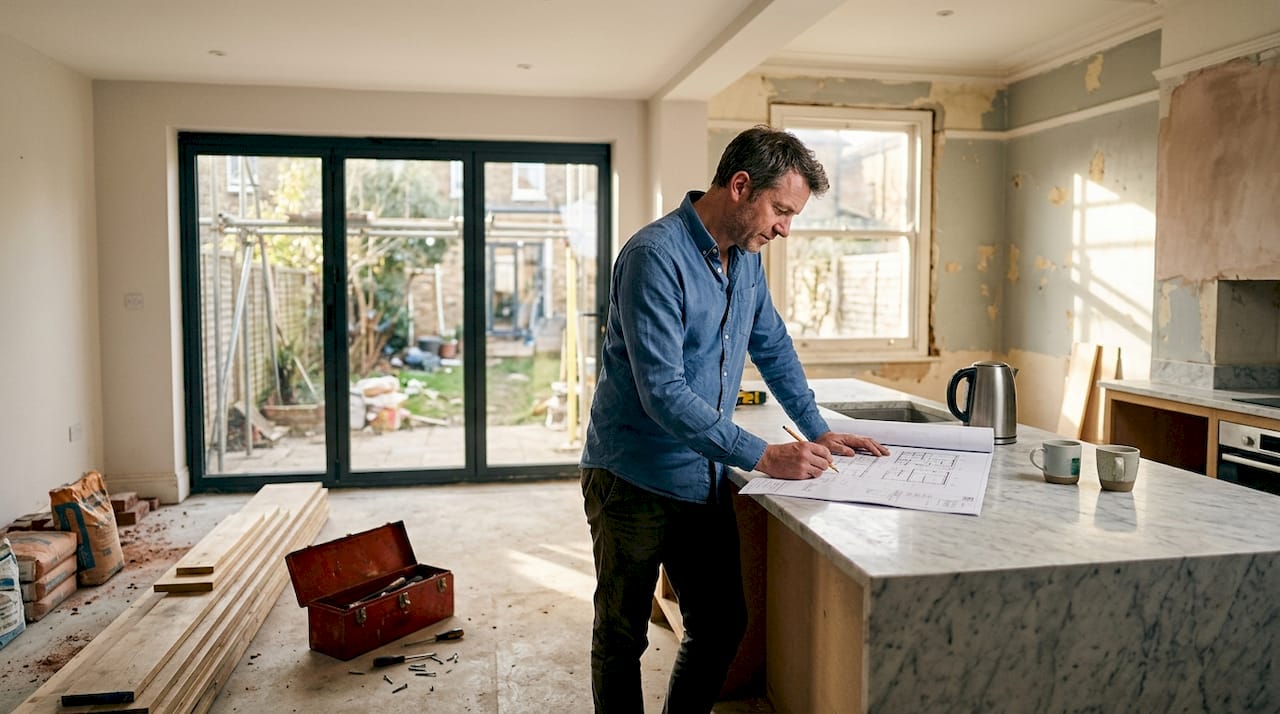
Most homeowners believe a home extension simply means adding a room. In reality, extensions in 2026 encompass rear additions, side returns, wraparound configurations, double-storey builds, and loft conversions, each governed by distinct planning rules and design possibilities. This guide clarifies what qualifies as an extension in West and Central London, unpacks the legal frameworks including Permitted Development rights and conservation area restrictions, explores innovative construction methods and materials transforming London properties, and provides transparent cost and timeline data to help you plan a successful project that enhances your living space and property value.
Table of Contents
Key Takeaways
Point | Details |
Extension types | In 2026 extensions include rear, side return, wraparound, double storey and loft conversions, each changing the footprint or height of the home. |
Permitted Development limits | Single storey rear extensions are allowed up to 3m for terraced or semi detached homes and 4m for detached, with maximum heights of 4m for pitched roofs and 3m for flat roofs, and the Larger Home Extension Scheme may permit 6 to 8m with prior approval. |
Legal and planning frameworks | Key requirements include Permitted Development rights, conservation area rules, the Party Wall Act, Article 4 directions and Building Regulations. |
Costs and timelines | The guide provides transparent information on typical costs and project timelines to help you plan, budget and avoid delays. |
What constitutes a home extension in 2026
A home extension is an addition to a property not part of its original construction, such as rear, side, wraparound, double-storey, or loft conversions, aimed at enhancing living space. Unlike internal reconfigurations or cosmetic renovations, extensions physically expand your home’s footprint or height, creating new rooms or enlarging existing spaces. The distinction matters because extensions trigger specific planning, structural, and legal requirements that simple refurbishments avoid.
Common extension types include:
Rear extensions: single or double-storey additions projecting from the back of your property, popular for kitchen-diners or family rooms
Side returns: infill extensions along narrow side passages, maximising ground floor space in terraced homes
Wraparound extensions: L-shaped combinations of rear and side returns, creating substantial open-plan living areas
Double-storey extensions: vertical additions providing extra bedrooms and bathrooms without consuming garden space
Loft conversions: transforming unused roof space into habitable rooms, technically an upward extension requiring structural alterations
London properties favour rear and side-return configurations due to narrow plots and terraced layouts. The benefits of doing a home extension in London include adapting Victorian and Edwardian homes to modern family needs, avoiding the expense and disruption of moving, and capitalising on property values in high-demand postcodes. Understanding which type suits your site, budget, and lifestyle goals forms the foundation of successful extension planning.
Planning and legal considerations for London homeowners in 2026
In West and Central London 2026, extensions must comply with Permitted Development rights: single-storey rear up to 3m for terraced or semi-detached properties, 4m for detached; height maximum 4m pitched roof or 3m flat; the Larger Home Extension Scheme allows up to 6-8m with prior approval. These thresholds determine whether you can proceed without full planning permission, saving months and thousands in fees. However, Permitted Development assumes your property sits outside conservation areas, is not listed, and has not exhausted previous PD allowances through earlier extensions or outbuildings.
Key legal frameworks include:
Party Wall Act: mandatory for work within 3m of a shared boundary or 6m if excavating below neighbour’s foundations, requiring formal notices and potentially party wall awards
Article 4 directions: remove PD rights in designated areas like Islington, Highgate, and parts of Westminster, forcing full planning applications even for modest extensions
Conservation area restrictions: limit materials, fenestration, and design to preserve historic character, often requiring planning consent regardless of size
Building Regulations: apply to all extensions for structural integrity, fire safety, insulation, and ventilation, enforced separately from planning permission
Edge cases include 2026 homebuying reforms mandating pre-purchase surveys for PD extensions, assessing structural risks and compliance, while over-development beyond neighbourhood norms risks negative return on investment. Article 4 restrictions in areas like Islington and Highgate mean even small rear extensions require planning permission, adding 8-16 weeks to timelines. Conservation areas impose strict material and design controls, often demanding traditional brickwork, sash windows, and pitched roofs that increase costs.
Pro Tip: Consult a planning specialist or architect familiar with your borough’s Local Plan before committing to designs. Early engagement identifies constraints like tree preservation orders, flood zones, or overlooking issues that could derail applications, saving costly redesigns and delays.
Navigating these layers requires understanding your property’s planning history, checking your council’s online planning portal for Article 4 designations, and obtaining a Lawful Development Certificate if relying on Permitted Development. Engaging expert home improvement services London ensures compliance from the outset, avoiding enforcement action or resale complications.
Innovative design and construction methods in London extensions
Construction methodologies include steel frame systems on ground screw foundations, reclaimed brickwork with timber frames, glass-reinforced concrete panels, and composite cladding, with a phased process spanning feasibility (2-4 weeks), design (8-12 weeks), planning (8-16 weeks), technical (8-12 weeks), and construction (20-40 weeks). Modern methods accelerate timelines and improve thermal performance compared to traditional masonry, while Building Regulations Part L mandates energy efficiency through insulation, airtightness, and efficient heating systems.
Innovative features transforming London extensions include:
Sculptural GRC pavilions in Belgravia using glass-reinforced concrete for complex curved forms and rapid installation
Steel-framed glazing inspired by local landmarks in Muswell Hill, maximising natural light and garden views
Air-source heat pumps integrated with green roofs in Hackney, delivering renewable heating and biodiversity benefits
Zinc canopies in Tooting providing passive solar shading while adding contemporary architectural interest
These designs balance aesthetic ambition with practical performance, addressing London’s dense urban context where overlooking, right-to-light, and daylight-sunlight assessments influence approvals. Steel frames reduce foundation loads on clay soils, while composite cladding offers fire resistance and low maintenance. Reclaimed brick matches existing facades in conservation areas, satisfying planning officers while incorporating modern insulation and damp-proofing.
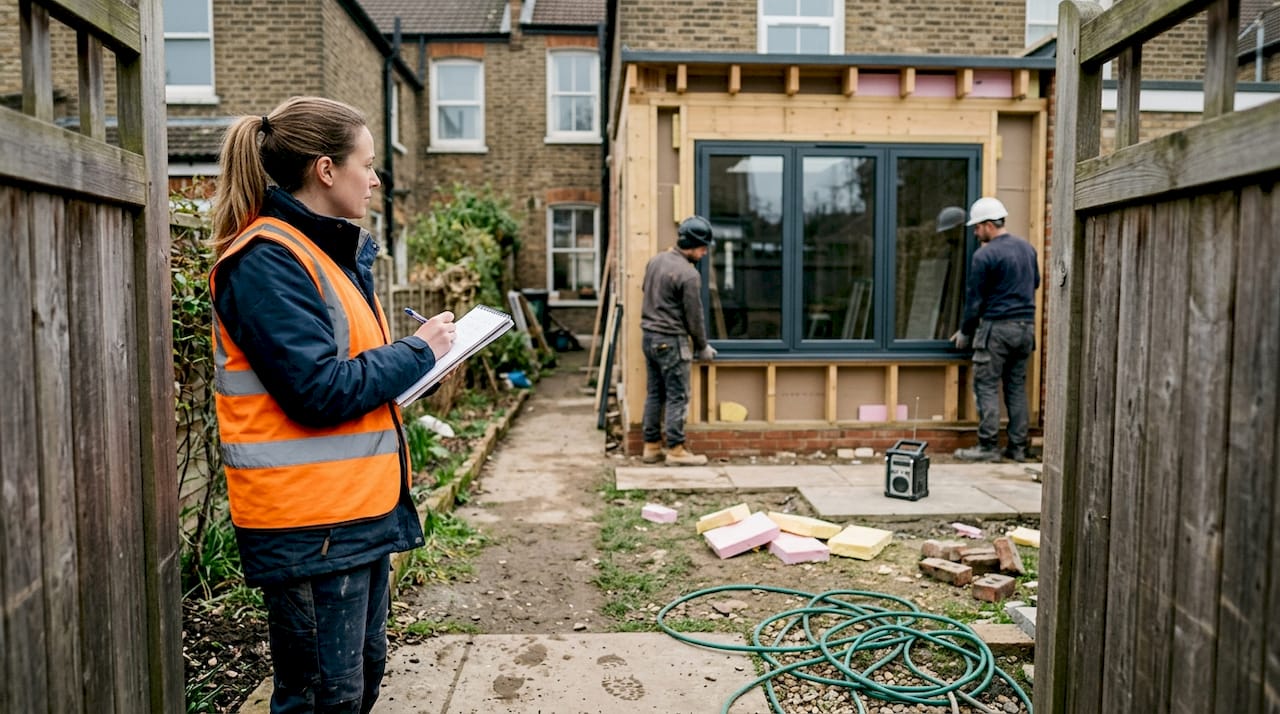
Pro Tip: Specify triple-glazed windows and mechanical ventilation with heat recovery (MVHR) to exceed Part L requirements, future-proofing against stricter 2027 updates and reducing energy bills by 30-40% compared to standard double glazing.
The phased approach allows iterative refinement, with feasibility studies confirming site constraints, design stages exploring layouts and materials, planning submissions securing approvals, technical drawings detailing construction specifications, and on-site builds delivering the finished extension. Engaging property improvement solutions London specialists early ensures designs align with buildability, budget, and regulatory requirements, avoiding abortive work.
Method | Cost impact | Timeline | Sustainability |
Traditional masonry | Baseline | Slower (weather dependent) | Moderate (embodied carbon in bricks) |
Steel frame systems | +10-15% | Faster (off-site fabrication) | High (recyclable, reduced waste) |
Timber frame | +5-10% | Faster (lightweight, pre-cut) | Very high (carbon sequestration) |
GRC panels | +20-30% | Fastest (modular installation) | Moderate (durable, low maintenance) |
Sustainability considerations extend beyond materials to include rainwater harvesting, photovoltaic panels, and green roofs that manage surface water runoff, crucial in flood-risk zones. Luxury London extension bathrooms design and build projects increasingly incorporate low-flow fixtures, underfloor heating from heat pumps, and natural ventilation strategies that reduce mechanical cooling needs during summer.
Costs, timelines and return on investment for London home extensions in 2026
2026 London costs range from single-storey £2,500-£4,600/m² (£60k-£135k typical), double-storey £2,200-£3,500/m² (£110k-£290k), and side-return £3,500-£5,500/m², with timelines of 9-18 months total and ROI of 10-25% property value increase. These figures reflect West and Central London’s premium labour rates, material logistics in congested areas, and quality expectations for high-value properties. Single-storey rear extensions delivering 25-30m² of additional space typically cost £75,000-£120,000, while wraparound extensions combining rear and side returns reach £150,000-£200,000 for 40-50m².
Key cost factors include:
Structural complexity: steel beams, underpinning, or complex rooflines add £15,000-£40,000
Finishes and fixtures: budget kitchens vs bespoke joinery, standard vs designer bathrooms create £20,000-£60,000 variance
Professional fees: architect (8-12% of build cost), structural engineer (£2,000-£5,000), party wall surveyor (£1,500-£3,500)
Planning and Building Control: planning application £206-£462, Building Control £1,000-£3,000 depending on extension size
Timeline phases break down as feasibility and initial design (2-4 weeks), detailed design and planning submission (8-12 weeks), planning determination (8-16 weeks for full applications, 6 weeks for prior approval), technical drawings and Building Regulations (8-12 weeks), and construction (20-40 weeks depending on complexity and weather). Party Wall Act processes add 2-6 weeks if neighbours dispute, while conservation area consultations extend planning by 4-8 weeks.
Steps to control costs and manage your project efficiently:
Obtain three detailed quotes from builders, comparing scope, materials, and payment schedules to identify outliers
Fix designs before construction starts, as changes during builds incur premium variation costs of 20-40%
Appoint a contract administrator or project manager to oversee quality, timelines, and budget adherence
Schedule payments to milestones (foundation completion, watertight stage, first fix, completion) rather than upfront lump sums
Maintain a 10-15% contingency for unforeseen issues like poor ground conditions or hidden defects in existing structure
Extension type | Cost per m² | Typical size | Total cost range | ROI (% value increase) |
Single-storey rear | £2,500-£4,600 | 25-30m² | £60,000-£135,000 | 10-15% |
Double-storey | £2,200-£3,500 | 50-80m² | £110,000-£290,000 | 15-25% |
Side-return | £3,500-£5,500 | 15-20m² | £50,000-£110,000 | 8-12% |
Wraparound | £3,000-£4,800 | 40-50m² | £120,000-£240,000 | 18-25% |
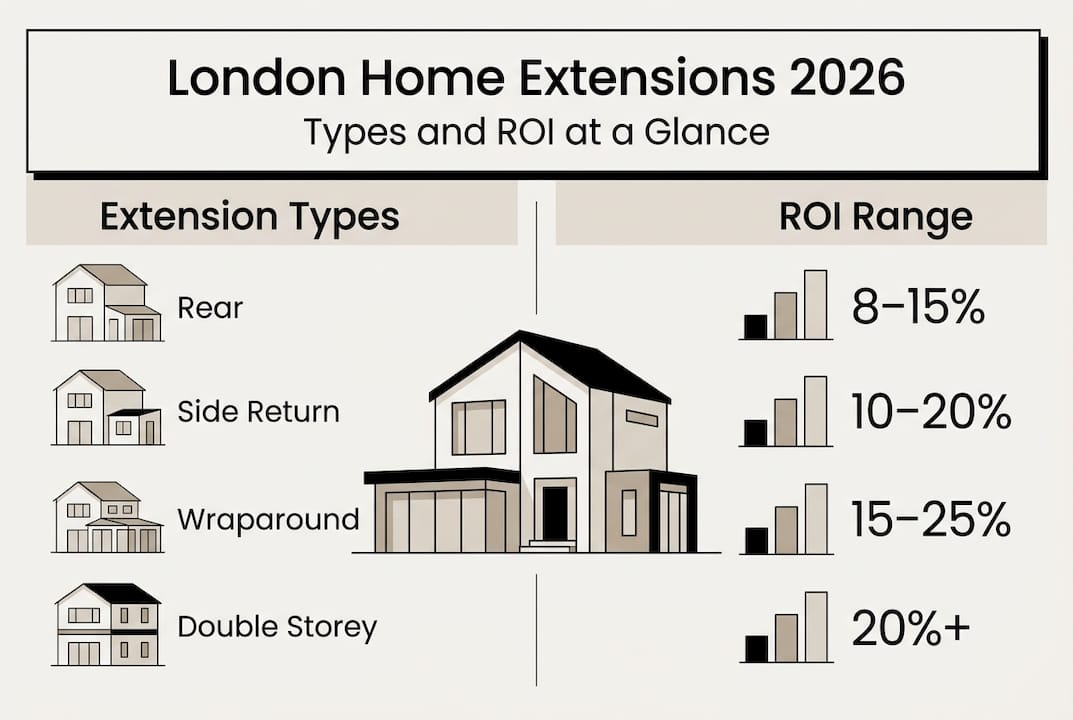
ROI varies by neighbourhood and property type. Adding 30m² to a £800,000 Fulham terrace typically increases value by £100,000-£140,000, a 12-17% return. However, over-extending a modest property in a lower-value postcode risks negative returns if the improved home exceeds neighbourhood comparables. Understanding London house extension costs in your specific area prevents over-capitalisation, while quality finishes and thoughtful design maximise value uplift.
Timelines extend in conservation areas (add 4-8 weeks for heritage consultations) and when neighbours object to Party Wall notices (add 2-6 weeks for dispute resolution). Winter weather can delay groundworks by 2-4 weeks, while material shortages post-pandemic occasionally extend lead times for bespoke joinery or specialist glazing by 6-8 weeks. Building in realistic buffers prevents stress and allows coordination with school holidays or work commitments. Projects that boost home value with London refurbishment integrate extensions with kitchen and bathroom upgrades, delivering cohesive interiors that appeal to buyers and maximise resale potential.
Why choose Tenen Ltd for your London home extension
Planning a home extension in West or Central London demands expertise in local regulations, innovative building techniques, and meticulous project management. Tenen Ltd brings 18 years of experience delivering high-quality London home extensions services across Fulham, Chelsea, Kensington, Chiswick, Hammersmith, and Notting Hill. We navigate Permitted Development complexities, conservation area restrictions, and Party Wall Act requirements, ensuring your project complies with 2026 regulations while achieving your design vision.
Our professional building services cover every stage from initial feasibility through to final finishes, coordinating architects, structural engineers, and specialist subcontractors to deliver on time and on budget. Whether you are considering a single-storey rear extension, wraparound configuration, or double-storey addition, we provide transparent costings, realistic timelines, and quality craftsmanship that enhances your home’s value and functionality. Our portfolio of loft conversions, extensions and refurbishments demonstrates our commitment to transforming London properties with attention to detail and customer satisfaction. Contact Tenen Ltd today for a personalised consultation and discover how we can bring your extension plans to life.
Frequently asked questions
What height limits apply to home extensions in London?
Permitted Development restricts single-storey rear extensions to 4m maximum height for pitched roofs and 3m for flat roofs, measured from ground level. Double-storey extensions must not exceed the original house’s ridge height and typically require planning permission. Conservation areas and Article 4 directions impose stricter limits, often capping extensions at existing eaves height.
Do I need planning permission for a wraparound extension?
Wraparound extensions combining rear and side returns usually require full planning permission because they exceed Permitted Development thresholds for side extensions (maximum half the width of the original house). Conservation areas and Article 4 zones mandate planning applications for any external alterations. Always check your council’s planning portal and consult an architect before proceeding.
How long does the planning permission process typically take?
Full planning applications take 8 weeks for standard cases, extending to 13 weeks for major developments or 16 weeks if your council requests additional information. Prior approval for larger rear extensions under the Larger Home Extension Scheme takes 6 weeks. Conservation area consultations add 4-8 weeks, while neighbour objections or committee referrals extend timelines by 8-12 weeks.
Can innovative green technologies affect my extension cost?
Air-source heat pumps, photovoltaic panels, and MVHR systems add £8,000-£18,000 to upfront costs but reduce energy bills by 30-50% annually, recovering investment within 8-12 years. Green roofs cost £100-£200/m² but manage surface water, improve insulation, and enhance biodiversity. Building Regulations Part L increasingly favours these technologies, making them cost-effective long-term investments that future-proof your home.
What risks does the Party Wall Act pose for neighbours?
The Party Wall Act requires serving notices 2 months before work starts if building within 3m of a boundary or 6m when excavating below foundations. Neighbours can consent, dissent (triggering party wall awards and surveyor appointments), or ignore notices (deemed dissent after 14 days). Disputes add £3,000-£8,000 in surveyor fees and delay projects by 6-12 weeks, though most resolve amicably with clear communication and fair compensation offers for any inconvenience.
Recommended
Comments