
The building contractor's role in West London homes

TL;DR:
A building contractor carries legal, financial, and practical responsibilities, ensuring project safety, quality, and compliance. Their role involves detailed planning, coordination, cost management, and maintaining clear communication to prevent disputes and delays. Choosing an experienced, reputable contractor is essential for project success, budget control, and long-term value in West London renovations.
Many homeowners assume that hiring a building contractor is simply a matter of finding someone to manage the builders on site. In reality, the role is far more layered than that. Your contractor is simultaneously a legal duty holder, a financial overseer, a trade coordinator, and your primary point of accountability throughout the entire project. Whether you are planning a rear extension in Fulham or a full refurbishment in Kensington, understanding exactly what your contractor is responsible for will help you protect your investment, avoid costly surprises, and keep your project on track from day one.
Table of Contents
Key Takeaways
Point | Details |
Legal responsibility | Your building contractor handles key legal and safety duties during home renovations. |
Project success depends on oversight | Proper management by your contractor prevents delays, defects, and disputes. |
Clear contracts protect homeowners | Insist on detailed contracts and variation documentation to avoid common issues. |
West London costs run higher | Expect 25–40% higher prices and longer schedules in West London than the UK average. |
Choosing the right contractor matters | Do careful checks—experience and communication are as important as price. |
What is a building contractor and why does their role matter?
A building contractor is the individual or company that takes legal and practical responsibility for delivering your construction project. They sit at the centre of everything, from coordinating tradespeople to managing your contract, handling regulatory submissions, and ensuring work is completed safely and to the agreed standard. Many homeowners think of the contractor simply as the person who hires the builders. That underestimates the role significantly.
In West London, where projects often unfold in conservation areas, terraced Victorian properties, or flats with complex lease arrangements, the contractor’s expertise directly determines whether your project succeeds or stalls. They are not just construction managers. They are your legal partners on site.
The responsibilities typically include:
Contract management: Drafting or reviewing agreements with sub-contractors and suppliers
Regulatory compliance: Ensuring building regulations, party wall agreements, and planning conditions are met
On-site safety: Maintaining a safe working environment for every person on your site
Quality control: Signing off on workmanship at each stage before the project progresses
Client communication: Keeping you informed and managing your expectations throughout
One aspect that surprises many homeowners is the legal dimension. Under the Construction (Design and Management) Regulations 2015, health and safety duties transfer to the principal contractor for domestic clients. This means your contractor bears formal obligations around site safety planning, method statements, and welfare provisions. This is not optional. It is a legal framework that protects you, your contractor, and the wider public.
“Choosing the right contractor is not just about price or availability. It is about finding someone who understands the full weight of the responsibilities they are taking on.”
Pro Tip: Before signing any contract, ask your contractor directly how they manage their CDM 2015 obligations. A confident, detailed answer tells you a great deal about their professionalism.
When you plan a home extension in West London, understanding the contractor’s legal and managerial position from the very beginning helps you build a more productive working relationship and gives you clearer recourse if things go wrong.
Key responsibilities of a building contractor in your renovation
Now you know what a contractor promises. Let’s see how these responsibilities play out across your project in practical terms.
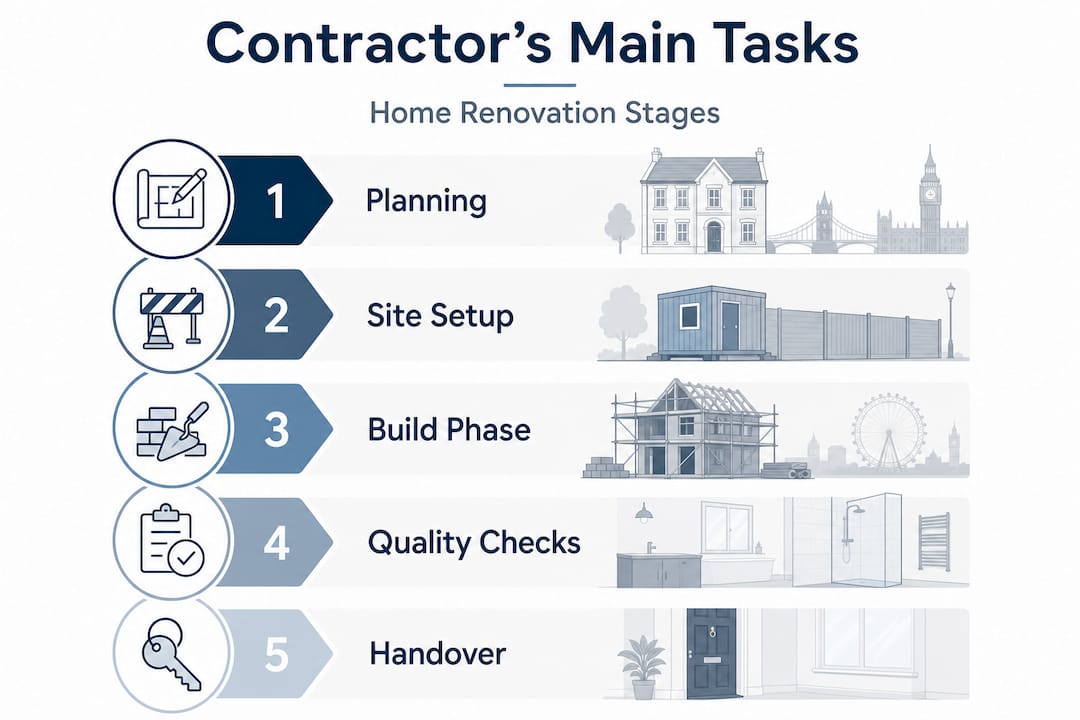
A skilled contractor approaches your renovation in a series of well-defined stages. Each stage carries its own demands, and the contractor’s ability to manage transitions between them is often what separates a smooth build from a stressful one.
Project planning: The contractor reviews your architect’s drawings, identifies potential clashes or buildability issues, and creates a realistic programme of works with clear milestones.
Procurement and contract negotiation: They source materials, appoint sub-contractors, and agree terms that protect both parties from cost overruns and delays.
Regulatory compliance: They coordinate with building control, ensure inspections happen at the right stages, and keep documentation updated throughout.
Trade scheduling and coordination: Electricians, plumbers, plasterers, and carpenters all need to work in the right order. The contractor manages this sequence so your project flows without expensive downtime.
Quality assurance: Regular site checks ensure that workmanship meets the agreed specification. Problems are far cheaper to fix at the point of discovery than after practical completion.
Cost monitoring: The contractor tracks expenditure against the agreed budget, flags variations early, and advises on value-engineering options if costs begin to drift.
Client communication: You should receive regular updates, not just when something goes wrong. A proactive contractor keeps you engaged and avoids unpleasant surprises.
It is also worth noting that under CDM regulations, if only one contractor is appointed on your project, they assume all client duties by default. This makes it even more important to choose someone who takes the full scope of these obligations seriously, not just the construction itself.
For a detailed overview of how these stages fit your specific property type, our home extension guide provides step-by-step guidance for homeowners across Kensington, Chelsea, Fulham, and Notting Hill. You might also want to explore what is a home extension if you are still in the early stages of deciding what kind of build suits your property.
Pro Tip: Ask for a written programme of works before any work starts. A contractor who cannot produce a clear timeline is likely to struggle managing one in practice.
Costs, durations, and what to expect from your West London build
With the contractor’s role clear, it is crucial to understand the financial and time commitments for West London projects.

West London commands a significant premium over national averages. High land values, restricted access in terraced streets, conservation area requirements, and a competitive skilled trades market all push costs upward. Your contractor plays a central role in helping you navigate this landscape without losing control of your budget.
Here is a realistic overview of typical project costs and timescales:
Project type | National average cost | West London estimate | Typical duration |
Single-storey extension | £20,000–£80,000 | £28,000–£112,000 | 10–16 weeks |
Double-storey extension | £50,000–£130,000 | £70,000–£180,000 | 16–24 weeks |
Loft conversion | £35,000–£75,000 | £49,000–£105,000 | 10–14 weeks |
Full house refurbishment | £60,000–£200,000 | £85,000–£280,000 | 16–32 weeks |
Kitchen renovation | £8,000–£35,000 | £11,000–£49,000 | 4–8 weeks |
Based on industry cost data, a single-storey extension ranges from £20,000 to £130,000 nationally, with West London projects typically attracting a 25–40% premium on top of that.
There are several variables your contractor should help you understand and manage:
Structural complexity: Basement dig-outs, steel beam installations, and underpinning all add cost and time
Material specification: Premium finishes for Kensington or Chelsea properties significantly increase budgets
Access restrictions: Narrow streets and limited parking for delivery vehicles can add logistical costs
Party wall agreements: These are common in terraced West London properties and add legal fees and potential delays
A good contractor will not present a single fixed quote and disappear. They will walk you through the key cost drivers, flag where the risks lie, and help you prioritise where to spend and where to save. For a more detailed breakdown of what to expect financially, our guide to West London refurbishment costs covers the numbers in depth, and our overview of London house extension costs gives you a solid foundation before approaching contractors.
Who is accountable? Legal and dispute scenarios explained
Understanding project costs goes hand-in-hand with knowing who is accountable when challenges arise.
Even the best-planned projects can hit problems. Delays, defective materials, disputes over variations, and payment disagreements are more common than most homeowners expect. According to building dispute specialists, the most frequent causes of disputes include delays, defects, and payment issues, often traced back to undocumented changes or ambiguous contracts.
Here is how common scenarios typically play out:
Dispute type | Cause | Contractor’s accountability |
Delay | Weather, supply issues, poor planning | Contractor must mitigate and communicate proactively |
Defective work | Poor workmanship or materials | Contractor is liable for rectification during and after completion |
Cost overrun | Undocumented variations | Disputed if no written variation order exists |
Sub-contractor failure | Scheduling or quality issues | Contractor remains accountable to you regardless |
Key protection measures you should insist upon:
A clear, written contract that specifies the scope of works, payment schedule, and variation procedure
Written variation orders for every change you request or the contractor identifies mid-build
Retention clauses that hold back a percentage of payment until defects are resolved
A dispute resolution mechanism such as adjudication, which is faster and less costly than litigation
“The contract is your single most important document. A verbal agreement on site is worth nothing if you end up in dispute six months later.”
If things do go wrong, the resolution pathway typically begins with direct negotiation, escalates to formal adjudication if necessary, and rarely requires full legal proceedings. Your contractor should understand this process and be willing to commit to it in writing. Completing our West London refurbishment checklist before you start can help you prepare the right questions and documentation from day one.
Tips for choosing the right contractor for your project
Armed with knowledge of disputes and responsibilities, you are ready to choose a trustworthy contractor.
Selecting the right building contractor in West London is one of the most important decisions you will make for your home. The good news is that due diligence is straightforward when you know what to look for.
Start with the basics:
Verify experience with similar projects: A contractor who has completed loft conversions in Chiswick understands the nuances of that kind of build far better than a generalist who has never worked in the area
Request and follow up on references: Speak to at least two previous clients directly. Ask about communication, budget management, and how the contractor handled unexpected problems
Check insurance and accreditations: Public liability insurance, employer’s liability, and relevant trade body memberships (such as FMB membership) are non-negotiable
Review their portfolio critically: Look for projects that match your property type and specification level
Assess their communication style early: How quickly do they respond to your enquiries? How clearly do they explain complex issues? These are strong indicators of how they will behave on site
One distinction that causes confusion is the difference between a building contractor and a project manager. A project manager coordinates trades and provides oversight, and may charge an additional 10% or more on top of your build costs. The key difference is legal accountability. As the HSE makes clear, the contractor remains the legal duty holder on site, regardless of any project management layer above them. Understanding this distinction helps you avoid paying twice for overlapping responsibilities.
Pro Tip: Always insist on written variation orders for every change to the agreed scope of works. Verbal agreements mid-build are the single most common cause of payment disputes in West London renovation projects.
When comparing contractors, do not let price be your only filter. The lowest quote rarely represents the best value. Explore the range of top home extension types to clarify your own vision before approaching the market, so that you are comparing like-for-like quotes from the start.
A contractor’s role: what most guides miss
Most articles about building contractors focus on what they do. Few talk honestly about how much their day-to-day judgement actually shapes your project outcome.
Here is something we have seen repeatedly over nearly two decades of working in West London: the contractor’s influence on site is often greater than the architect’s drawings suggest. An architect designs the vision. The contractor makes it real. And the gap between those two things is where most projects either succeed or struggle. A skilled contractor finds practical solutions to problems the drawings never anticipated. A poor contractor lets those problems become your headaches.
Neighbour relations are another area that guides rarely address honestly. In West London’s tightly packed terraces and mansion blocks, how your contractor manages relationships with adjacent residents can directly affect your project. A contractor who communicates proactively with neighbours, respects working hours, and keeps the site clean tends to avoid the formal objections and council complaints that can cause real delays. This is not a soft skill. It is a project management tool.
Then there is the reality of council inspectors and building control officers. An experienced West London contractor knows which inspectors serve which boroughs, what they prioritise, and how to prepare for sign-off without unnecessary hold-ups. That knowledge is invisible in any quote but it makes a real difference to your programme.
The uncomfortable truth is this: choosing the wrong contractor because they were cheaper or more available is almost always more expensive in the long run. Defects, delays, disputes, and remediation costs add up quickly. The right contractor does not just deliver your project. They protect you from the dozens of small decisions that could quietly derail it. When you are thinking about how to boost your home value through an extension or refurbishment, the quality of your contractor is the single variable with the greatest impact on whether you actually achieve that uplift.
Ready to transform your West London home?
If this guide has helped you understand just how central the building contractor’s role is, you are already better prepared than most homeowners who start the process. The next step is finding a team with the track record, local knowledge, and professional approach to bring your project to life.

At Tenen Ltd, we have been delivering high-quality extensions, refurbishments, and conversions across West and Central London since 2006. Our full range of Tenen Ltd services covers everything from rear and side-return extensions to full property refurbishments, ensuring you have a single trusted partner for every stage of your project. Whether you are considering London loft conversions to unlock valuable space in your home, or exploring property refurbishment services to breathe new life into a tired interior, our team is ready to guide you through the process with clarity and confidence. Get in touch today to discuss your project.
Frequently asked questions
What legal duties does a building contractor have during home renovations?
For domestic works, CDM 2015 duties transfer to the principal contractor, making them legally responsible for site safety planning, inductions, and welfare provision throughout your project.
How do building contractors help prevent disputes and defects?
Contractors reduce risk through clear written contracts, regular progress updates, and documented variation orders. As dispute records confirm, most conflicts trace back to undocumented changes or ambiguous agreements.
What is the difference between a contractor and a project manager?
A building contractor is the legal duty holder accountable for site delivery and compliance. A project manager coordinates trades and may charge around 10% extra, but under CDM regulations the contractor retains ultimate legal responsibility.
How much does a typical West London home extension cost?
A single-storey extension costs £20,000–£130,000 nationally, but West London projects typically attract a 25–40% premium, so budgeting from £28,000 upward is a realistic starting point for most homeowners in the area.
Recommended
Comments