
How to prepare for a West London renovation

TL;DR:
Proper preparation for West London renovations involves understanding legal permissions, budgeting with contingencies, and organizing living arrangements during construction. Navigating planning permission, Building Regulations, and party wall notices ensures compliance, while realistic timelines and separated contingency funds prevent overruns. Partnering with experienced builders like Tenen Ltd helps homeowners achieve successful projects that stay on schedule and within budget.
Starting a renovation without proper preparation is one of the most expensive mistakes West London homeowners make. Missed legal notices, underestimated budgets, and poor sequencing can turn an exciting transformation into months of stress. Knowing how to prepare for renovation before a single brick is moved saves you money, protects your relationships with neighbours, and keeps your project on track. This guide covers the legal permissions, realistic budgeting, and practical home management strategies that experienced homeowners wish they had known from the start.
Table of Contents
Key Takeaways
Point | Details |
Separate legal approvals | Planning permission, Building Regulations, and party wall notices operate independently and all may be needed. |
Plan contingencies | Budget 15%-25% extra and allow time buffers for complex West London renovations. |
Prepare your home | Declutter, protect belongings, and create safe live-in arrangements to reduce disruption. |
Manage inspections | Schedule Building Control checks timely to avoid costly rework or enforcement. |
Use experts early | Engage builders and surveyors during design to coordinate permissions and manage risk. |
How to prepare for renovation: understanding legal permissions and notices
To prepare effectively, you must first understand these separate but essential legal requirements. Many homeowners assume renovation is simply a matter of hiring a builder and getting started. In West London, that approach leads quickly to enforcement notices, neighbour disputes, and costly delays.
There are three parallel workstreams every UK renovation must navigate: planning permission, Building Regulations approval, and party wall notices. They run concurrently but are completely independent processes, each with its own application, timeline, and consequences if missed.
Here is what each one covers:
Planning permission governs how your development affects the wider area. Extensions beyond permitted development limits, changes to the external appearance, or any work in a conservation area (which includes much of Chelsea, Kensington, and Notting Hill) will require full planning consent from your local authority.
Building Regulations approval ensures the structural, fire, electrical, and insulation safety of the work itself. This is mandatory regardless of whether you need planning permission. A loft conversion with no planning requirement still needs Building Regulations sign-off.
Party wall notices protect your neighbours where work affects a shared wall, boundary, or nearby excavation. Statutory notice periods in London range from one to two months depending on the section of the Party Wall etc. Act 1996 that applies.
Legal process | Who oversees it | When required | Typical lead time |
Planning permission | Local planning authority | Extensions, conservation areas, listed buildings | 8 weeks standard |
Building Regulations | Building Control (local or private) | Almost all structural and safety works | 3 to 5 weeks for Full Plans |
Party wall notice | Party wall surveyor | Shared walls, boundaries, excavations | 1 to 2 months statutory |
Confusing these processes is extremely common. Homeowners sometimes apply for planning permission and assume Building Control is included. It is not. Similarly, sending a party wall notice after work begins is not just unhelpful, it is unlawful. Use our home refurbishment checklist to track each workstream from the outset, and read our house refurbishment guide for a full sequencing overview.
Planning your renovation timeline and budget with contingencies
Having understood the legal permissions, the next step is to plan your renovation timeline and budget carefully. Getting these two elements wrong is where the majority of West London projects lose control.
A realistic timeline must treat legal approval periods as fixed constraints, not variables. Building Regulations Full Plans approval takes 3 to 5 weeks and costs between £200 and £500. You cannot start structural work until this is in place. Factor that in before agreeing a start date with your builder.
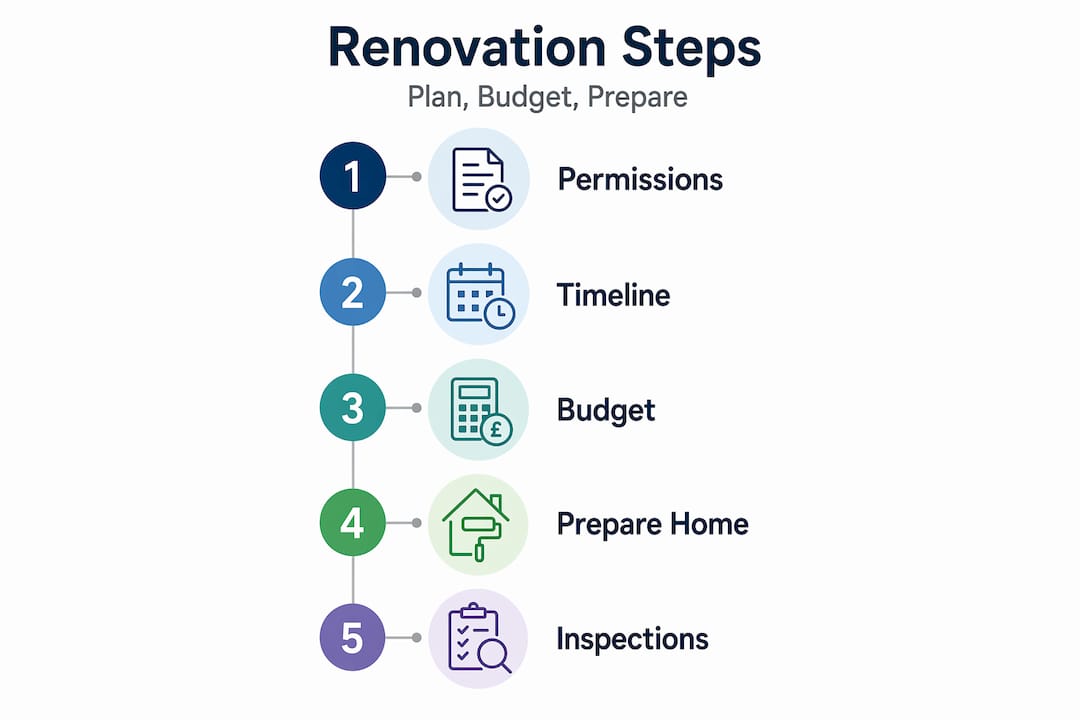
On the budget side, UK guidance recommends building in a 10 to 25% contingency depending on the age and complexity of the property. For most modern homes, 10 to 15% is sufficient. For Victorian and Edwardian terraces common across Fulham, Chiswick, and Hammersmith, 15 to 25% is more realistic given the frequency of unexpected discoveries.
Property type | Recommended contingency | Common unexpected costs |
Modern (post-1980) | 10 to 15% | Minor drainage or insulation issues |
Victorian or Edwardian | 15 to 25% | Drainage, subsidence, asbestos, hidden damp |
Listed or heritage | 20 to 25%+ | Heritage restrictions, specialist materials |
Here is how to structure your renovation budget effectively:
Calculate the core scope cost (labour, materials, fixtures)
Add a cost contingency for physical unknowns (structural surprises, material price changes)
Add a time contingency for schedule delays (approval hold-ups, supplier lead times, weather)
Keep these two reserves separate so you can track which one you are drawing on
Treat your budget like a project document, not a rough guess. Review it weekly with your contractor and update it as decisions are made.
Pro Tip: Submit your Building Regulations application before finalising your builder’s start date. The approval period is non-negotiable, and building it into your schedule from day one prevents the most common cause of project delay.
Use our detailed guide to budgeting your refurbishment and our West London refurbishment checklist to build your financial plan with confidence.
Preparing your home and living arrangements during renovation
Once budget and timeline are set, the focus shifts to physically preparing your home and managing life during renovation. This is the stage most homeowners underestimate, and it is where day-to-day comfort either holds together or falls apart.

Living in your home during renovation is absolutely possible, but it requires clear physical separation between work and living areas, well-thought-out access routes, and realistic expectations about noise and dust.
Follow these steps before work begins:
Declutter the renovation zone completely. Remove all furniture, fixtures, and personal items from the areas being worked on. Decluttering before demolition reduces disruption and rework significantly, because trades can move faster without working around your belongings.
Install dust barriers. Heavy-duty polythene sheeting across doorways is the minimum. For larger projects, consider temporary hoarding boards to create a genuine physical separation between the building site and your living space.
Establish safe access routes. Agree with your contractor which doors, staircases, and corridors the trades will use, and keep those routes clear. This protects both your family’s safety and your home’s finishes.
Set up a temporary functional space. If your kitchen is being renovated, plan a temporary kitchen setup elsewhere. A microwave, kettle, and a small fridge in another room make a significant difference to daily life.
Secure valuables and sensitive items. Move jewellery, documents, and irreplaceable items to a secure location well away from the work zone before the team arrives.
Here are some additional practical points to keep in mind:
Expect noise from around 8am on weekdays. Early morning starts are standard on London sites and are governed by local noise guidelines.
Building Control inspectors will need clear access to specific elements at key stages. Coordinate with your contractor to ensure trades do not close up walls or ceilings before the inspector has signed off.
Protect finished floors in non-renovation areas with hardboard or heavy-duty floor protection film before works begin.
Pro Tip: Ask your contractor to give you a weekly schedule every Friday covering the following week’s work. Knowing what is happening each day helps you plan around noise, access, and inspection visits rather than being caught out by them.
Our guides on expert home improvement services and the West London kitchen renovation guide cover room-specific preparation in more depth.
Coordinating inspections and approvals throughout the build
With preparations complete, managing inspections properly ensures your renovation stays on track and compliant. Building Control inspections are not a formality. They are a legal requirement at specific stages, and missing one has real consequences.
Inspections must be booked at defined stages of the build, including foundations, steel beam installation, insulation, and drainage. If a stage is closed up (plastered over, for example) before the inspector has seen it, they can legally require you to open it back up. That means additional labour, materials, and weeks of delay.
Here is how to manage inspections effectively:
Book each inspection at the start of each build phase, not the day before. Building Control officers have busy schedules, and last-minute bookings risk holding up your contractor.
Ensure clear access to all structural, electrical, and plumbing elements at the time of inspection. Cluttered sites cause failed inspection visits and rescheduling delays.
Never start notifiable work before approvals are in place. Starting early to save time often results in enforcement action that costs far more time than it saved.
Collect all certificates before practical completion. This includes your Building Regulations completion certificate, electrical installation certificates (Part P), and any gas safety records. Without these, you face complications when selling the property.
Key documents to collect during your renovation:
Building Regulations completion certificate
Structural engineer’s calculations and sign-off
Electrical Installation Condition Report (EICR) or Part P certificate
Gas Safe certificates for any gas works
Party wall surveyor’s award (where applicable)
These documents are not optional extras. They protect your investment, demonstrate compliance, and are frequently requested by solicitors during property sales. Keep them together in a dedicated file from the start.
Our home refurbishment checklist and house refurbishment guide outline the full inspection schedule in practical detail.
Why many West London renovations run over budget and how to avoid it
After nearly two decades of working on properties across West London, we have seen the same pattern repeat itself. A homeowner sets a confident budget, appoints a builder, and within six weeks is facing a request for additional funds. Not because the builder is unreliable, but because the home held surprises nobody had accounted for.
West London’s housing stock is predominantly Victorian and Edwardian. These properties are beautiful, but they come with aging drainage systems, lead pipework, hidden damp, and foundations that were not built to today’s standards. Complex London projects require higher than average contingency precisely because of these structural, drainage, and heritage factors. In our experience, a 10% contingency on a Fulham terrace is not caution, it is optimism.
The smarter approach is to separate your contingency into two distinct reserves: one for hidden physical risks (the things you discover when you open up walls), and one for schedule overruns (delays caused by approvals, supplier lead times, or trades unavailability). When these sit in the same pot, it is nearly impossible to understand which is driving cost increases or how much genuine buffer you have left.
Experienced builders also manage a layer of planning that homeowners rarely see. Coordinating supplier deliveries to avoid storage costs, sequencing subcontractor visits so one trade is never waiting on another, and pre-booking Building Control inspections weeks in advance all contribute to a project that runs close to programme. When these things are not managed, delays compound. One missed inspection can push your completion date back by three weeks.
Our refurbishment budgeting advice gives you the framework to build a budget that holds, not one that is quietly optimistic from the outset.
How Tenen Ltd supports your West London renovation success
After thorough preparation, partnering with experienced builders ensures your renovation vision becomes reality without the common pitfalls.

At Tenen Ltd, established in 2006, we have supported hundreds of West London homeowners through exactly the preparation process described in this guide. From the moment you engage us during the planning stage, we help you navigate legal permissions, build realistic timelines, and manage the sequencing that keeps budgets under control. Our London loft conversions are managed with full Building Regulations compliance and party wall coordination built in. Our kitchen and bathroom refurbishment service coordinates all trades and inspections so nothing is left to chance. For whole-property transformations, our London property refurbishments team brings the experience to deliver on time and within a carefully managed budget. Get in touch with us early. The earlier you involve us, the better the outcome.
Frequently asked questions
Do I always need planning permission for a home renovation in West London?
Not always; many extensions and internal alterations fall under permitted development rights. However, planning permission is required where work exceeds permitted development limits, or where the property is in a conservation area or is a listed building.
How long does the party wall notice process take?
The minimum notice period is one month for existing boundary walls and two months for structural works such as loft conversions. Section 2 notices covering loft conversions and beam installations carry the longer two-month requirement, and further delays occur if neighbours dissent and surveyors are appointed.
Can I live in my West London home during renovation?
Yes, but it requires careful planning. Living in the house during works means creating physical work zone separation, installing dust barriers, establishing safe access routes, and planning your routine around early-morning noise and inspection visits.
Why is it important to book Building Control inspections on time?
Missing a required inspection can result in enforcement action requiring you to expose completed work for retrospective sign-off. Inspections booked at key stages such as foundations, steelwork, and drainage ensure compliance and prevent costly, time-consuming remedial work.
Recommended
Comments