
How extensions add value: boost your West London home
TL;DR:
Adding a well-designed extension in West London can significantly boost property value, especially in prime areas like Kensington and Chelsea. The highest returns come from loft conversions and double-storey extensions, which can add up to 25% in value; careful planning ensures these investments pay off. Proper execution, understanding planning restrictions, and avoiding common pitfalls are essential for maximizing the extension’s financial benefits.
Adding a well-planned extension to your West London home can feel like a gamble, but the numbers tell a reassuring story. In prime locations such as Kensington and Chelsea, a quality extension can add £100,000 to £300,000 to your property’s value, with inner London returns reaching an extraordinary 165 to 190 percent on your investment. This guide cuts through the confusion around cost versus benefit, showing you exactly which extension types yield the strongest returns, how to navigate West London’s planning landscape, and what pitfalls to sidestep so your investment pays off handsomely.
Table of Contents
Key Takeaways
Point | Details |
Value uplift potential | Extensions in West London typically boost home value by 10–25 percent, often adding £100k or more. |
Best ROI types | Loft conversions and double-storey extensions usually return the most for your investment. |
Planning matters | Permitted Development can streamline your build, but conservation areas often require full planning permission. |
Quality is crucial | Well-executed, properly permitted projects add more value and reduce future selling risks. |
Avoid common mistakes | Poor design, overbuilding, or ignoring regulations can reduce rather than increase your property’s value. |
Why extensions add value: the West London effect
West London is one of the most sought-after property markets in the UK. Space here is genuinely scarce, which means every square metre you add carries real financial weight. Unlike towns where land is plentiful and buyers can simply move to a larger house nearby, West London homeowners face a very different reality. The combination of limited housing stock, strong buyer demand, and historically high prices creates conditions where extending is almost always more economical than moving.
“In West London, you are not just adding square footage. You are tapping into one of the most supply-constrained property markets in the country, where the premium for space can translate directly into exceptional value growth.”
Extensions boost property market value by 5 to 25 percent depending on the type, location, and quality of the work. In West London specifically, those figures skew towards the upper end, particularly in inner boroughs. Our West London home extension guide explores this dynamic in more detail, but the core principle is straightforward: buyers in Fulham, Chelsea, and Notting Hill are willing to pay a significant premium for turn-key homes with generous, well-designed living space.
Several factors drive this outsized uplift:
Scarcity of comparable larger homes. If buyers cannot easily find a four-bedroom house nearby, they will pay more for the one that already has the extra space.
High average property prices. When a home is worth £1.5 million, a 10 percent uplift means £150,000 added value. The maths simply work better in expensive postcodes.
Quality-conscious buyers. West London purchasers tend to scrutinise design and build quality closely. A beautifully executed extension commands a premium over a tired, dated house of similar size.
Lifestyle expectations. Open-plan kitchen-diners, home offices, and extra bedrooms are not luxuries here; they are baseline expectations for buyers in this market.
Understanding the benefits of London home extensions goes well beyond headline value figures. Extensions also reduce the emotional cost and financial friction of moving, including estate agent fees, solicitor costs, and stamp duty.
Types of extensions and their return on investment
Not all extensions are created equal. The type you choose will significantly influence your return on investment, so it is worth understanding the options before you commit to a project.
Here is a practical comparison to help you plan:
Extension type | Typical cost (West London) | Value added | Approximate ROI |
Rear single-storey | £60,000 to £100,000 | 5 to 15% | 100 to 150% |
Side-return | £50,000 to £90,000 | 5 to 15% | 110 to 160% |
Loft conversion | £60,000 to £120,000 | 15 to 25% | 150 to 190% |
Double-storey rear | £90,000 to £160,000 | 15 to 25% | 130 to 175% |
Kitchen-diner wrap | £80,000 to £130,000 | 10 to 20% | 120 to 165% |
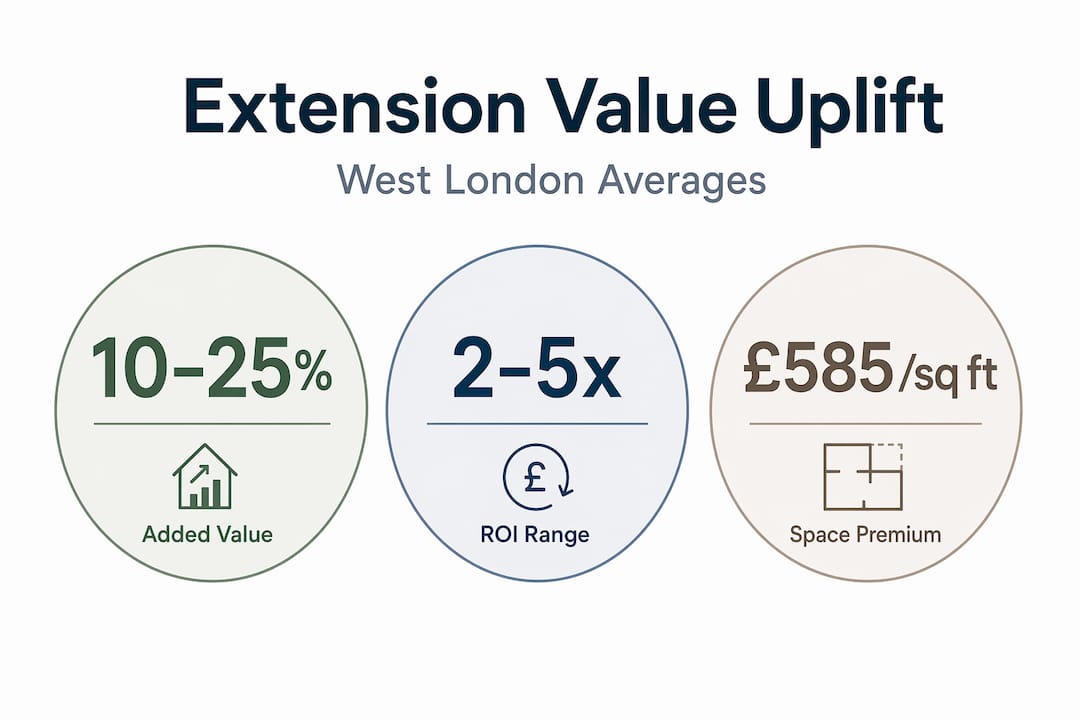
Research confirms that loft conversions add 15 to 25 percent in value, often delivering better return per square metre than ground-floor extensions. This is largely because loft conversions create entirely new bedrooms and bathrooms, which buyers perceive as high-value additions. A Nationwide study found that adding a double bedroom alone increases a home’s value by approximately 14 to 15 percent, and a full loft conversion with a bedroom and bathroom can push that figure to 25 percent for a three-bedroom property.
Here is a step-by-step way to think through which extension suits your home and goals:
Define your primary objective. Are you extending to sell soon, or to live in the home for another decade? If you are planning to sell within two to three years, focus on extensions that appeal broadly to buyers, such as additional bedrooms or open-plan living.
Assess your property’s layout. A terraced Victorian house in Hammersmith might be a perfect candidate for a side-return extension, while a Kensington townhouse may benefit most from a loft conversion.
Research comparable sales. Look at what similar extended homes in your street are selling for. This tells you the ceiling price in your area and prevents overcapitalising.
Consider your budget headroom. Leave a contingency of at least 15 percent above your initial budget for unexpected structural or planning costs.
Pro Tip: Speak to local estate agents before you finalise your extension plans. Ask specifically what buyers in your postcode are requesting. In areas like Chiswick or Fulham, open-plan kitchen-diners with garden access are consistently top of buyers’ wish lists, which makes rear or wraparound extensions particularly appealing. Our guide to boosting home value by 25% and our detailed roof extension guide can help you narrow down the right option for your property.
Planning, permissions, and hidden value drivers
Before you invest in architectural drawings and start sourcing materials, you need a solid grasp of what planning rules apply to your property. In West London, this is more nuanced than in many other parts of the country.
Under Permitted Development (PD) rights, you can often extend without a full planning application. Rear extensions of three to eight metres for detached homes, and three to four metres for terraced or semi-detached properties, can sometimes proceed under PD. However, West London contains a significant proportion of conservation areas and Article 4 zones. In fact, 73 percent of Kensington falls within a conservation area, where stricter rules apply and the risk of refusal is meaningfully higher.
Here is a quick guide to the planning landscape by extension type:
Extension type | Typical planning route | Conservation area implications |
Rear single-storey | Often Permitted Development | May require full permission |
Loft conversion | Usually PD with conditions | Dormer styles may be restricted |
Side-return | Often PD, subject to size limits | More scrutiny on design and materials |
Double-storey | Almost always full planning needed | Higher refusal risk; architect essential |
Key points to keep in mind around planning:
Always check your specific property’s status before assuming Permitted Development applies. Article 4 directions can remove PD rights even from properties that look straightforward.
Use a pre-application consultation. Many West London councils offer a paid service where a planning officer reviews your proposal before formal submission. This dramatically reduces refusal risk.
Quality of design matters to planners. In conservation areas, planners want extensions that complement the existing streetscape. An architect with local experience is invaluable here.
Building regulations approval is always required, even when planning permission is not. Building regs cover structural safety, insulation, fire safety, and other critical elements that protect both you and future buyers.
Properly permitted and certified work has a direct impact on your ability to sell the property. Buyers’ solicitors will ask for evidence of planning consent and building regulations completion certificates. Missing paperwork can delay or even derail a sale. Our guide to planning a home extension walks you through the entire process, and you can also find a thorough Permitted Development overview to help clarify your options.
Pro Tip: If your home is in a conservation area, consider working with an architect who specialises in sympathetic extensions within protected zones. Their familiarity with what local planners accept, both in terms of materials and design language, can be the difference between approval and rejection.
Common pitfalls and surprising factors that impact value
Even a well-intentioned extension project can fail to deliver its expected return if certain traps are not avoided. Some of these pitfalls are well-known; others are genuinely surprising, even to experienced homeowners.
Poor design reduces value, not just aesthetics. An extension that creates a dark, awkward interior or a choppy floor plan can actually reduce buyer interest. Poor design choices are one of the most common reasons extensions underperform financially.
Overcapitalising is a real risk. Every street has a ceiling price. If extended homes in your road sell for a maximum of £1.8 million and your project costs £200,000 on top of a current value of £1.7 million, you may not recoup your spend.
Light and layout matter as much as square footage. A 40 square metre rear extension flooded with natural light through skylights and bi-fold doors adds far more value than the same footprint with small windows and a cramped layout.
Intended use shapes buyer perception. A bedroom in a loft conversion is valued differently to a utility room extension. Think carefully about how future buyers will use and perceive each space.
Regulatory compliance affects mortgageability. If a buyer needs a mortgage, their lender will almost certainly require confirmation that extensions were properly permitted and signed off. Non-compliant work can make a property unmortgageable, severely limiting your pool of buyers.
“The most overlooked factor in extension value is the cost of not extending. In West London, stamp duty alone can exceed £30,000 on a move to a larger property, and that is before you factor in agent fees, removal costs, and conveyancing. Extending often wins by default.”
It is also worth noting that London’s space premium of £585 per square foot means the financial calculus here is markedly different from other parts of the UK, where extension ROI can fall as low as 82 to 98 percent. Understanding your extension costs in detail and considering the full spectrum of extension ideas for London homes before committing will help you make a genuinely informed decision.
The truth about adding value: what most advice misses
After nearly two decades working on extensions across West London, we have noticed that most advice focuses almost entirely on the headline ROI percentages. While those numbers are important, they tell only part of the story.
The real differentiator between an extension that transforms a home’s value and one that disappoints is execution quality and design intelligence. A cookie-cutter rear extension built to minimum standards will always underperform a thoughtfully designed space that genuinely improves how the home feels and functions. Buyers in West London are sophisticated. They notice the difference between a plasterer who left rough corners and a craftsman who took pride in every surface.

There is also a risk dimension that conventional guides downplay. Planning rejection, budget overruns, poor contractor selection, and market timing all carry genuine financial consequences. We would always encourage homeowners to approach extensions as investments requiring proper due diligence, not simply aesthetic projects. That means scrutinising contractor credentials, understanding your planning risk level before you spend money on designs, and building a realistic contingency into your budget.
Perhaps most importantly, sometimes not extending is the right call. If your home already sits close to the ceiling price for your street, if your plans would require planning permission in a high-refusal conservation area, or if a full refurbishment would achieve similar value uplift for far less cost, it is worth pausing to reconsider. Brave advice from a trusted contractor sometimes means recommending a smaller scope of work, or even none at all. Explore some creative extension ideas and weigh them honestly against your specific circumstances before committing.
Take the next step: expert extension services for your West London home
If this guide has helped you see the genuine opportunity that extensions represent in West London, the next step is getting expert advice tailored to your specific property and goals. At Tenen Ltd, we have been helping homeowners across Fulham, Chelsea, Kensington, Chiswick, Hammersmith, and Notting Hill create beautiful, high-value extensions since 2006.
Whether you are considering a loft conversion, a side-return, or a full double-storey project, our team can walk you through realistic costs, planning considerations, and design options that maximise your return. Browse our all extension services to see the full range of what we offer, including loft conversions and side return extensions. Contact us today to arrange a personalised property assessment and take the first step towards transforming your home’s potential into genuine, lasting value.
Frequently asked questions
How much value could a typical West London extension add?
Depending on the extension type and your specific location, you can realistically expect added value of 10 to 25 percent, and in prime inner West London areas such as Kensington and Chelsea, returns can be even higher, sometimes reaching 165 to 190 percent on the investment itself.
Which type of extension gives the best return on investment?
Loft conversions with bedrooms and bathrooms and double-storey rear extensions typically deliver the strongest returns in West London, often adding 15 to 25 percent to a property’s value and offering a better return per square metre than single-storey ground-floor options.
Are there limits on extensions in West London conservation areas?
Yes, many West London properties fall within Article 4 or conservation zones, which can remove Permitted Development rights entirely and require full planning permission, bringing a higher risk of refusal and stricter design controls.
Does the quality of building work impact value added?
Absolutely. Poor design and substandard workmanship can reduce a property’s value rather than increase it, while high-quality, well-designed, and properly certified extensions inspire buyer confidence and command the strongest price uplifts.
Recommended
Comments