
Unlock space and value: hip to gable loft conversion in London
TL;DR:
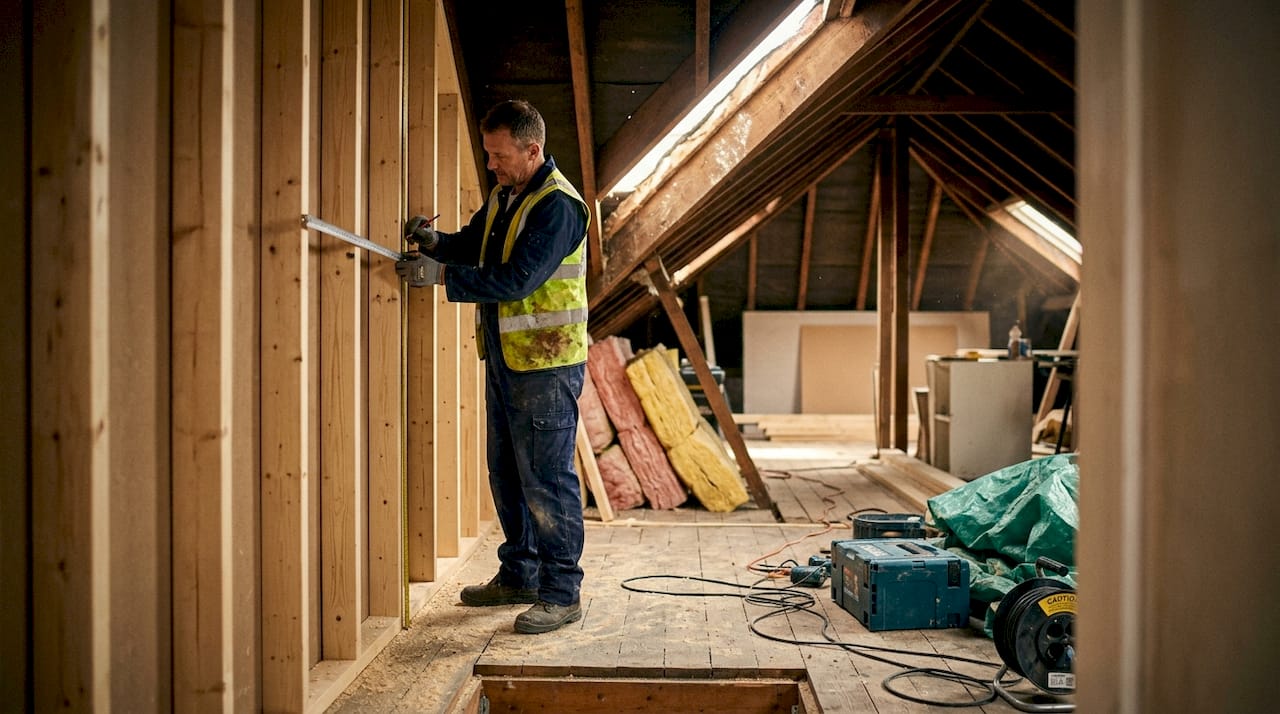
Many West London homeowners overlook the hidden potential of their hipped roofs, which restrict usable loft space. A hip to gable conversion replaces the sloping side with a vertical wall, significantly increasing headroom and floor area for versatile living spaces. This process enhances property value, avoids loss of garden space, and is often achievable within permitted development rights, making it an attractive choice for many homeowners.
Many West London homeowners are sitting on a hidden asset without realising it. If your home has a hipped roof, that sloping triangle on the side is quietly eating into the floor space you could be living in. A hip to gable conversion transforms that wasted slope into a full vertical wall, dramatically increasing headroom and usable area. This guide walks you through everything you need to know, from what the process actually involves, to costs, planning rules, and how to avoid the mistakes that catch homeowners out.
Table of Contents
Key Takeaways
Point | Details |
Maximise unused lofts | Hip to gable conversions turn limited attic space into practical, valuable rooms. |
Boost property value | A quality conversion can significantly increase your home’s market worth in West London. |
Understand your options | Comparing hip to gable, dormer, and mansard conversions helps you choose the right approach. |
Plan thoroughly | Careful preparation and knowledge of regulations can help avoid costly pitfalls. |
What is a hip to gable loft conversion?
A hipped roof slopes down on all four sides of a building. Unlike a standard gable roof, which has a triangular vertical wall at each end, a hipped roof tapers away. This design looks elegant from the street, but it creates a loft space that narrows sharply towards the sides, leaving you with awkward, cramped corners that are difficult to use as habitable rooms.
A hip to gable conversion solves this by removing the sloping “hip” on the side of the roof and replacing it with a vertical gable end wall. The ridge of the roof is extended outwards to meet this new wall, significantly widening the internal loft space. Think of it as squaring off the roof to extract every usable square metre.
As noted in our guide to hip to gable conversions, these conversions are “ideal for homes with hipped roofs, commonly found in West London, allowing for a full-width rear dormer and maximising floor space.” This combination, a new gable wall plus a rear dormer, is what truly opens the space up.
West London properties that typically benefit most include:
Semi-detached Edwardian and Victorian houses in areas like Chiswick, Hammersmith, and Fulham
End-of-terrace properties with a hip on the exposed side
1930s detached homes found throughout Kensington and Notting Hill
Larger inter-war semis with generous roof pitches in Richmond and Ealing borders
A hip to gable conversion is not simply a structural change; it is the difference between a loft that stores boxes and a loft that becomes a proper bedroom, office, or bathroom suite.
If you have been considering dormer loft conversions as an alternative, it is worth noting that a hip to gable conversion is often paired with a rear dormer for maximum effect. Together, they transform two different dimensions of the loft simultaneously.
Key benefits of a hip to gable conversion in West London
Now that you know what a hip to gable conversion is, let’s examine why it is so sought after in West London.
The most obvious advantage is space. By removing the sloping hip and extending the ridge, you gain a full-width floor area that can realistically accommodate a bedroom, an en suite bathroom, a home office, or even a playroom. For families in Fulham or Chelsea where moving to a larger home means spending hundreds of thousands more, creating a new room within your existing footprint is a genuinely compelling alternative.
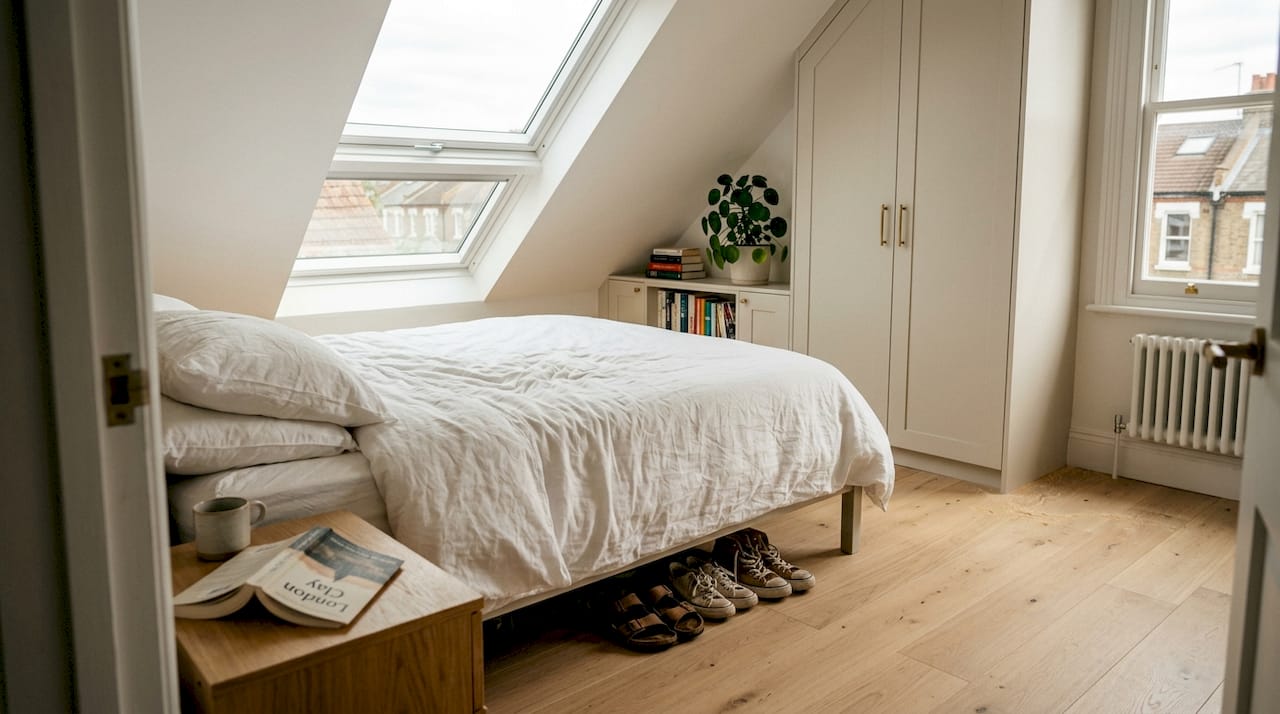
The financial case is equally strong. Maximising loft space value in London is well understood by estate agents and surveyors alike. As the evidence shows, a “well-executed hip to gable loft conversion can significantly increase both usable space and property value in London homes.” In practical terms, adding a bedroom and bathroom to a West London property can add between 15% and 25% to its market value. That is a meaningful return on an investment that typically costs a fraction of what a ground-floor extension or house move would.
Other key advantages include:
No loss of garden space, unlike a rear or side extension
Minimal impact on neighbours, as the work is largely above the existing roofline
Potential to stay within permitted development, avoiding a full planning application in many cases
Improved kerb appeal, as a well-designed gable end can enhance the external appearance of the home
Improved thermal performance, as modern insulation installed during the conversion can reduce heating bills
Pro Tip: Even if natural light in the new loft space looks adequate on paper, always consider adding Velux skylights or a dormer window. Natural light transforms a functional loft into a genuinely enjoyable living space, and it costs relatively little to include at the build stage compared to retrofitting later.
Comparing hip to gable with other London loft conversion styles
While hip to gable is popular, it is worth understanding how it stacks up against other conversion options available to West London homeowners.
Conversion type | Space gained | Best suited to | Planning complexity | Relative cost |
Hip to gable | High | Semi-detached and end-of-terrace with hipped roofs | Low to medium | Medium |
Dormer | Medium to high | Most roof types | Low (often permitted development) | Medium |
Mansard | Very high | Terraced houses and period properties | Higher (often requires planning) | Higher |
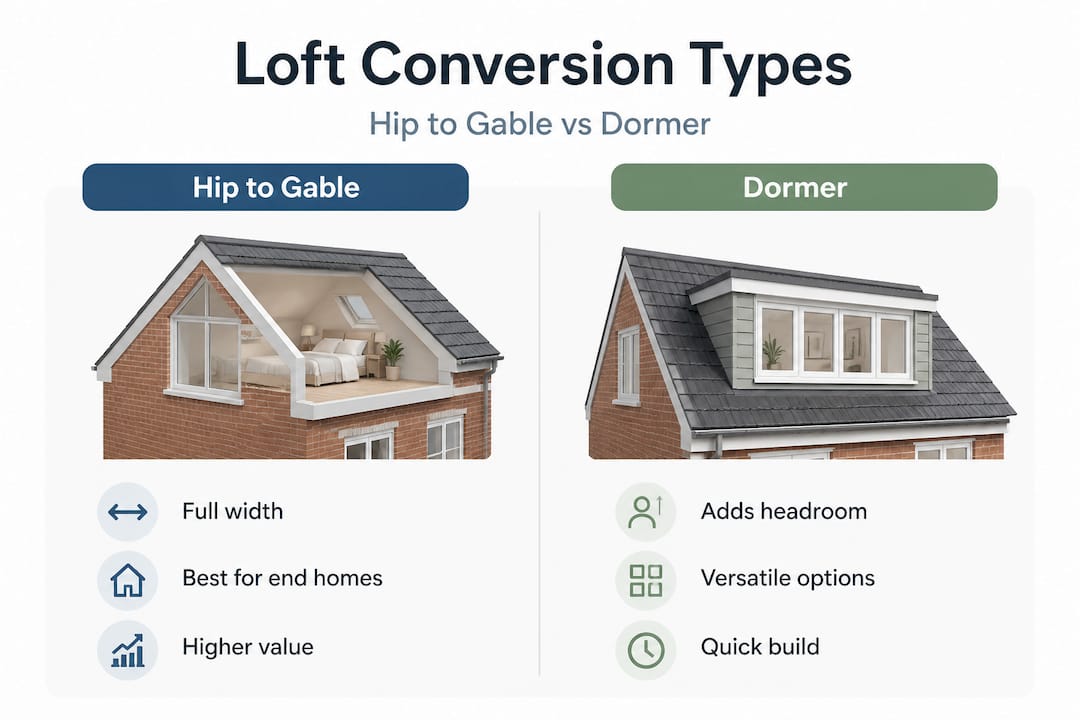
As the guidance on loft conversions in West London makes clear, “choosing between hip to gable, dormer, or mansard conversions depends on roof structure, planning constraints and desired space.” There is no single right answer; it depends on your specific property.
A standard dormer conversion projects outward from an existing roof slope and works well on most house types. It adds headroom and floor space but does not address the width restriction created by a hipped end. If your primary frustration is the narrow, tapering sides of your loft, a dormer alone will not fully solve the problem.
A mansard loft conversion involves rebuilding the rear roof slope at a near-vertical angle with a flat top, creating a box-like structure that maximises internal space. Mansard conversions are extremely effective for terraced properties and period homes in Chelsea and Notting Hill, but they almost always require full planning permission and carry a higher build cost. They are the right choice when maximum space is the priority and the property cannot accommodate a hip to gable approach.
When is each type the best choice?
Hip to gable: Semi-detached or end-of-terrace homes with hipped roofs; ideal for maximising both width and rear headroom when combined with a dormer
Dormer only: Straightforward roof structures where adding a side extension is not practical or necessary
Mansard: Terraced homes in conservation areas or where the maximum possible square footage is needed
What to expect from the hip to gable conversion process
Having chosen your conversion style, the next key question is what the process looks like and how long you will be living in a building site.
A typical hip to gable loft conversion moves through the following stages:
Initial feasibility survey: A structural survey confirms whether your roof pitch and property type are suitable. This is also when head height is measured to confirm viability.
Design and architectural drawings: Plans are prepared showing the new gable wall, any dormer, roof structure, staircase position, and internal layout.
Planning and building regulations: Depending on your property, this may involve a permitted development confirmation, a full planning application, and a building regulations application submitted to the local authority.
Party wall agreements: If you share a wall with a neighbour, you are legally required to serve a party wall notice before works begin. This applies to most semi-detached homes.
Scaffolding and site preparation: Access scaffolding is erected around the property before any structural roof work begins.
Structural works: The hip is removed, the gable wall is built, and the roof ridge is extended. This is the most visually dramatic stage.
Internal works: Floor joists, insulation, plasterboard, electrical, plumbing, and staircase installation take place.
Completion and sign-off: Building control inspection confirms compliance, and your new room is ready to use.
According to our overview of hip to gable project steps, a “standard hip to gable loft conversion in London takes around 8-12 weeks, depending on complexity and any planning requirements.” Most families continue to live in the property throughout the build, though the scaffolding phase and roof opening stage can be disruptive for a few days.
Stage | Typical duration |
Survey and design | 2 to 4 weeks |
Planning and approvals | 4 to 8 weeks (if required) |
Structural and external works | 2 to 3 weeks |
Internal fit-out | 4 to 6 weeks |
Snagging and sign-off | 1 week |
Pro Tip: Speak to your neighbours before you even appoint a contractor. Party wall agreements can take weeks to resolve if a neighbour objects, and building good relations early smooths the entire process considerably. A simple, friendly conversation about what you are planning can prevent delays that cost you both time and money.
Costs, regulations, and common pitfalls to avoid
Finally, before you start, let’s clarify what a hip to gable conversion will likely cost, what the legal process involves, and how to protect your investment against common mistakes.
In West London, a hip to gable loft conversion typically costs between £50,000 and £80,000 for a straightforward project. Adding a full rear dormer, an en suite bathroom, or premium finishes can push the cost higher, towards £90,000 to £110,000. Several factors directly influence the final figure:
Roof pitch and complexity: A steeper pitch gives more headroom naturally, reducing structural work costs
Property type: End-of-terrace conversions tend to be slightly more straightforward than semi-detached
Finish quality: Standard joinery and tiling versus bespoke fitted rooms represent a significant cost difference
Staircase design: A feature staircase costs considerably more than a straightforward loft ladder or standard flight
On the regulatory side, the rules around London loft regulations are clear: “London properties may require planning permission, especially on end-of-terrace and semi-detached homes, and must comply with building regulations at every stage.” Permitted development rights cover many conversions, but conservation areas, Article 4 directions, and specific borough policies can remove these rights entirely. Always verify your permitted development status before committing to a design.
Skipping the building regulations process is never a shortcut worth taking. Without sign-off, you cannot legally sell your home without disclosing the unauthorised work, which can derail a sale at the worst possible moment.
Common pitfalls to avoid include:
Choosing a contractor on price alone without checking references or previous loft conversion projects specifically
Under-budgeting by not including VAT, structural engineer fees, party wall surveyor costs, or building regulations fees in the total
Late design changes that force the contractor to reorder materials or redo completed work, adding both cost and weeks to the programme
Ignoring fire safety requirements, which are strictly enforced during building control inspections for habitable loft rooms
Pro Tip: Always insist on a fixed-price contract before any work begins. A detailed schedule of works tied to a fixed price protects you from unexpected cost increases and gives both parties clear expectations from day one.
A builder’s perspective: what most homeowners don’t realise about hip to gable loft conversions
Having worked on loft conversions across West London for nearly two decades, we have noticed a consistent pattern. Most homeowners focus intensely on the final result: the new room, the finishes, the added value. Far fewer invest enough attention in the planning stage, and that is almost always where problems begin.
Budget overruns rarely come from the structural works themselves. They tend to come from design changes requested mid-build, from specifications that were not pinned down clearly at the start, or from contractors who priced a basic job without fully understanding the brief. When you change a window position or decide you want underfloor heating after the floor has been laid, costs climb quickly. Being decisive and thorough before works start is genuinely the most cost-effective thing you can do.
Local knowledge is also more valuable than most people give it credit for. West London’s boroughs are not a uniform block. Hammersmith and Fulham, Kensington and Chelsea, and the Royal Borough of Kingston all have their own planning approaches, conservation area designations, and interpretations of permitted development. A contractor who has experience specifically in your borough will navigate that landscape far more efficiently than one flying in from elsewhere. They will know the right contacts, they will understand which questions to ask, and they will not be surprised by local requirements.
The disruption factor is almost always underestimated. Eight to twelve weeks sounds manageable on paper. In practice, that means weeks of scaffolding, a period where your roof is partially open, noise during working hours, and dust migrating through the house. It is entirely liveable, but going in with a clear plan for managing daily life during the build makes the experience far less stressful. Talk to your contractor about phasing, about protecting the lower floors, and about when the most disruptive work will happen, so you can plan around it.
Experienced specialists are worth the investment, every time. On a project of this scale, the few thousand pounds difference between a highly experienced contractor and a cheaper generalist is nothing compared to the cost of fixing mistakes, managing delays, or dealing with a failed building control inspection.
Transform your West London home with trusted experts
If you are seriously considering a hip to gable conversion, the right team makes all the difference. At Tenen Ltd, we have been delivering high-quality London loft conversion services since 2006, working with homeowners across Fulham, Chelsea, Kensington, Chiswick, Hammersmith, and Notting Hill.
Our hip to gable specialists manage every stage from feasibility survey and architectural design through to planning submissions, building regulations, and the full build. You stay informed throughout without having to chase a dozen different trades or navigate bureaucracy alone. We also handle broader property refurbishment in London should you want to refresh the rest of the home at the same time. Get in touch with our team today to book your initial consultation.
Frequently asked questions
Do hip to gable loft conversions always require planning permission in London?
Not always; many fall within permitted development, but planning rules depend on the type of property and location, so always check with your local borough before proceeding.
How long does a hip to gable loft conversion take from start to finish?
Most take 8 to 12 weeks from construction start, but complex designs or additional planning requirements can extend the overall programme beyond that.
Will a hip to gable conversion add value to my West London home?
Yes, in most cases it increases property value significantly, with an added bedroom and bathroom typically delivering strong returns in the West London market.
What is the main difference between hip to gable and dormer conversions?
A hip to gable conversion transforms a sloping side roof into a vertical wall to widen the loft, while a dormer projects outwards from an existing slope to add headroom and light.
Recommended
Comments