
Why ventilate your home: a guide for UK homeowners

TL;DR:
Proper home ventilation controls indoor air quality and prevents moisture buildup that causes mold and structural damage.
Using natural or mechanical methods, including trickle vents and heat recovery systems, maintains fresh air flow efficiently.
Home ventilation is defined as the controlled exchange of indoor and outdoor air to remove moisture, pollutants, and stale air from your living spaces. Without it, everyday activities like cooking, showering, and even breathing release contaminants that build up to harmful levels. Poor ventilation causes condensation, mould growth, and respiratory problems that affect your family’s health and your property’s structure. The good news is that understanding why ventilate your home matters is the first step to fixing it, and the solutions range from simple daily habits to purpose-built mechanical systems.
How does ventilation improve indoor air quality and health?
Indoor air is often more polluted than outdoor air. Cooking releases nitrogen dioxide and particulate matter. Cleaning products emit volatile organic compounds (VOCs). Dust mites, pet dander, and viruses circulate freely in poorly aired rooms. Ventilation dilutes and removes these contaminants before they accumulate to levels that trigger asthma, allergies, and other respiratory conditions.
Moisture is the most immediate threat. Every person in your home produces moisture through breathing, cooking, and bathing. Without adequate air exchange, that moisture condenses on cold surfaces, feeding mould colonies that release spores into the air you breathe. Insulation alone does not prevent this. Ventilation is the mechanism that actually removes moisture at the source.
The health benefits of ventilation extend beyond mould prevention. Sustained exposure to elevated CO2 levels, even in the absence of visible mould, causes fatigue, headaches, and reduced concentration. Fresh air supply keeps CO2 at safe levels and supports better sleep and cognitive function. These are not minor quality-of-life improvements. They are measurable health outcomes linked directly to how well your home breathes.
Key indoor pollutant sources to address through ventilation:
Cooking fumes, grease, and steam from the kitchen
VOCs from paints, adhesives, and cleaning products
Moisture from bathrooms, laundry, and occupant respiration
Dust, allergens, and airborne viruses in living areas
CO2 from occupants, particularly in bedrooms overnight
Pro Tip: Open bedroom windows for at least ten minutes before bed. Overnight CO2 build-up in a closed room is one of the most overlooked causes of poor sleep quality.
What are the common methods to ventilate a home effectively?
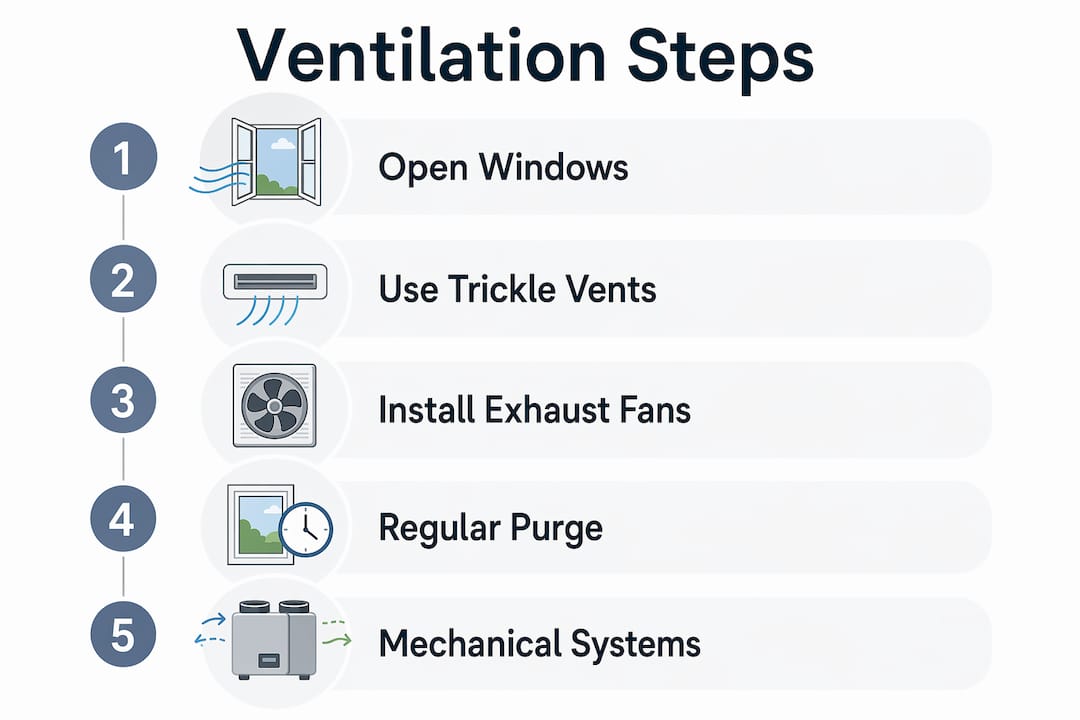
Natural ventilation relies on wind pressure and temperature differences to move air through your home. Opening windows on opposite sides of a room creates cross-ventilation, where fresh air enters on one side and stale air exits on the other. Internal doors play a key role in this process. Keeping them open creates clear air pathways throughout the house, allowing airflow to reach rooms that do not have direct window access.

The most practical natural ventilation routine is “purge” ventilation. Opening windows for 10–20 minutes each morning flushes out the moisture and CO2 that accumulated overnight. This is most effective when done across multiple rooms simultaneously, ideally creating a through-draft from front to back of the property.
Trickle vents are small, adjustable slots built into window frames that provide continuous background ventilation without fully opening the window. They are particularly useful in bedrooms and living rooms where you want fresh air without draughts or noise. Many homeowners close them in winter to save heat, but this is counterproductive. The UK government’s ventilation guidance is clear: closing trickle vents causes moisture and CO2 to build up, leading to condensation damage that costs far more to repair than the heat you saved.
Mechanical ventilation systems offer a more controlled approach. The table below compares the main options available to UK homeowners.
System type | How it works | Approximate cost | Best suited for |
Continuous exhaust fan | Extracts stale air from wet rooms constantly | Very low running cost | Flats and smaller homes |
Heat recovery ventilator (HRV) | Exchanges stale and fresh air, recovering heat | Higher upfront cost | Airtight new builds |
Energy recovery ventilator (ERV) | As HRV, but also manages humidity | Higher upfront cost | Humid climates or large homes |
Trickle vents | Passive background airflow via window frames | Minimal | All home types |
Continuous exhaust fan systems run at an estimated cost of £7–£15 per year in electricity. That makes them one of the most affordable ways to maintain consistent moisture and stale air removal. HRV and ERV systems cost significantly more to install but recover heat from outgoing air, reducing the energy penalty of ventilation in well-insulated homes.
Pro Tip: For kitchen ventilation specifically, an extractor fan vented to the outside is far more effective than a recirculating model. Recirculating fans filter grease but return moisture and CO2 to the room.
Why is controlled ventilation necessary in modern airtight homes?
Modern homes are built to be airtight. Double-glazed windows, insulated cavity walls, and draught-proofed doors all reduce uncontrolled air leakage. This is excellent for energy efficiency. It is a serious problem for air quality if ventilation is not actively managed.
Older, draughty properties had a form of uncontrolled natural ventilation through gaps in the building fabric. It was inefficient and uncomfortable, but it did keep moisture and pollutants moving. When you seal those gaps through a refurbishment or retrofit, you remove that accidental ventilation. Replacing draughty windows with airtight units can trigger “sick building” syndrome if ventilation is not upgraded at the same time. This is one of the most common and costly mistakes homeowners make during renovation.
The building science principle here is straightforward: airtightness and ventilation are not opposites. They work together. A well-sealed home with controlled mechanical ventilation uses less energy than a draughty home, while maintaining far better air quality. The misconception that you must choose between warmth and fresh air is simply wrong.
Issues that arise from poor ventilation in airtight homes:
Persistent condensation on windows and cold walls
Black mould in corners, behind furniture, and in wardrobes
Rising CO2 levels causing fatigue and headaches
Musty odours that do not clear with cleaning
Structural timber damage from sustained moisture exposure
Mechanical ventilation is now considered foundational infrastructure in high-performance homes, not an optional extra. If you are planning a loft conversion, extension, or full refurbishment, ventilation must be part of the specification from the outset. Retrofitting it afterwards is always more expensive and less effective. For homeowners considering period property upgrades in West London, this is particularly relevant, as older buildings often need both improved airtightness and a fresh ventilation strategy.
Pro Tip: If you are upgrading insulation or replacing windows, commission a ventilation assessment at the same time. The cost is small relative to the refurbishment budget, and it prevents expensive moisture problems later.
How to maintain and optimise home ventilation year-round
Good ventilation does not require constant effort. A few consistent habits and well-maintained systems will keep your home’s air quality high throughout the year without wasting energy.
Keep trickle vents open at all times. This applies even in winter. The heat loss through a trickle vent is minimal compared to the damage caused by the moisture and CO2 that builds up when they are closed.
Practise daily purge ventilation. Open windows across the house for 10–20 minutes each morning. This single habit removes the bulk of overnight moisture and refreshes the air before the day begins.
Clean extractor fans every three to six months. Grease and dust clog fan blades and reduce airflow significantly. A blocked kitchen or bathroom extractor fan provides almost no ventilation benefit.
Use extractor fans correctly. Run the bathroom fan during and for at least 15 minutes after showering. Run the kitchen fan throughout cooking, not just when smoke appears.
Position furniture away from external walls. Wardrobes and sofas pushed against cold external walls block airflow and create cold spots where condensation forms. A gap of at least 50mm allows air to circulate.
Review your heating and ventilation balance. Ventilating a cold home feels wasteful, but the alternative is moisture damage. If heat loss is a concern, an HRV system recovers up to 90% of the heat from outgoing air, making it possible to ventilate without significant energy loss.
Consider a mechanical upgrade when renovating. If you are planning a refurbishment or home energy efficiency improvements, this is the right moment to install a whole-house ventilation system. Doing so during construction work reduces disruption and cost considerably.
Balancing ventilation with sustainable renovation practices is increasingly straightforward. Modern HRV and ERV systems are quiet, low-maintenance, and designed to integrate with standard UK construction methods. The upfront investment pays back through lower heating bills, reduced maintenance costs, and a healthier home environment.
Key takeaways
Proper home ventilation is the single most effective way to prevent mould, protect your property’s structure, and maintain healthy indoor air quality year-round.
Point | Details |
Ventilation removes pollutants | Daily purge ventilation for 10–20 minutes flushes moisture, CO2, and VOCs from living spaces. |
Airtightness needs active ventilation | Sealing a home without upgrading ventilation causes moisture damage and poor air quality. |
Trickle vents must stay open | Closing trickle vents to save heat causes condensation damage that costs far more to repair. |
Mechanical systems suit modern homes | HRV and ERV systems maintain fresh air supply while recovering heat from outgoing air. |
Ventilation belongs in every renovation | Installing ventilation during a refurbishment is cheaper and more effective than retrofitting later. |
Ventilation is the renovation detail most homeowners overlook
I have seen this pattern repeatedly across West and Central London properties. A homeowner invests in new windows, upgraded insulation, and a full refurbishment. The result looks excellent. Then, six months later, black mould appears in the bedroom corners. Condensation streaks the new glazing every morning. The culprit is almost always the same: ventilation was not part of the plan.
The conventional wisdom is that a warm, well-insulated home is a healthy home. That is only half the equation. Warmth without airflow creates exactly the conditions that mould needs to thrive. I have seen this cause thousands of pounds of damage to properties that were otherwise beautifully finished.
The uncomfortable truth is that ventilation is unglamorous. It does not photograph well. It does not add the visual impact of a new kitchen or a loft conversion. So it gets deprioritised. But the homes I have seen that perform best over time, the ones that stay fresh, dry, and structurally sound, are the ones where ventilation was treated as seriously as any other building system.
My advice to any homeowner planning work in 2026 is this: put ventilation on the specification before you finalise anything else. It is far easier to route ductwork during a build than to chase it through finished walls. And the property upkeep benefits of getting it right from the start are significant. A well-ventilated home requires less maintenance, holds its value better, and is simply a more pleasant place to live.
— Mateja
How Tenenltd can help you get ventilation right
If you are planning a renovation, extension, or loft conversion, ventilation should be part of the conversation from day one. Tenenltd has been working with homeowners across Fulham, Chelsea, Kensington, and Chiswick since 2006, and we build ventilation planning into every project we take on.

Whether you are considering a home extension to improve your living space, a loft conversion that adds a new floor to your property, or a full property refurbishment that brings your home up to modern standards, our team will make sure airflow and moisture management are built in, not bolted on. Get in touch with Tenenltd to discuss your project and find out how we can help you create a home that is healthy, efficient, and built to last.
FAQ
Why is ventilation important in a well-insulated home?
Insulation reduces heat loss but also traps moisture and pollutants inside. Without active ventilation, airtight homes develop condensation, mould, and elevated CO2 levels that affect both health and building structure.
How long should I open windows to ventilate my home?
Opening windows for 10–20 minutes each morning provides effective purge ventilation. This flushes out overnight moisture and CO2 without losing significant heat from the property.
Should I keep trickle vents open in winter?
Yes. UK government guidance confirms that closing trickle vents causes moisture and CO2 build-up, leading to condensation damage. The heat loss through an open trickle vent is minimal compared to the cost of repairing mould damage.
What is the difference between an HRV and an ERV system?
A heat recovery ventilator (HRV) recovers heat from outgoing stale air and uses it to warm incoming fresh air. An energy recovery ventilator (ERV) does the same but also manages humidity levels, making it better suited to homes with high moisture output.
When should I upgrade to a mechanical ventilation system?
The best time to install mechanical ventilation is during a renovation or refurbishment. Fitting ductwork during construction is significantly cheaper and less disruptive than retrofitting it into a finished property.
Recommended
Bài viết này ngắn gọn mà dễ hiểu thật, mình đọc liền một lượt là nắm được ý, cảm ơn bạn đã chia sẻ. Mình cũng có thói quen xem thống kê XSMB mỗi ngày, nhưng hồi trước cứ phải mở nhiều chỗ khác nhau nên hơi mất công. Về sau mình tự gom lại cho tiện, lúc cần chỉ việc mở ra xem nhanh, đỡ phải nhớ hôm nay đã tra ở đâu. Mình để chung một nơi trên soicau247.com để theo dõi cho gọn, nhất là những lúc bận không có thời gian ngồi lọc từng nguồn. Ai cũng hay cập nhật số liệu theo ngày như mình thì có thể tham khảo ở đây: https://soicau247.com/xo-so-vinh-long-xsvl.html.