
What is a cellar conversion? London guide 2026

TL;DR:
A cellar conversion transforms an underused subterranean space into a fully habitable room that complies with Building Regulations.
In London, costs typically range from £2,000 to £3,000 per square metre, with professional fees adding 10-18%, and structural waterproofing being critical to success.
Proper planning, waterproofing, and structural compliance maximize property value and usability, making conversions a smart investment.
A cellar conversion is defined as the process of transforming an existing below-ground cellar into fully habitable living space by meeting structural, waterproofing, ventilation, and fire safety requirements. This is not a simple renovation. It is a re-engineering of a subterranean environment to comply with Building Regulations and function as a genuine room. For London homeowners, the appeal is clear: property prices make every square metre precious, and an unused cellar represents untapped floor space sitting directly beneath your feet. Done correctly, a cellar conversion can add significant value and transform how your home functions day to day.
What is a cellar conversion and what does it involve?
A cellar conversion turns an underused, often damp storage space into a compliant, functional room. The industry also refers to this as a basement conversion, and the two terms are used interchangeably across London’s construction sector. The core difference between a cellar conversion and a standard room renovation is the environment: below-ground spaces face hydrostatic pressure, moisture ingress, limited natural light, and restricted ventilation. Addressing all four is non-negotiable before any design work begins.

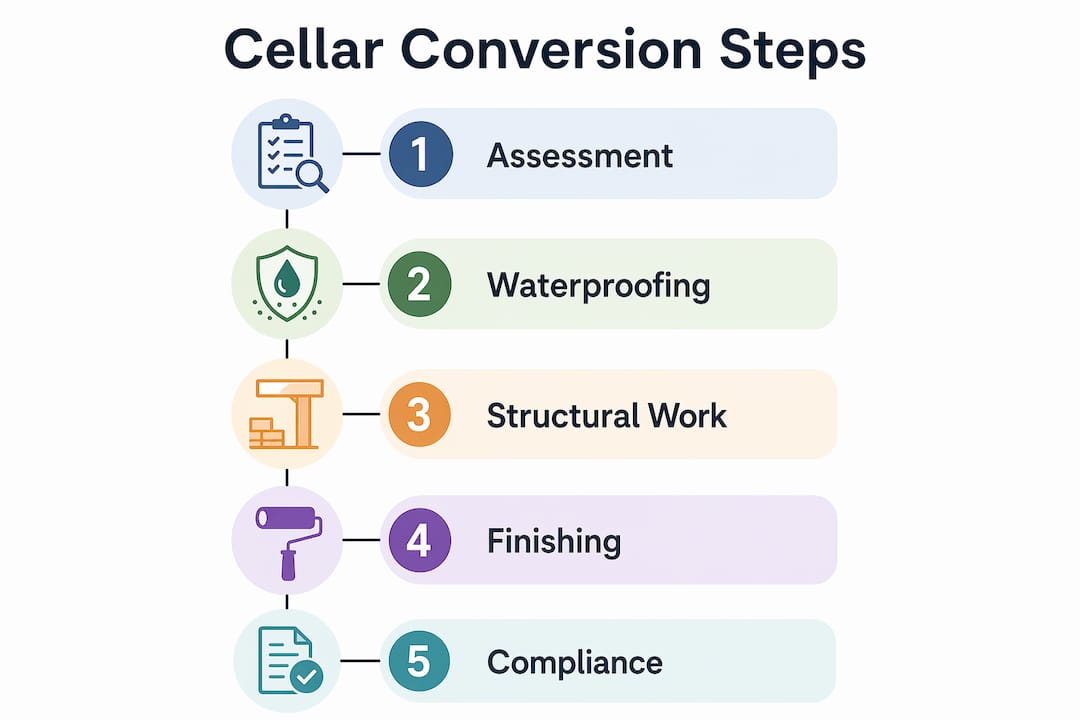
The process typically involves waterproofing the walls and floor (known as tanking), installing mechanical ventilation, improving or creating headroom, and connecting the space to the rest of the home with a safe staircase and fire exit route. Structural works vary considerably depending on the existing condition of the cellar. Some properties in Kensington, Chelsea, and Fulham have Victorian cellars with reasonable headroom already in place, while others require full excavation and underpinning to reach usable ceiling heights.
The minimum headroom required for habitable use is 2m to 2.4m, and moisture and fire safety compliance under Building Regulations Parts B and C is mandatory. This is the baseline. Everything else, from a home cinema in Notting Hill to a guest suite in Chiswick, is built on top of that foundation.
What are the main costs involved in converting a cellar in London?
Cost is the first question most homeowners ask, and the honest answer is that it varies considerably. Typical costs range from £1,500 to £4,000 per square metre depending on the complexity of structural work, the depth of excavation required, and the specification of waterproofing and finishes. London commands a premium at the upper end of that range.
A more specific benchmark: London cellar conversions average £2,000 to £3,000 per square metre, with a standard 40m² project typically costing between £95,000 and £100,000. That figure covers construction but not always professional fees. Structural engineers, drainage surveys, and building control submissions add a further 10 to 18 per cent on top of the build cost. Many homeowners budget carefully for the build and then find themselves surprised by these additional professional costs.
The table below summarises typical cost ranges by project type:
Project type | Estimated cost range | Key cost drivers |
Basic conversion (existing headroom) | £1,500–£2,000 per m² | Waterproofing, ventilation, finishes |
Mid-range with some structural work | £2,000–£3,000 per m² | Underpinning, floor lowering, steelwork |
Complex dig-down or full excavation | £3,000–£4,000+ per m² | Excavation, drainage, structural engineers |
The biggest cost variable in London is underpinning. If your cellar ceiling sits below 2m, the floor must be lowered, which means excavating beneath existing foundations and reinforcing them with concrete underpins. This is skilled, time-consuming work and it drives costs up quickly. Waterproofing is the second major variable: a cavity drain membrane system costs more than basic tanking but offers far better long-term performance.
Pro Tip: Set aside a contingency of at least 15 per cent of your total budget. Below-ground projects regularly uncover unexpected conditions including old drainage runs, poor brickwork, or groundwater issues that are impossible to predict without opening up the structure.
What legal and building standards must a cellar conversion comply with?
Building Regulations apply to every cellar conversion in England, without exception. Even if you are simply changing the use of an existing cellar without altering its structure, you must retrofit full compliance across fire safety, ventilation, sound insulation, and moisture control. This surprises many homeowners who assume that an existing space avoids the need for formal approval.
The key parts of Building Regulations that govern cellar conversions are:
Part B (Fire safety): A secondary escape route or fire exit is required. This is often achieved through a lightwell with an outward-opening door or hatch at ground level.
Part C (Moisture proofing): The walls, floor, and ceiling must be protected against moisture ingress. A professional waterproofing system, certified to BS 8102, is the standard approach.
Part E (Sound insulation): If the converted cellar sits beneath a habitable room, sound insulation between floors must meet minimum performance standards.
Part F (Ventilation): Mechanical ventilation is required in all below-ground habitable spaces. Natural ventilation alone is rarely sufficient.
Planning permission is not usually required for a cellar conversion in London, provided the work is internal and does not alter the external appearance of the property. The main exception is when a lightwell or external access point is created, which may require permitted development approval or a full planning application depending on your borough and whether your property is listed or in a conservation area.
For detailed guidance on home extension regulations that overlap with cellar compliance requirements, it is worth reviewing the 2026 standards before committing to a design.
Pro Tip: Appoint a structural engineer and a waterproofing specialist before you appoint a contractor. Their input shapes the design and the budget. Bringing them in after a contractor has quoted often leads to costly revisions.
What structural works and design options are involved?
The structural work in a cellar conversion is where the project either succeeds or fails. Waterproofing is not a finishing detail. It is, as specialists describe it, the load-bearing component of the entire project. If the waterproofing fails, the project fails, and insurers often require professional certification of the waterproofing system before they will cover the finished space.
Structural works typically include underpinning existing foundations, lowering the floor slab, installing steel beams to support load-bearing walls, and strengthening the existing masonry. Drainage solutions are integrated at this stage, including sump pumps and cavity drain channels that manage any water that does penetrate the structure. These are not optional extras. They are part of a properly engineered below-ground environment.
Natural light is one of the most transformative improvements you can make to a cellar conversion. Lightwells cut into the pavement or garden at ground level bring daylight into what would otherwise be a windowless space. Glazed walkways above the cellar ceiling are another option used in higher-specification projects across Kensington and Chelsea. For more on how glazing and rooflights can work in subterranean and extension contexts, the guide to rooflights covers the principles clearly.
Once the structural and environmental work is complete, the design possibilities open up considerably. Popular uses for converted cellars in London include:
Home cinemas, which benefit from the natural sound insulation of below-ground walls
Wine rooms and temperature-stable storage, where the cellar’s natural coolness is an asset
Fitness studios and home gyms, which require robust flooring and ventilation
Guest suites with en-suite bathrooms, adding genuine accommodation to the property
Utility rooms and plant rooms that free up ground-floor space for living areas
The most successful conversions connect naturally with the rest of the home. A cellar that feels like a separate bunker, however well finished, rarely adds the same value or usability as one that flows from the ground floor with good stair access, consistent finishes, and integrated lighting. Usability and connection to the home are the true measures of a successful conversion, not the specification of the finishes alone.
What are the practical benefits of converting your cellar?
The financial case for a cellar conversion in London is strong. A cellar conversion adds 10 to 20 per cent to a home’s value nationally, with London properties in premium postcodes potentially seeing value increases of up to 54 per cent under ideal conditions. That figure reflects the acute shortage of space in London and the premium buyers place on additional habitable square footage. For context, a loft conversion or rear extension rarely achieves the same proportional return in the most sought-after London boroughs.
The functional benefits are equally compelling. You gain usable floor space without altering the external footprint of your home, which matters enormously in terraced streets and conservation areas where planning restrictions limit what you can build outward or upward. A 40m² cellar conversion effectively adds a floor to your home without touching the roof or the garden.
Benefit | Impact |
Property value uplift | 10–20% nationally; up to 54% in prime London locations |
Additional floor space | Typically 30–60m² without external footprint change |
Design flexibility | Home gym, cinema, guest suite, wine room, or utility space |
Planning advantage | Usually no planning permission required for internal works |
Compared to a loft conversion or a rear extension, a cellar conversion also tends to cause less disruption to daily living during construction, since the work is largely contained below ground. The renovation ideas that deliver the strongest returns in London consistently include cellar conversions alongside kitchen refurbishments and bathroom upgrades.
Key takeaways
A cellar conversion delivers maximum value in London when waterproofing, structural compliance, and functional design are treated as equal priorities from the outset, not as sequential afterthoughts.
Point | Details |
Definition and scope | A cellar conversion re-engineers a below-ground space to meet habitable Building Regulations standards. |
Cost expectations | Budget £2,000–£3,000 per m² in London, plus 10–18% for professional fees and a 15% contingency. |
Regulatory compliance | Parts B, C, E, and F of Building Regulations apply; a secondary fire escape is mandatory. |
Waterproofing priority | Professional waterproofing certified to BS 8102 is the foundation of every successful conversion. |
Value return | London conversions can add up to 54% in property value, outperforming most other home improvements. |
Why waterproofing should be your first conversation, not your last
I have seen more cellar conversion projects go wrong at the waterproofing stage than at any other point, and almost always for the same reason: it was treated as a contractor decision rather than a design decision. By the time a homeowner realises the tanking system specified is inadequate for their groundwater conditions, the floor slab is already down and the walls are lined. Correcting it at that stage costs far more than getting it right at the start.
The other pattern I see repeatedly in London is homeowners underestimating the structural scope. A cellar that looks reasonable on a viewing often reveals poor brickwork, old drainage runs cutting through the floor, or foundations that need significant reinforcement once the project begins. These are not contractor errors. They are the reality of working with Victorian and Edwardian buildings that were never designed to be habitable below ground.
My honest recommendation is to spend money on a pre-project structural survey and a waterproofing specialist’s assessment before you request a single build quote. That investment, typically a few hundred pounds, shapes every decision that follows and prevents the kind of mid-project surprises that derail budgets and timelines. The cellars I have seen transformed most successfully in Fulham, Hammersmith, and Notting Hill share one thing in common: the homeowner treated the technical groundwork as seriously as the design.
— Mateja
Transform your cellar with Tenenltd
If you are ready to explore what your cellar could become, Tenenltd has been delivering high-quality construction and refurbishment projects across West and Central London since 2006. From structural assessments and waterproofing coordination to full design integration and building control sign-off, the team manages every stage of your conversion with the precision that London properties demand.

Whether your goal is a home cinema in Chelsea, a guest suite in Kensington, or a fitness studio in Chiswick, Tenenltd brings the expertise to make it happen correctly and to the standard your home deserves. Explore the full range of London home extensions and conversion services, or get in touch to discuss your project and receive a detailed consultation.
FAQ
Does a cellar conversion require planning permission?
Planning permission is not usually required for a cellar conversion in London, provided the work is internal and does not change the external appearance of the property. A lightwell or new external access point may require permitted development approval or a full application depending on your borough.
How long does a cellar conversion take?
A standard cellar conversion with good planning takes roughly two to three weeks for the core structural and waterproofing works, with fit-out adding further time depending on specification. Complex projects involving excavation or underpinning take considerably longer.
What is the difference between tanking and a cavity drain membrane?
Tanking applies a waterproof coating directly to the walls and floor to prevent moisture penetration, while a cavity drain membrane lines the walls and floor to manage water that does enter, directing it to a sump pump. Cavity drain systems are generally considered more reliable for below-ground habitable spaces in London’s variable ground conditions.
Can any cellar be converted into habitable space?
Most cellars can be converted, but the cost and complexity vary significantly. The key requirements are achieving minimum headroom of 2m to 2.4m, installing a compliant waterproofing system, and providing a secondary fire escape route. A structural survey will confirm feasibility before any commitment is made.
How much value does a cellar conversion add in London?
A cellar conversion adds 10 to 20 per cent to a home’s value nationally, with London properties in prime locations potentially seeing increases of up to 54 per cent. The return depends on the quality of the conversion, the postcode, and how well the new space connects with the rest of the home.
Recommended
Comments