
What is a building quote? A homeowner's guide
- luka bursac
- 1 day ago
- 8 min read

TL;DR:
A building quote is a legally binding document from a contractor detailing a fixed scope of work for a set price. It ensures homeowners are protected from cost increases unless formally agreed, unlike estimates which are non-binding guesses. Comparing fully itemized, valid quotes and watching for red flags prevents unexpected expenses and project issues.
A building quote is a legally binding written offer from a contractor for a defined scope of work at a fixed price. Once you accept it, it forms a contract. The contractor is bound to deliver the stated work at the stated cost, barring any formally agreed changes. Understanding this distinction matters enormously before you sign anything. This guide explains what a building quote includes, how it differs from an estimate, and how to compare quotes so you get the best result for your home.
What is a building quote and why does it matter legally?
A building quote is a formal, fixed-price document that commits a contractor to a specific scope of work for a specific sum. The industry term you will also encounter is a “fixed-price quotation.” Both phrases describe the same thing. The critical point is that acceptance creates a contract, binding both parties to the agreed terms.
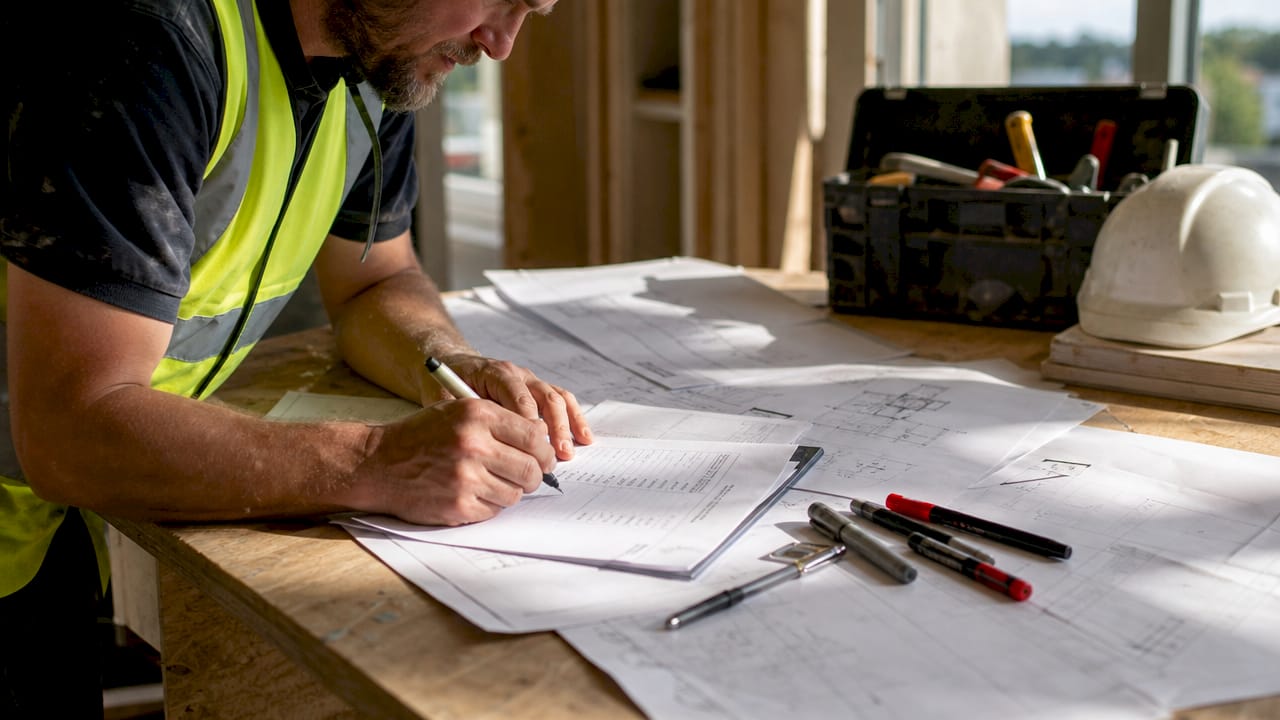
This legal weight is what separates a quote from a rough figure scribbled on a notepad. If a contractor gives you a verbal number or a vague written estimate, neither carries the same contractual force. For any project of meaningful scale, whether a kitchen renovation in Fulham or a rear extension in Chiswick, you need a written quote before work begins.
The practical consequence is straightforward. If costs rise due to the contractor’s miscalculation or poor planning, the fixed-price quote protects you. Any changes to scope must go through a formal variation order, agreed in writing by both parties, before additional costs are incurred.
What should a building quote include?
Best practice guidelines establish a clear minimum standard for what a professional building quote must contain. A quote missing several of these elements is incomplete and should not be accepted.
A thorough building quote covers:
Itemised scope of works: Every task listed individually, from groundworks to finishing, so there is no ambiguity about what is included.
Labour and materials breakdown: Separate costs for each, so you can see where your money goes and spot any unusual pricing.
Milestone-based payment schedule: Payments tied to specific stages of completion, not arbitrary dates or the contractor’s cash flow needs.
Start and completion dates: Firm dates, or at minimum a realistic programme of works with clear milestones.
VAT status: Whether the quoted price includes VAT or excludes it. This distinction can add 20% to your costs if overlooked.
Insurance and warranty details: Confirmation of public liability insurance and any workmanship guarantee offered.
Validity period: The window during which the quoted price is guaranteed, typically around 30 days.
Exclusions list: A clear statement of what the quote does not cover, such as skip hire, scaffolding, or specialist surveys.
The exclusions list deserves particular attention. Explicitly listing what is not included protects you from scope creep, where costs accumulate through items the contractor claims were never part of the original agreement. Read the exclusions as carefully as the inclusions.
Quote vs estimate: what is the difference?
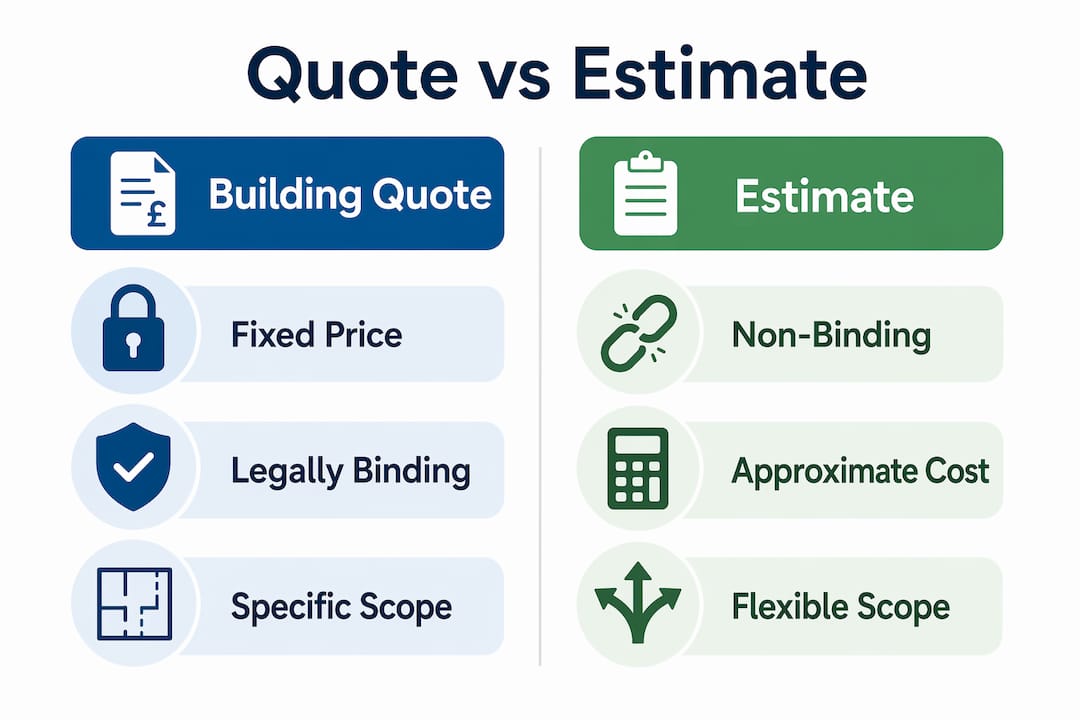
The terms “quote” and “estimate” are used interchangeably in everyday conversation, but they carry very different legal meanings. Confusing the two is one of the most common and costly mistakes homeowners make.
A quote is fixed and binding. Once accepted, the contractor cannot increase the price unless you formally agree to a change in scope. This is the document you want for any significant project.
An estimate is approximate and non-binding. It is a contractor’s best guess at likely costs, based on the information available at the time. The final bill can and often does differ.
Misleading terminology is common. Some contractors label documents as “quotes” when they are, in practice, estimates. Check whether the document states a fixed price for a defined scope, or whether it contains language like “approximately” or “subject to survey.”
Verbal estimates carry no legal weight. A figure mentioned in a phone call or site visit is not a quote. It is an informal indication that offers you no protection.
Written quotes prevent cost overruns. Homeowners who insist on a detailed written quotation before work starts are far less likely to face unexpected bills at the end of a project.
The building estimate definition, in formal terms, is a non-binding forecast. The construction quote, by contrast, is a firm offer. Always insist on the latter for any project where budget certainty matters to you.
How to get building quotes and compare them fairly
Getting multiple quotes is not just good practice. It is the only reliable way to understand the true market rate for your project. Obtaining 3 to 5 written quotes gives you enough data to benchmark pricing and identify bids that are suspiciously low.
Prepare an identical information pack
Every contractor you approach must receive exactly the same brief. This means the same drawings, specifications, materials list, and site access information. Providing identical information packs prevents underbidding tactics, where a contractor wins the job cheaply and then charges for “extras” that were always part of the scope. It also makes comparison far more straightforward.
Spot suspiciously low bids
Quotes 25–30% below the market average are a warning sign, not a bargain. They typically indicate missing scope items, lower-grade materials, or a contractor who plans to recover margin through variations once work has started. If one quote stands significantly apart from the others, ask the contractor to walk you through their pricing line by line.
Normalise your quotes before comparing
Never compare bottom-line figures alone. Normalising quotes means creating a side-by-side comparison that lists every scope item and its associated cost across all quotes. Items missing from one quote but present in another must be priced and added before you draw any conclusions.
Scope item | Quote A | Quote B | Quote C |
Structural works | £8,500 | £7,200 | £9,000 |
Scaffolding | £1,200 | Not included | £1,100 |
Waste removal | £600 | Not included | £550 |
Plastering and finishing | £3,400 | £3,100 | £3,600 |
Normalised total | £13,700 | £13,700 | £14,250 |
The table above illustrates how a lower headline figure can disappear once missing items are added. Quote B looked cheapest until scaffolding and waste removal were included. This is why professional builders for your renovation always present fully itemised documents.
Pro Tip: Ask each contractor to confirm in writing what their quote excludes. The exclusions list is often where the real cost differences between quotes are hiding.
Red flags to watch for when reviewing a building quote
A poorly constructed quote is not just inconvenient. It can expose you to significant financial risk. Knowing what to look for protects your budget and your project.
Vague or verbal quotes: Any contractor unwilling to provide a detailed written document is not someone you want managing your home. A verbal agreement offers you no legal protection whatsoever.
Excessive upfront deposits: Avoid deposits exceeding 10–15% of the total project cost. Demands for large cash payments upfront are a major warning sign of financial instability or bad faith.
No validity period: Quotes without a validity period leave you exposed to price increases driven by material cost volatility. A standard validity window of around 30 days is reasonable and expected.
Missing insurance details: Any contractor working on your property must carry public liability insurance. If this is absent from the quote, ask for written confirmation before proceeding.
Unclear variation process: The quote should state how changes to scope are handled. If there is no mention of a formal variation order process, you have no mechanism to control cost increases once work begins.
No exclusions list: A quote with no exclusions is not comprehensive. It is incomplete. Every professional quote should state clearly what falls outside the agreed scope.
For guidance on evaluating quality contractors in West London, the criteria above form a reliable checklist.
Pro Tip: Before signing any quote, ask the contractor to explain their variation order process. How they answer tells you as much about their professionalism as the document itself.
Key takeaways
A building quote is a fixed-price, legally binding document that protects you from unexpected costs, and accepting one without checking its components, validity period, and exclusions list is the single most avoidable mistake homeowners make.
Point | Details |
Legal binding status | A quote becomes a contract once accepted, fixing the price and scope for both parties. |
Essential components | Every quote must include itemised scope, payment milestones, VAT status, and an exclusions list. |
Quote vs estimate | An estimate is non-binding; always insist on a written fixed-price quote for cost certainty. |
Compare fairly | Normalise quotes by adding missing items before comparing totals, not just headline figures. |
Red flags | Avoid excessive deposits above 15%, missing validity periods, and vague or verbal agreements. |
What I have learned from years of building quotes
By Mateja
After years of working alongside homeowners on extensions, loft conversions, and full refurbishments across West London, one pattern stands out above all others. The homeowners who end up unhappy are almost never the ones who paid the most. They are the ones who accepted the cheapest quote without reading it properly.
The lowest price is almost always the lowest price for a reason. A contractor who wins work by undercutting the market has to recover that margin somewhere. It usually appears as a variation order halfway through your project, when you are already committed and have limited options.
My honest advice is to treat the exclusions list as the most important page in any quote. I have seen projects where the “cheap” quote excluded scaffolding, structural engineer fees, and building control costs. Once those were added, it was the most expensive option on the table.
The build contract process rewards homeowners who ask questions before they sign. Ask every contractor to walk you through their quote line by line. The ones who welcome that conversation are the ones worth hiring.
— Mateja
Planning a project? Tenenltd can help
Tenenltd has been delivering high-quality construction and refurbishment projects across West and Central London since 2006. From home extensions in London to full property refurbishments, every project begins with a detailed, transparent quote that covers scope, costs, payment milestones, and exclusions.
You will never receive a vague figure or a verbal promise from Tenenltd. The team provides written quotations that meet professional standards, so you can make confident decisions about your home. Whether you are planning a loft conversion in Kensington or a kitchen renovation in Hammersmith, contact Tenenltd for a consultation and a quote you can actually rely on.
FAQ
What is the difference between a building quote and an estimate?
A building quote is a fixed-price, legally binding offer that becomes a contract once accepted. An estimate is a non-binding, approximate forecast that can change before or during the project.
How many quotes should I get for a building project?
Getting 3 to 5 written quotes is the recommended approach. This gives you enough data to benchmark the market rate and identify any bids that are unusually low or missing key scope items.
What should I do if a quote has no validity period?
Ask the contractor to add one before you proceed. A quote without a validity period leaves you exposed to price increases, and a standard window of around 30 days is a reasonable expectation.
Is a verbal building quote legally binding?
A verbal quote carries no meaningful legal protection. Always insist on a written, itemised quotation before agreeing to any work or paying any deposit.
How much deposit is normal for a building project?
A deposit of 10–15% of the total project cost is standard. Any demand for a larger upfront payment, particularly in cash, is a red flag and should be treated with caution.
Recommended
Comments