
Bathroom fixture options: a homeowner's renovation guide
TL;DR:
Choosing bathroom fixtures requires confirming plumbing compatibility and considering budget constraints first. Core categories include taps, showers, toilets, sinks, bathtubs, and accessories, with finishes like chrome, brass, and black offering different styles. Prioritizing essential fixtures and matching finishes create a cohesive, functional, and cost-effective bathroom design.
Bathroom fixtures are the essential mechanical and decorative components that define both the look and the function of your bathroom. Choosing the right bathroom fixture options means balancing plumbing compatibility, material quality, and visual style before a single tile goes down. The National Kitchen and Bath Association (NKBA) recommends confirming rough-in measurements and clearances before specifying any fitting, because plumbing constraints often limit your choices more than aesthetics do. Entry-level fixtures start at around £75, while luxury or specialist fittings can reach several thousand pounds, so knowing your budget early shapes every decision that follows.
1. What are the main bathroom fixture options available?
Bathroom fixtures fall into six core categories: taps, showers, toilets, sinks, bathtubs, and accessories. Each category contains several popular styles, and choosing bathroom fixtures well means understanding what sits within each group before committing to a design direction.
Core fixture categories at a glance:
Taps: Single-hole, centerset, widespread, wall-mounted, and vessel-fill styles
Showers: Concealed thermostatic systems, exposed bar valves, rain heads, handheld units
Toilets: Close-coupled, back-to-wall, wall-hung, rimless, and smart toilets
Sinks: Undermount, wall-mounted, pedestal, countertop, and vessel basins
Bathtubs: Freestanding, built-in, drop-in, and corner baths
Accessories: Towel rails, toilet roll holders, mirrors, and lighting
Common finishes and materials:
Finish | Character | Best suited to |
Polished chrome | Bright, reflective | Classic and contemporary schemes |
Brushed brass | Warm, muted gold | Period and transitional interiors |
Matte black | Bold, graphic | Modern and industrial bathrooms |
Polished nickel | Soft silver sheen | Luxury and traditional settings |
Brushed stainless | Understated, durable | Minimalist and family bathrooms |
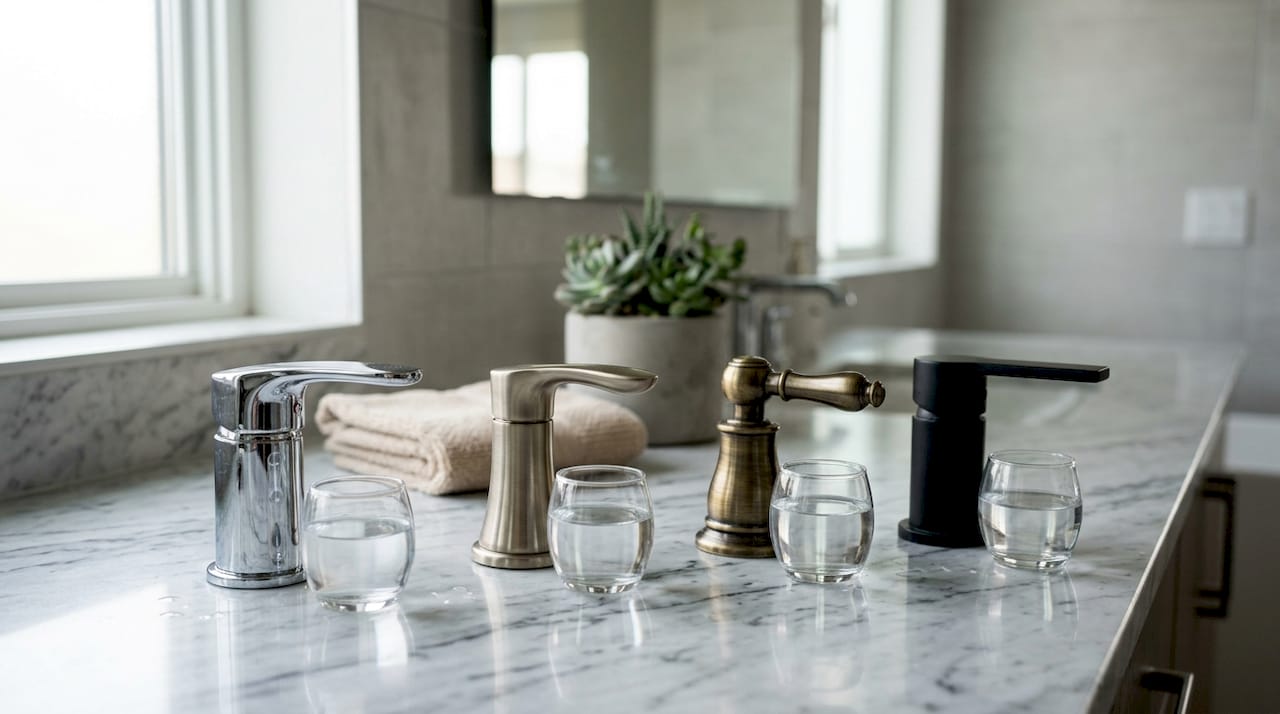
Brass and nickel finishes are considered investment-grade fittings by professional designers, offering enduring elegance that outlasts trend cycles. Chrome remains the most widely specified finish because it suits almost every style and is straightforward to clean.
2. How to choose bathroom faucets that match your sink and style
Tap selection depends directly on your sink’s hole configuration. Centerset taps fit three holes with 4-inch spacing, while widespread taps suit larger basins with hole spacing from 6 to 16 inches. Getting this wrong means returning the fitting before installation has even started.
The five main bathroom faucet types:
Single-hole: One tap body covers one hole; ideal for compact basins and vessel sinks
Centerset: Tap and handles on a shared base plate; suits standard vanity units
Widespread: Separate hot and cold handles; suits larger basins and traditional schemes
Wall-mounted: Fitted to the wall above the basin; maximises counter space
Vessel-fill: Tall, upright spout designed for above-counter bowl sinks
Wall-mounted taps and lever handles improve countertop cleaning and maximise vanity space, which is a genuine advantage in smaller London bathrooms. Lever handles are also easier to operate for all ages, making them a practical default for family homes.
Finish choice should complement your sink material and the wider room palette. Polished chrome suits white ceramic basins in contemporary schemes. Brushed brass works well with stone or concrete surfaces in warmer, more textured interiors.
Pro Tip: Confirm the tap’s rough-in measurements and your water pressure rating before ordering. A high-flow tap on a low-pressure system will underperform regardless of how good it looks.
3. Popular shower fixture options and installation considerations
Shower fixtures split into two fundamental types: concealed and exposed systems. Confirming wall depth before ordering is the single most important step, because concealed thermostatic valves require a minimum wall cavity that many older London properties cannot accommodate without additional building work.
Shower fixture types and their key traits:
Concealed thermostatic system: Valve hidden behind the wall; clean, minimal appearance; requires 100mm+ wall depth
Exposed bar valve: Valve sits on the wall surface; easier to retrofit; suits period and industrial schemes
Rain showerhead: Large overhead head for an immersive experience; needs adequate water pressure
Handheld showerhead: Flexible hose attachment; practical for families, elderly users, and cleaning
Body jets: Side-wall jets for a spa-like experience; requires high flow rate and a larger hot water supply
Flow rate and water pressure matter as much as aesthetics. A rain head typically requires a minimum dynamic pressure of 1 bar to perform well. If your property runs on low pressure, a pump may be needed, and that adds both cost and installation complexity.
Maintenance is worth factoring in at the selection stage. Showerheads with silicone nozzles are far easier to descale than fixed metal ones, which is a practical consideration in hard-water areas like West and Central London.
4. Choosing toilets and sinks for practicality and style
Modern renovations favour rimless and back-to-wall toilets for easier cleaning. The logic is straightforward: rimless pans eliminate the hidden ledge where bacteria accumulate, and back-to-wall designs conceal the cistern inside a fitted unit, removing another hard-to-clean surface.
Toilet types compared:
Back-to-wall: Cistern hidden in furniture; clean lines; suits contemporary and traditional schemes
Wall-hung: Pan fixed to the wall with no floor contact; easiest to clean beneath; requires a structural frame inside the wall
Rimless: Open-flush pan with no inner rim; hygienic; available in floor-standing and wall-hung versions
Smart toilet: Integrated bidet, heated seat, and auto-flush; premium price point; suits luxury refurbishments
Sink installation options:
Type | Space needed | Best for |
Undermount | Standard vanity unit | Clean countertop lines; easy wiping |
Wall-mounted | Minimal floor space | Small bathrooms; accessible design |
Pedestal | Floor space for base | Traditional schemes; hides pipework |
Vessel (countertop bowl) | Solid surface below | Statement bathrooms; pairs with tall taps |
Planning installation clearances is non-negotiable. Building Regulations in England require a minimum 600mm clear space in front of a toilet pan. Wall-hung toilets need a concealed cistern frame rated for the wall construction, which affects both cost and programme on site.
5. How to coordinate fixtures with accessories and budget
Fixtures do not all need to match exactly, but they must feel cohesive. Plumbing specifications often limit fixture options more than style preferences do, so confirm compatibility first and then work outward to finishes and accessories.
Pro Tip: Select your anchor fixtures first: the main tap, shower system, and toilet. Lock in their finishes before purchasing towel rails, toilet roll holders, or mirror frames. This prevents the common mistake of buying accessories in a slightly different metal tone that clashes under bathroom lighting.
Prioritising spending on essential fixtures over decorative accessories reduces budget overruns and improves long-term satisfaction. A quality thermostatic shower valve will outlast three sets of decorative accessories and adds more daily value than a premium towel ring.
Where to allocate your fixture budget:
Spend more on: Shower valve, main basin tap, toilet pan and cistern
Spend less on: Towel rails, toilet roll holders, soap dispensers
Mid-range is fine for: Mirrors, shaving points, heated towel rails
A useful reference for bathroom refurbishment costs in London shows that fixture selection typically accounts for 30–40% of a total bathroom renovation budget. Knowing this proportion helps you allocate funds before you fall in love with a fitting that breaks the budget entirely.
Grouping finishes across the room creates visual harmony without requiring identical products. Brushed brass taps, a brass-framed mirror, and brass towel hooks read as a considered scheme. Mixing polished chrome taps with matte black accessories, by contrast, creates visual noise that no amount of good tiling can resolve.
Key takeaways
Selecting bathroom fixtures in the right sequence, starting with plumbing compatibility and anchor pieces, produces the most cohesive and cost-effective results.
Point | Details |
Confirm plumbing specs first | Rough-in measurements and water pressure limit your fixture options more than style does. |
Select anchor fixtures early | Choose your tap, shower valve, and toilet before buying any accessories or hardware. |
Match finishes, not products | Fixtures need visual cohesion, not identical branding; group tones across the room. |
Budget by category | Spend more on daily-use essentials and less on decorative accessories to avoid overruns. |
Check installation clearances | Building Regulations require minimum clearances; confirm these before ordering fittings. |
What I’ve learnt from years of bathroom renovations
The most common mistake I see homeowners make is falling in love with a fixture online and ordering it before confirming the plumbing layout. A wall-hung toilet looks extraordinary in a showroom. On site, it requires a structural frame inside the wall, a minimum wall depth of around 150mm, and a floor that can take the fixing loads. None of that is visible in a product photograph.
The second mistake is treating finishes as interchangeable. Polished brass and brushed brass are not the same finish under bathroom lighting. Satin nickel and brushed chrome look almost identical in a catalogue and completely different once installed. My advice: always view finish samples together in the actual room, under the lighting you plan to use.
I also think the industry undersells the value of renovation material quality in fixtures specifically. A £150 thermostatic valve from a reputable manufacturer will outlast a £60 alternative by a decade or more. The internal cartridge is the part that fails, and quality cartridges are the difference between a ten-minute fix and a full valve replacement.
The fixtures that age best are the ones chosen for function first. Polished nickel and unlacquered brass develop a patina that many homeowners come to love. Matte black, by contrast, shows water spots and fingerprints constantly in hard-water areas. That is not a reason to avoid it, but it is a reason to go in with clear expectations.
— Mateja
Planning your bathroom refurbishment with Tenenltd
A well-specified bathroom starts long before any fitting is purchased. Tenenltd has been delivering bathroom refurbishments across London since 2006, working with homeowners in Fulham, Chelsea, Kensington, Chiswick, Hammersmith, and Notting Hill to select fixtures that suit both the space and the plumbing layout.
The Tenenltd team handles fixture compatibility checks, rough-in verification, and full installation as part of every bathroom project. Whether you are specifying a single new basin or a complete wet room, the team brings the technical knowledge to make your fixture choices work in practice, not just on paper. Get in touch to discuss your renovation and receive expert guidance on the fittings that will perform best in your home.
FAQ
What are the main types of bathroom fixture options?
The six core categories are taps, showers, toilets, sinks, bathtubs, and accessories. Each category contains multiple styles suited to different plumbing configurations and design schemes.
How do I choose the right bathroom faucet type?
Faucet choice depends on your sink’s hole configuration. Centerset taps fit 4-inch three-hole sinks, while widespread taps suit basins with 6–16 inch hole spacing.
Are rimless toilets worth the extra cost?
Rimless toilets eliminate the hidden inner ledge where bacteria accumulate, making them significantly easier to clean. Modern renovations increasingly specify them as a standard choice rather than a premium upgrade.
Do all bathroom fixtures need to match?
Fixtures do not need to be identical, but finishes must feel cohesive across the room. Plumbing compatibility is the primary constraint; visual harmony comes from grouping similar tones rather than buying from a single range.
What should I spend most of my fixture budget on?
Prioritise the shower valve, main basin tap, and toilet pan. These are used daily and their quality directly affects long-term satisfaction. Decorative accessories such as towel rails and toilet roll holders can be sourced at mid-range prices without compromising the overall result.
Recommended
Comments