
Kitchen worktop comparison for UK homeowners
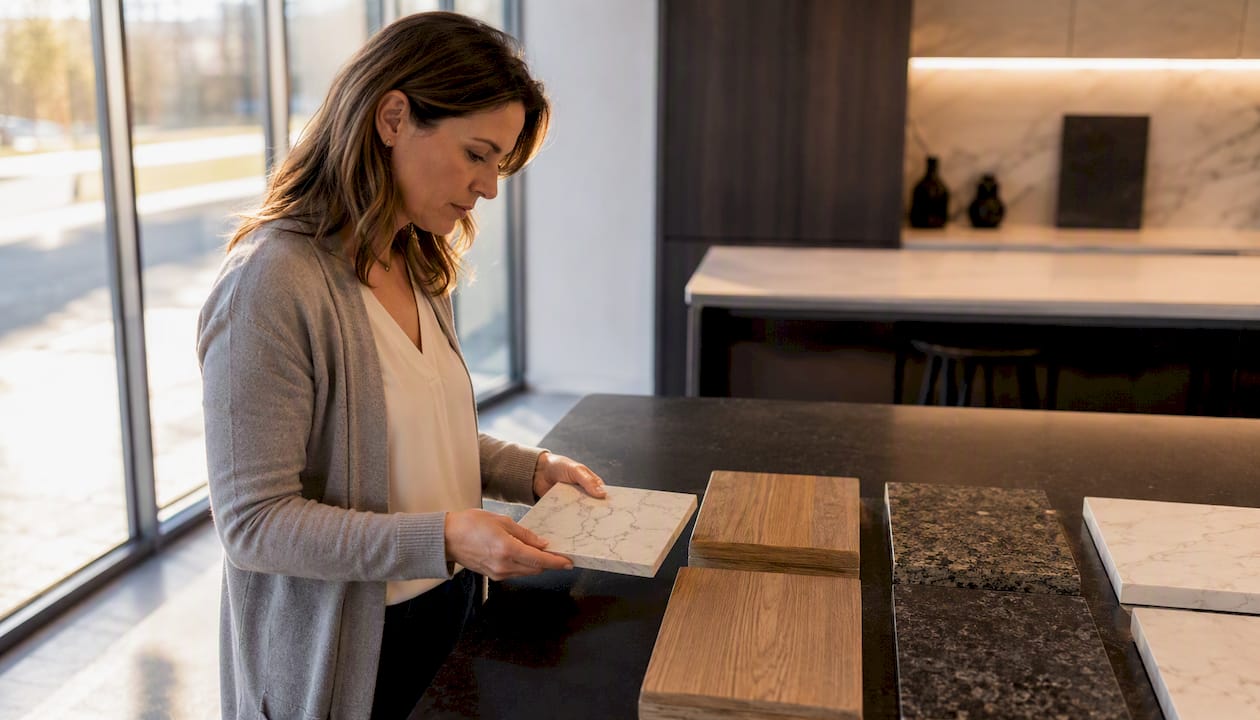
Porcelain or sintered stone is the best all-round choice for durability and heat resistance; engineered quartz wins for low-maintenance everyday use; granite and quartzite deliver natural stone character with long-term resilience; solid timber brings warmth and repairability; and compact laminate is the sharpest option when budget is the primary concern. The right material depends on how you actually use your kitchen, not on which surface looks best in a showroom.
Porcelain/sintered stone: non-porous, UV-stable, and resistant to heat, scratches and staining — the strongest technical performer and the top pick for busy families or outdoor kitchens. Lifespan measured in decades with virtually no maintenance.
Engineered quartz: consistent appearance, non-porous and stain-resistant, though not fully heat-proof — always use a trivet. The go-to for homeowners who want a premium look without the upkeep of natural stone.
Compact laminate/HPL: convincingly replicates stone and timber at a fraction of the price, hard-wearing and easy to clean. The most practical choice when budget is tight or for secondary surfaces.
Pro Tip: Consider mixing materials rather than committing one surface to the whole kitchen. A solid timber island paired with a porcelain or quartz prep surface gives you warmth and character where it matters aesthetically, and a genuinely durable working surface where you need it most.
Table of Contents
Which worktop material is right for your kitchen?
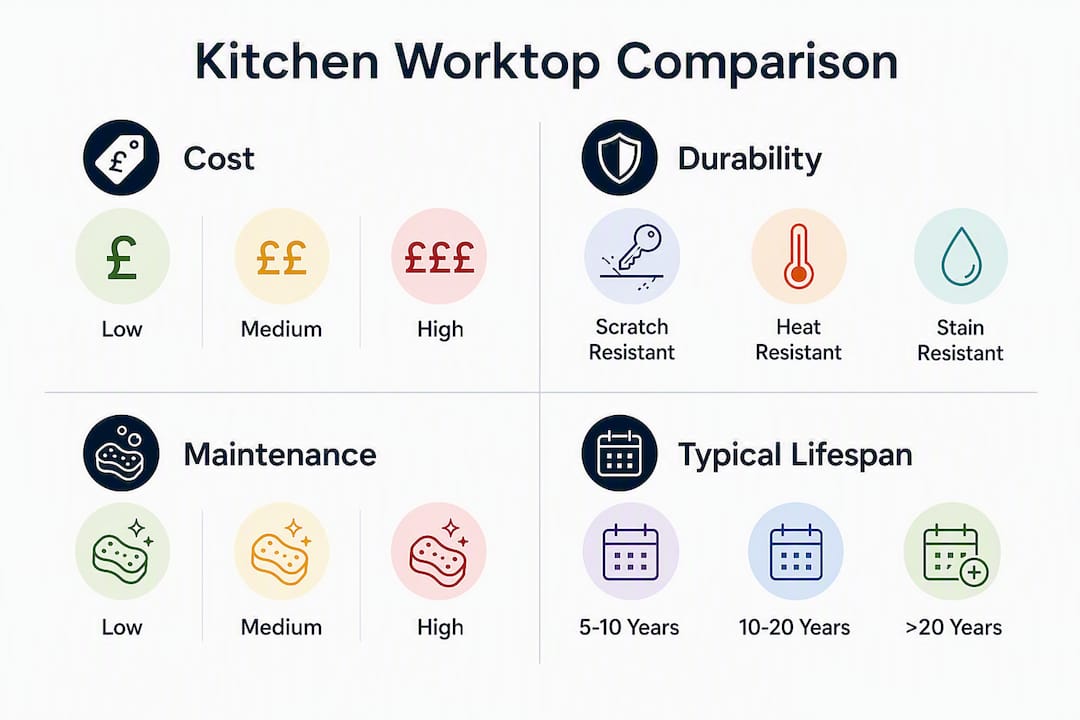
No single surface wins every category, so a side-by-side kitchen worktop comparison is the most useful place to start. The table below maps the key decision dimensions across the main materials available to UK homeowners.

Material | Typical UK cost (per m²) | Scratch resistance | Heat resistance | Stain resistance | Maintenance | Typical lifespan | Best lifestyle fit | Installation complexity |
Porcelain/sintered | Premium price | Excellent | Excellent | Excellent | Very low | Long lifespan | Busy family, outdoor kitchen | High (specialist required) |
Engineered quartz | Premium price | Very good | Moderate (use trivet) | Excellent | Very low | Long lifespan | Keen cook, family kitchen | Moderate–high |
Granite | Premium price | Very good | Excellent | Good (seal annually) | Low–moderate | Long lifespan | Natural stone lover, avid cook | High |
Marble | Premium price | Moderate | Good | Poor (porous, etches) | High | Long lifespan (with care) | Luxury aesthetic, occasional user | High |
Quartzite | Premium price | Very good | Excellent | Good (seal regularly) | Moderate | Long lifespan | Natural stone with better durability than marble | High |
Solid surface (acrylic) | Premium price | Moderate | Poor | Good | Low | Moderate lifespan | Family kitchen, integrated sink | Moderate |
Solid timber | Mid price | Moderate | Poor | Moderate (oil regularly) | Moderate–high | Moderate lifespan (with care) | Traditional kitchen, island feature | Moderate |
Compact laminate/HPL | Budget price | Good | Moderate | Good | Very low | Moderate lifespan | Budget-conscious, secondary surfaces | Low–moderate |
Stainless steel | Premium price | Moderate (scratches patina) | Excellent | Excellent | Low | Long lifespan | Professional cook, contemporary kitchen | Moderate–high |
Recycled/composite | Mid price | Moderate | Moderate | Good | Low | Moderate lifespan | Eco-conscious homeowner | Moderate |
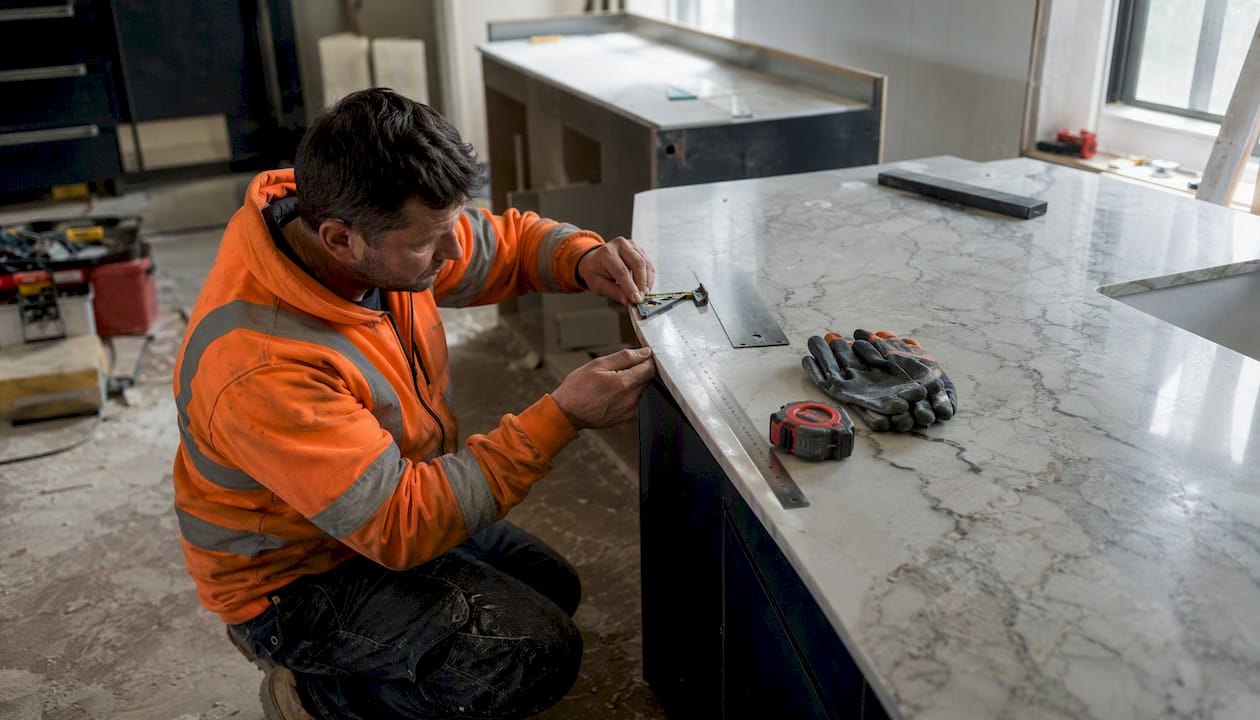
Cost ranges are indicative and reflect standard UK fabrication. Island wraps, mitred waterfall edges, integrated sinks and upstands all add to the final figure.
Porcelain and sintered stone
Porcelain and sintered surfaces are the top-ranked materials for overall durability. They are non-porous, UV-stable, and genuinely resistant to heat, scratches and staining — you can place a hot pan directly on the surface without damage. Large-format slabs (up to 160 x 320cm) mean seams can often be eliminated entirely in a standard kitchen run.
Pros: hardest-wearing surface available; no sealing required; suitable for outdoor kitchens; wide range of finishes including ultra-realistic stone looks.
Cons: brittle at edges if poorly fabricated; requires specialist cutting and installation; chipping is difficult to repair invisibly.
Best for: busy families, avid cooks, anyone who wants a genuinely low-effort surface.
UK cost: £150–£350 per m², rising with slab size and edge complexity.
Finishes: matte, polished, brushed, textured; matte tends to show fewer everyday marks than polished.
Engineered quartz
Engineered quartz combines crushed natural quartz with resin binders to produce a non-porous, consistent surface. It is widely specified in premium kitchens for its stain resistance and the predictability of its patterning — unlike natural stone, every slab looks the same. The resin content means it can discolour under prolonged UV exposure, so it is not ideal for outdoor use, and hot pans should always go on a trivet.
Pros: non-porous; no sealing; consistent colour and veining; very stain-resistant.
Cons: not heat-proof; can discolour in direct sunlight; resin content means it is not fully “natural.”
Best for: family kitchens, homeowners who want a premium look with minimal upkeep.
UK cost: £200–£500 per m².
Finishes: polished, honed, leathered; available in a vast colour range including convincing marble and concrete looks.
Granite
Granite is a natural igneous stone with genuine heat resistance and a hardness that resists scratching. Each slab is unique, which appeals to homeowners who want character. It does need sealing on installation and typically once a year thereafter to prevent staining, but day-to-day it is one of the more forgiving natural stones.
Pros: heat-resistant; very hard; unique natural patterning; long lifespan.
Cons: requires annual sealing; heavy (structural implications for cabinetry); limited slab sizes compared to porcelain.
Best for: avid cooks who use the hob heavily; homeowners who want natural stone without marble’s fragility.
UK cost: £150–£400 per m².
Marble
Marble is the prestige choice, and it comes with real trade-offs. It is calcium carbonate, which means acids — lemon juice, wine, vinegar — etch the surface chemically rather than just staining it. Polished marble etches visibly; honed marble hides etches better but still requires careful management. For a household that cooks frequently and is not prepared to treat the surface with care, marble is a poor fit.
Pros: exceptional aesthetic; cool surface ideal for pastry work; increases perceived property value.
Cons: porous; etches easily; requires frequent sealing and careful daily use.
Best for: occasional-use kitchens, bakers who want a cool surface, homeowners prioritising luxury aesthetics.
UK cost: £200–£600 per m².
Quartzite
Quartzite is a metamorphic natural stone that is harder than marble and more heat-resistant, making it a better practical choice for those who love the veined stone aesthetic. It still needs sealing but holds up better to daily use than marble. Quartzite is sometimes confused with quartz (engineered) in showrooms — always confirm which you are buying.
Pros: harder than marble; natural veining; heat-resistant.
Cons: still requires sealing; can be expensive; availability varies.
UK cost: £200–£500 per m².
Solid surface (acrylic)
Solid surface worktops — brands such as Corian are the best-known example — are made from acrylic or polyester resins with mineral fillers. They are non-porous, repairable (scratches can be sanded out), and allow for seamless integrated sinks. Heat resistance is the main weakness: hot pans will mark the surface.
Pros: seamless joins and integrated sinks possible; repairable; non-porous; wide colour range.
Cons: not heat-resistant; can scratch more easily than stone; less premium feel.
Best for: family kitchens where an integrated sink is a priority; accessible kitchens where a seamless surface matters.
UK cost: £150–£350 per m².
Solid timber and butcher block
Solid timber brings warmth and character that no engineered material fully replicates, and it is the only worktop you can sand back and refinish if it gets damaged. The trade-off is ongoing maintenance: regular oiling (typically every three to six months), prompt drying of standing water, and avoiding prolonged exposure to moisture near sinks. Oak, walnut and iroko are the most common UK choices.
Pros: warm aesthetic; repairable by sanding and re-oiling; relatively affordable; good for island features.
Cons: vulnerable to water damage near sinks; requires regular oiling; not heat-proof; can harbour bacteria if not maintained.
Best for: traditional or Shaker-style kitchens; island features paired with a more durable prep surface.
UK cost: £100–£300 per m².
Compact laminate and HPL
Compact laminate (high-pressure laminate) has moved well beyond the thin, chipboard-core laminates of the 1990s. Modern HPL is solid through its thickness, hard-wearing, and available in finishes that convincingly replicate stone, timber and concrete. It performs well for secondary surfaces, utility areas, and budget-led full kitchens.
Pros: affordable; hard-wearing; wide finish range; easy to clean; no sealing required.
Cons: joins and edges are visible up close; cannot be repaired if chipped; less premium feel than stone.
Best for: budget-conscious renovations; secondary surfaces; rental properties.
UK cost: £40–£120 per m².
Stainless steel
Stainless steel is the professional kitchen standard for good reason: it is hygienic, heat-resistant, and virtually indestructible. In a domestic setting it reads as contemporary and industrial. The surface will scratch and develop a patina over time, which some homeowners find appealing and others do not. Fingerprints and water marks show readily on a polished finish; a brushed finish is more forgiving.
Pros: hygienic; heat-resistant; extremely durable; easy to clean.
Cons: scratches and shows fingerprints; noisy; cold aesthetic not suited to all kitchens; can dent.
Best for: professional-style kitchens; keen cooks; contemporary designs.
UK cost: £200–£500 per m².
Recycled and composite materials
Recycled worktops — made from materials such as recycled glass, paper composite, or reclaimed timber — are a growing category for eco-conscious homeowners. Performance varies significantly by product, so always ask for specific durability data from the supplier. They tend to sit in the mid-price range and suit homeowners for whom sustainability credentials are a genuine priority.
Pros: environmental credentials; unique appearance; mid-range pricing.
Cons: performance varies by product; limited availability from UK suppliers; fewer finish options.
UK cost: £100–£250 per m².
A note on fabrication costs: the per-m² figure is only part of the story. Island wraps, mitred waterfall edges, integrated sink cutouts and upstands each add to the total. A complex island in porcelain with a mitred waterfall edge can add £500–£1,500 to the fabrication bill alone. Always ask for an itemised quote.
How do you choose the right worktop for your home?
The single most important criterion is how intensively you use your kitchen. Lifestyle, cooking habits and cleaning routines determine the best material far more reliably than prestige or showroom appeal. A marble worktop in a household with young children and a busy cooking schedule is a recipe for frustration; the same surface in an occasional-use kitchen is a genuinely beautiful choice.
Work through this checklist before you speak to a supplier or fitter.
Buyer checklist
Lifestyle filter: How often do you cook? Do you have children or pets? Do you place hot pans directly on the worktop? Do you use acidic ingredients (lemon, vinegar, wine) regularly? Honest answers here will eliminate several materials immediately.
Aesthetic filter: Is your kitchen contemporary, traditional, or transitional? Do you want a consistent, uniform look (quartz) or natural variation (granite, quartzite, marble)? Does the worktop need to match or contrast with your cabinetry colour?
Budget filter: Set a realistic total budget including fabrication, installation, upstands and any sink cutouts — not just the per-m² material cost. For a typical mid-size London kitchen (roughly 8–12 m² of worktop), budget £1,500–£4,000 for a quality laminate or compact laminate installation, £3,000–£8,000 for engineered quartz, and £4,000–£12,000+ for premium natural stone or porcelain with complex edges.
Environmental priorities: If sustainability matters, ask suppliers about recycled content, country of origin, and whether the material can be recycled at end of life. Timber from FSC-certified sources and recycled composite worktops are the strongest options here.
Timeline: Stone and sintered slabs require templating (measuring on-site after cabinets are fitted), then fabrication, then installation. Allow three to five weeks from cabinet installation to worktop fitting for most stone and quartz options. Compact laminate can often be turned around in one to two weeks.
Questions to ask your supplier or fitter
What does the warranty cover, and for how long? Does it cover fabrication defects, colour change, or damage?
What are the fabrication tolerances for seams and mitres?
What is the lead time from templating to installation?
How will seams be placed, and can you see the slab before fabrication?
Which sink types are compatible, and how will the cutout be sealed?
Does the surface require resealing, and if so, how often and with what product?
Will you remove and dispose of the old worktop?
Red flags in quotes and fitter behaviour
No site survey before quoting (accurate measurement is non-negotiable for stone).
No written warranty or vague verbal assurances only.
Unusually short lead times for stone or sintered slabs (less than two weeks is a warning sign).
No mention of templating as a separate step.
Pressure to choose from a limited slab selection without seeing the actual slab.
For a broader view of how worktop selection fits into the full renovation sequence, the kitchen renovation workflow guide at Tenenltd covers the coordination steps in detail.
What maintenance does each worktop material need?
Porcelain, sintered stone and engineered quartz are the lowest-maintenance options: wipe clean with a damp cloth, no sealing required, no special products needed. Natural stones — granite, quartzite, marble — need periodic sealing and more careful daily management. Timber needs the most consistent attention of all.
Material | Lifespan (years) | Resealing frequency | Primary failure modes |
Porcelain/sintered | 20+ | None required | Edge chipping, cracking under impact |
Engineered quartz | — | None required | UV discolouration (outdoor), resin burn marks |
Granite | 20–30 | Annually | Staining if unsealed, chipping |
Marble | 20+ (with care) | Every 12 months | Etching, staining, scratching |
Quartzite | 20–30 | Every 12 months | Staining if unsealed |
Solid surface | — | None required | Scratching, heat marks, dullness |
Solid timber | — | Oil every three to six months | Warping, water damage, staining |
Compact laminate | — | None required | Edge chipping, surface delamination |
Stainless steel | 20–30 | None required | Scratching, denting |
Recycled/composite | — | Varies by product | Varies by product |
Material-specific maintenance notes
Porcelain and quartz: daily cleaning with warm water and a mild detergent is all that is needed. Avoid abrasive pads, which can dull a polished finish over time. For quartz, keep it away from prolonged direct sunlight.
Granite and quartzite: seal on installation using a penetrating stone sealer, then reseal annually. Test whether sealing is due by dropping water on the surface — if it soaks in rather than beading, it is time to reseal. Clean with a pH-neutral stone cleaner rather than standard kitchen sprays, which can degrade the sealant.
Marble: the same sealing routine as granite, but more frequent — every six months for a polished finish. Wipe acidic spills immediately; do not leave lemon juice or wine to sit. Etching (a dull mark left by acid) can be polished out by a stone specialist, but prevention is far easier than cure.
Solid timber: oil every three to six months with a food-safe oil such as Danish oil or a dedicated worktop oil. Dry the surface promptly after contact with water, particularly around the sink. Minor scratches and stains can be sanded back with fine-grit sandpaper and re-oiled. Never use bleach or harsh chemical cleaners.
Solid surface: scratches can be buffed out with a fine abrasive pad. Avoid placing hot pans directly on the surface. Clean with a non-abrasive household cleaner.
Do and don’t: heat, stains and cutting
Do use a trivet or heat mat under hot pans on quartz, solid surface, laminate and timber.
Do wipe spills on marble and granite immediately, especially anything acidic.
Don’t cut directly on stone or quartz — it will blunt your knives and risk chipping the surface at the cutting point.
Don’t use bleach-based cleaners on natural stone; they degrade the sealant.
Don’t leave standing water on timber, particularly near sink cutouts.
Do use a chopping board on every surface — it protects both the worktop and your knives.
How do finishes, thickness and edge profiles affect your worktop?
The specification choices you make beyond the material itself — thickness, edge profile, seam placement and sink type — have a real impact on the final look, cost and durability of your worktop.
Thickness
Standard quartz and granite worktops are typically 20mm or 30mm thick. Porcelain and sintered slabs are available in slimmer profiles — 12mm is common — which gives a lighter, more contemporary look and reduces weight on cabinetry. A 12mm porcelain slab weighs considerably less than a 30mm granite equivalent, which matters both for structural loading and for access in tight spaces. Laminated or mitre-jointed edges can make a 12mm slab appear thicker at the front edge, giving the visual weight of stone without the structural load.
Timber worktops are typically 40mm thick, which gives them a substantial, furniture-like presence. Compact laminate is usually 12–20mm.
Edge profiles
Square/eased edge: the most contemporary look; sharp corners softened slightly. Lower fabrication cost.
Bullnose: fully rounded edge; traditional feel; safer in households with young children.
Ogee: decorative, traditional profile; suits Shaker and classic kitchens.
Mitred waterfall: the slab wraps vertically down the side of an island, creating a continuous stone face. Striking effect, but significantly more expensive to fabricate and requires precise templating.
Each step up in edge complexity adds to fabrication time and cost. A mitred waterfall island edge in porcelain or quartz is one of the most labour-intensive finishes available and should be budgeted accordingly.
Seams and slab sizes
Porcelain slabs up to 160 x 320cm mean that many standard kitchen runs can be completed without a visible seam. Granite and quartz slabs are typically smaller — around 140 x 300cm — so longer runs or L-shaped kitchens will usually have at least one seam. A skilled fabricator will place seams at natural break points (near a sink or hob cutout) to minimise visibility. Always ask to see the slab layout plan before fabrication begins.
Sinks: undermount, top-mount and integrated
Undermount sinks suit stone, quartz and porcelain well — the sink sits below the worktop surface, creating a clean line and making it easy to sweep debris directly into the basin. The cutout edge must be sealed carefully to prevent water ingress.
Top-mount (inset) sinks work with any material and are easier to install, but the rim sits on the worktop surface and can trap dirt.
Integrated sinks in solid surface (acrylic) are moulded as one continuous piece with no join — the most hygienic option and ideal for accessible kitchens.
Timber worktops near sinks need particular attention: the cutout edge should be sealed with a waterproof sealant and re-checked annually.
Splashbacks and upstands
Matching the worktop material to the splashback creates a cohesive, high-end look — particularly effective with large-format porcelain. An upstand (a short strip of worktop material running up the wall) is a more affordable alternative to a full-height splashback and is easier to install. For a contemporary finish that pairs well with different worktop colours, the best kitchen respray colours for 2026 from Refinishing Studio offers useful guidance on cabinet finishes that complement stone and quartz tones.
When should you hire a professional fitter?
Heavy stone slabs, sintered surfaces, undermount sinks, and large mitred waterfall islands must always be handled by a specialist. These are not jobs for a general handyman or a confident DIYer. Stone and sintered slabs require experienced fitters, careful planning for access, and may increase installation time and cost significantly — particularly in period London properties where stairwells are narrow and slab access is genuinely challenging.
Compact laminate and some solid surface products can be installed by a competent joiner, but even here, a specialist fabricator will produce cleaner joints and a better finish.
What a professional installation should include
A site survey and accurate template (taken after cabinets are fully fitted and levelled).
Written confirmation of the installation date and the fabrication lead time.
Removal and disposal of the old worktop.
Protection of cabinetry, flooring and appliances during installation.
Sealing of all cutouts (sink, hob) on the day of installation.
A written warranty covering fabrication defects and installation workmanship.
A snagging walkthrough with you before the fitter leaves.
Pro Tip: On installation day, check every seam, cutout edge and corner before the fitter packs up. Run your hand along each seam to feel for any unevenness, and check that all cutout edges are sealed. Photograph any snags immediately and send them to the contractor in writing the same day — this creates a clear record and makes resolution straightforward.
A common installation pitfall
One scenario that comes up regularly on London projects: a homeowner orders a large granite or porcelain slab for a first-floor kitchen in a Victorian terrace, and the slab cannot be manoeuvred up the stairwell in one piece. A professional fitter will identify this risk at the site survey stage, plan for a two-piece installation with a carefully placed seam, and adjust the fabrication accordingly. A fitter who has not visited the property before delivery day will not have that plan in place — and the consequences (a damaged slab, a delayed installation, or a poorly placed emergency seam) are expensive and avoidable.
For guidance on coordinating worktop installation within a full kitchen renovation, the types of kitchen countertops guide at Tenenltd covers material definitions and current design trends in detail.
Which material is best for your situation?
Use-case | Best material | One-line rationale | Key trade-off |
Busy family kitchen | Porcelain/sintered | Non-porous, heat-proof, wipe-clean — nothing phases it | Edge chipping if poorly fabricated; specialist installation required |
Avid cook / heavy hob use | Granite or porcelain | Genuine heat resistance; granite adds natural character | Granite needs annual sealing |
Small budget | Compact laminate (HPL) | Hard-wearing, easy to clean, wide finish range at low cost | Visible joins; cannot be repaired if chipped |
Luxury aesthetic | Marble or quartzite | Unmatched natural veining and prestige feel | Marble etches and stains; both need regular sealing |
Baker / pastry work | Marble | Naturally cool surface ideal for working with dough | High maintenance; acid-sensitive |
Outdoor kitchen | Porcelain/sintered | UV-stable and fully weatherproof | Requires specialist cutting and installation |
Eco-conscious homeowner | Recycled composite or FSC timber | Genuine sustainability credentials | Performance varies; limited UK supplier choice |
Contemporary / industrial look | Stainless steel | Hygienic, heat-resistant, professional aesthetic | Scratches and shows fingerprints; noisy |
Marble deserves a specific caution: it looks exceptional in photographs and in showrooms, but it is the highest-maintenance material on this list. If you are drawn to it, spend time with a real sample in your kitchen before committing — and be honest about whether your household will treat it with the care it needs.
Key takeaways
Porcelain or sintered stone is the strongest all-round performer for UK homeowners, combining genuine heat and scratch resistance with zero maintenance, while compact laminate remains the sharpest budget choice and engineered quartz sits between the two for low-effort premium results.
Point | Details |
Match material to lifestyle | Cooking frequency, children, pets and cleaning habits matter more than aesthetics alone when choosing a worktop. |
Budget beyond the per-m² price | Fabrication, edge profiles, sink cutouts and installation add significantly to the total; always request an itemised quote. |
Allow three to five weeks for stone | Templating, fabrication and installation of stone or quartz takes three to five weeks from cabinet completion; plan your renovation timeline accordingly. |
Seal natural stone on day one | Granite, quartzite and marble need a penetrating sealant applied on installation and resealed annually (marble every six months). |
Tenenltd manages the full process | Tenenltd handles site surveys, templating coordination, fabrication management and installation for kitchen renovations across West and Central London. |
A renovation expert’s perspective
The most common misstep I see homeowners make is choosing a worktop based on a small sample tile under showroom lighting, then being surprised when the full slab looks different in their kitchen. Natural stone in particular varies enormously from slab to slab — the sample is a guide, not a guarantee. Always ask to see the actual slab that will be cut for your kitchen before fabrication begins. If a supplier will not show you the slab, that tells you something.
The second misstep is underestimating the installation. A worktop is only as good as its fit. Poorly levelled cabinets, an inaccurate template, or a fitter who does not seal cutouts properly will undermine even the best material. At Tenenltd, worktop installation is coordinated as part of the full kitchen renovation — cabinets are checked for level before templating, access routes are assessed at the site survey stage, and the installation is signed off with a snagging walkthrough. That coordination is what separates a kitchen that looks right from one that performs right for the next twenty years.
Pro Tip: Order a full-size sample or off-cut of your chosen slab and live with it in your kitchen for a week before committing. Prop it against the cabinets, see it in morning light and evening light, and check it against your flooring and wall colours. It is a small step that prevents a very expensive regret.
Kitchen renovation in West and Central London? Tenenltd can help
Choosing the right worktop material is only one part of a successful kitchen renovation. Getting the installation right — accurate templating, coordinated fabrication, proper sealing and a clean finish — is where the real work happens, and where the difference between a good result and a great one is made.
Tenenltd has been delivering kitchen renovations across West and Central London — Fulham, Chelsea, Kensington, Chiswick, Hammersmith and Notting Hill — since 2006. The team manages the full process: site survey, cabinet installation, worktop templating coordination, fabrication management, fitting, sealing and snagging. You get a single point of contact and director oversight throughout, not a relay race between separate trades.
Site surveys and accurate measurements before any material is ordered
Coordination with specialist stone and sintered surface fabricators
Full kitchen refurbishment including cabinetry, plumbing, electrical and worktop installation
Project management from first design conversation to final snagging
To get started, book a kitchen refurbishment consultation with Tenenltd. Prepare your kitchen measurements, a shortlist of preferred materials from this guide, and a realistic budget range — the team will advise on what is achievable and provide a detailed, itemised quote after the site survey.
Useful sources and further reading
How to Choose the Right Kitchen Worktop Material | Tolle Kitchens Yorkshire — lifestyle-led guidance on matching worktop materials to how you actually use your kitchen.
The Most Durable and Low-Maintenance Kitchen Countertop Materials | Homes & Gardens — durability rankings and maintenance expectations by material.
Kitchen worktop: Materials and what to look out for | BORA — trade-level guidance on installation complexity, slab weight and specialist handling requirements.
Types of kitchen countertops: your complete UK guide | Tenenltd — Tenenltd’s guide to current material options and design trends for UK homeowners.
Your essential kitchen renovation guide for West London | Tenenltd — localised renovation considerations for West London properties, including worktop selection and contractor coordination.
Recommended
Comments