
Best tiling products for bathrooms: homeowner's guide
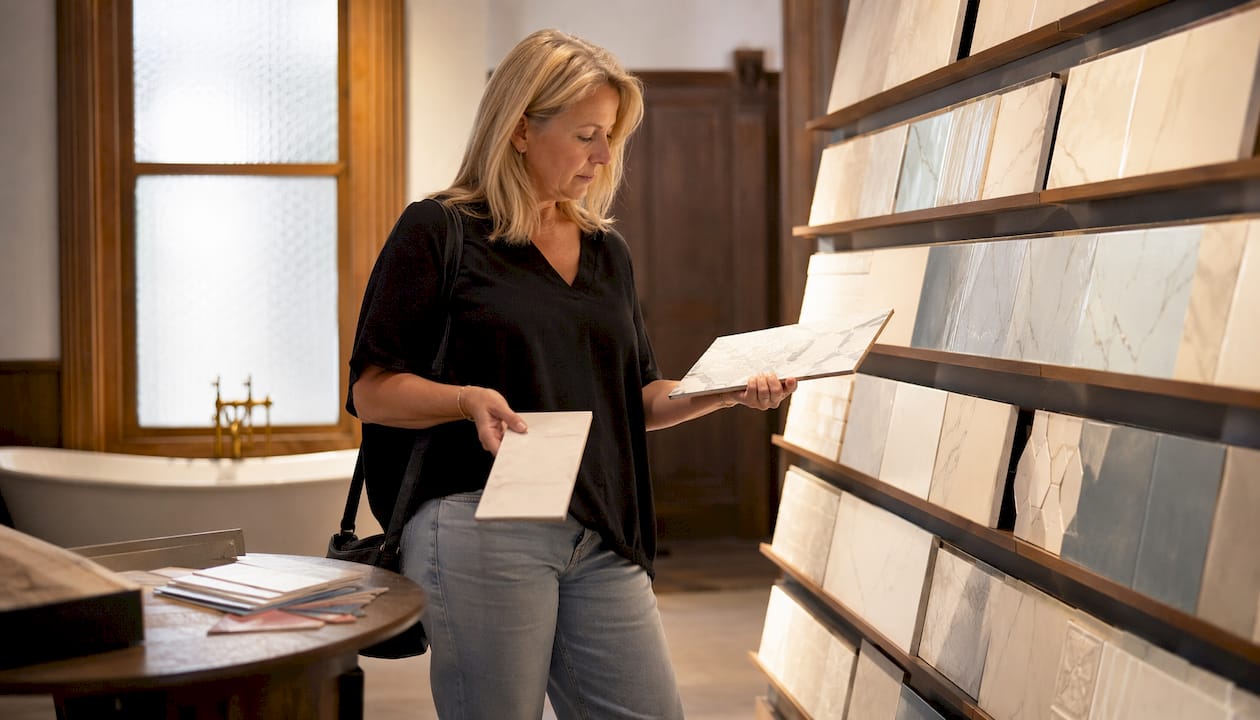
Porcelain is the best overall material for bathroom floors and wet areas; ceramic is the best value for walls and backsplashes. Porcelain is classified as impervious under ASTM standards because of its very low water absorption, making it a highly durable and low-maintenance choice for UK bathrooms. Tenenltd bathroom renovation projects across West and Central London consistently use porcelain for floors and ceramic for walls, a combination that balances performance with budget.
Quick picks by use-case:
Bathroom floors: Matte or textured porcelain (e.g. Porcelanosa or Topps Tiles large-format ranges) — durable, water-resistant, low maintenance
Walls and backsplashes: Glazed ceramic (e.g. Johnson Tiles or Topps Tiles ceramic wall ranges) — lighter, easier to install, wide finish choice
High-end or feature areas: Natural stone or large-format porcelain (e.g. Marshalls natural stone or Porcelanosa premium lines) — striking aesthetic, higher maintenance commitment
Table of Contents
Which bathroom tile material is right for you?
Choosing between materials comes down to where the tile goes and how much upkeep you want. The table below covers the five main options against the criteria that matter most for a UK bathroom renovation.
Criteria | Porcelain | Ceramic | Natural stone | Mosaic | Large-format |
Best for | Floors, showers, wet rooms | Walls, backsplashes | Feature walls, floors | Shower floors, accents | Walls, open floors |
Material | Dense fired clay | Standard fired clay | Marble, slate, travertine | Porcelain or ceramic | Porcelain or stone |
Finish & slip resistance | Matte/textured R10–R11; polished for walls only | Gloss or satin; not ideal for wet floors | Honed or tumbled; variable PTV | Multiple grout joints = higher traction | Polished (walls); matte (floors) |
Maintenance & sealing | No sealing needed; seal grout | Wipe clean; seal grout | Regular sealing required; specialist cleaners | Grout maintenance; epoxy grout recommended | As per tile type |
Underfloor heating | Excellent conductor | Good | Variable (check stone type) | Good with flexible adhesive | Good with flexible adhesive |
Durability/water absorption | <0.5% absorption; highly durable | 3–7% absorption; durable for walls | Variable; porous without sealing | Durable; grout is the weak point | Durable; fewer grout joints |
Recommended adhesive/grout | Flexible cement-based (e.g. Mapei Ultraflex); epoxy grout for wet rooms | Standard cement-based adhesive; cementitious grout | Flexible adhesive; penetrating sealer | Flexible adhesive; epoxy grout | Large-format flexible adhesive (e.g. Ardex X77) |
UK brand examples: Porcelanosa and Marshalls cover the premium end for porcelain and natural stone respectively. Johnson Tiles and Topps Tiles offer strong mid-range ceramic and porcelain ranges widely available across the UK.
PEI rating note: For floor tiles, look for A PEI rating suitable for bathroom floors. Porcelain’s very low water absorption is the key benchmark that differentiates it from standard ceramic for wet-area use.
How do you choose the right tile for each bathroom zone?
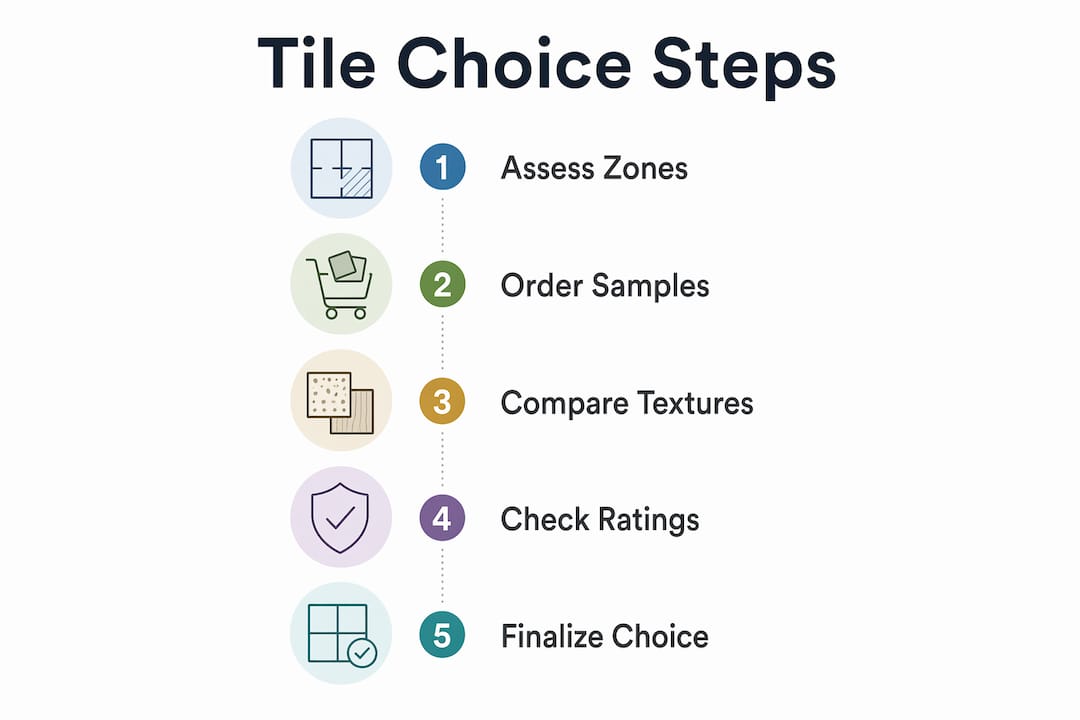
Getting the zone right before you buy saves costly mistakes. Work through these decisions in order:
Shower floors: Choose small-format mosaic or textured porcelain with a wet DCOF of 0.42 or higher. Mosaics’ multiple grout joints help installers follow the slope for drainage — large-format tiles make this far harder.
General bathroom floors: Matte porcelain, minimum R10 slip rating. Confirm the PTV (Pendulum Test Value) with the supplier datasheet before ordering.
Shower walls: Glazed ceramic or polished porcelain wall tiles work well here — the surface stays vertical and dry between uses, so slip resistance is less critical than on floors.
Wet-room floors: Textured porcelain or mosaic with verified R11 or DCOF ≥ 0.42. Wet rooms have no shower tray to contain water, so the entire floor must meet the wet slip standard.
General walls and backsplashes: Glazed ceramic wall tiles are the practical choice — lighter than porcelain, easier to cut, and available in hundreds of finishes.
Underfloor heating: Confirm tile and adhesive are rated for thermal cycling. Flexible cement-based adhesive is non-negotiable here; standard adhesive can crack under repeated heat expansion.
Pro Tip: Order two or three samples and lay them in the actual room before committing. Colour, sheen and texture shift noticeably under bathroom lighting versus a showroom. Always request the supplier’s datasheet to verify the slip rating — do not rely on a product description alone.
Adhesives, grouts, sealants and trims: what to use and when
The tile is only as good as what holds it. These are the product categories and UK-available brands worth specifying:
Adhesives:
Flexible cement-based adhesive (e.g. Mapei Ultraflex 2, Weber.set Rapid, Ardex X77): use for porcelain on heated floors and large-format tiles. Flexibility absorbs thermal movement.
Rapid-set adhesive (e.g. Ardex X7 Plus, Everbuild 730 Rapid Set): suited to wet-room upgrades where you need to waterproof and tile quickly without extended cure times.
Standard cement-based adhesive (e.g. Everbuild 702 Wall Tile Adhesive): adequate for ceramic wall tiles in non-heated, low-movement areas.
Grouts:
Epoxy grout (e.g. Mapei Kerapoxy, Ardex WA): the best choice for wet rooms, shower floors and high-traffic areas. Highly resistant to staining and moisture penetration; worth the extra cost in any zone that stays wet.
Cementitious grout (e.g. Weber.joint, Everbuild Grout): suitable for standard bathroom floors and walls. Seal it after installation and reseal annually.
Sealants and waterproofing:
Natural stone requires a penetrating sealer (e.g. Tile Doctor Pro-Clean and Seal) before grouting and at regular intervals thereafter.
Wet rooms need a full tanking membrane or liquid waterproofing system beneath the tiles. Schlüter-Systems’ KERDI membrane and DITRA uncoupling mat are widely specified by UK contractors for wet rooms and heated floors.
Trims:
Schlüter-Systems RENO and JOLLY profiles provide clean, durable transitions between tile and other floor surfaces. They also protect tile edges from chipping at doorways — a detail worth specifying when you coordinate bathroom doors and thresholds.
Always request manufacturer datasheets and check warranty terms before specifying adhesive and grout combinations. Mixing brands across a system can void individual product warranties.
What slip resistance rating should your bathroom tiles have?
Finish choice is a safety decision, not just an aesthetic one. The three finish categories behave very differently underfoot:
Matte and textured finishes: Higher grip in wet conditions; recommended for all bathroom and wet-room floors. Textured porcelain outperforms polished porcelain on traction in wet conditions.
Polished and high-gloss finishes: Visually striking but significantly lower grip when wet. Reserve these for walls only.
Honed stone: Moderate grip; better than polished but still requires a slip-rating check before specifying for floors.
The benchmark to request: A wet Dynamic Coefficient of Friction (DCOF) of 0.42 or higher for any frequently wet floor. For showers and wet rooms, aim higher. The R-scale (R9–R13) is the European standard you will see on most UK product datasheets; R10 is the minimum for domestic bathroom floors, R11 for wet rooms.
Safety note: For households with young children or elderly occupants, anti-slip finishes are standard practice, not an optional upgrade. Ask your supplier for the test certificate, not just the marketing description.
Pro Tip: For shower floors and wet-room transitions, specify mosaics or textured tiles and ask the supplier to provide the British Standards slip-test certificate (BS 7976-2 Pendulum Test) before you place the order.
Cleaning and long-term care by tile material
Porcelain is the easiest to maintain. Its dense, nonporous structure resists stains and moisture without sealing. A weekly wipe with a pH-neutral cleaner keeps it looking new. The grout is the vulnerable point — seal it after installation and check it annually.
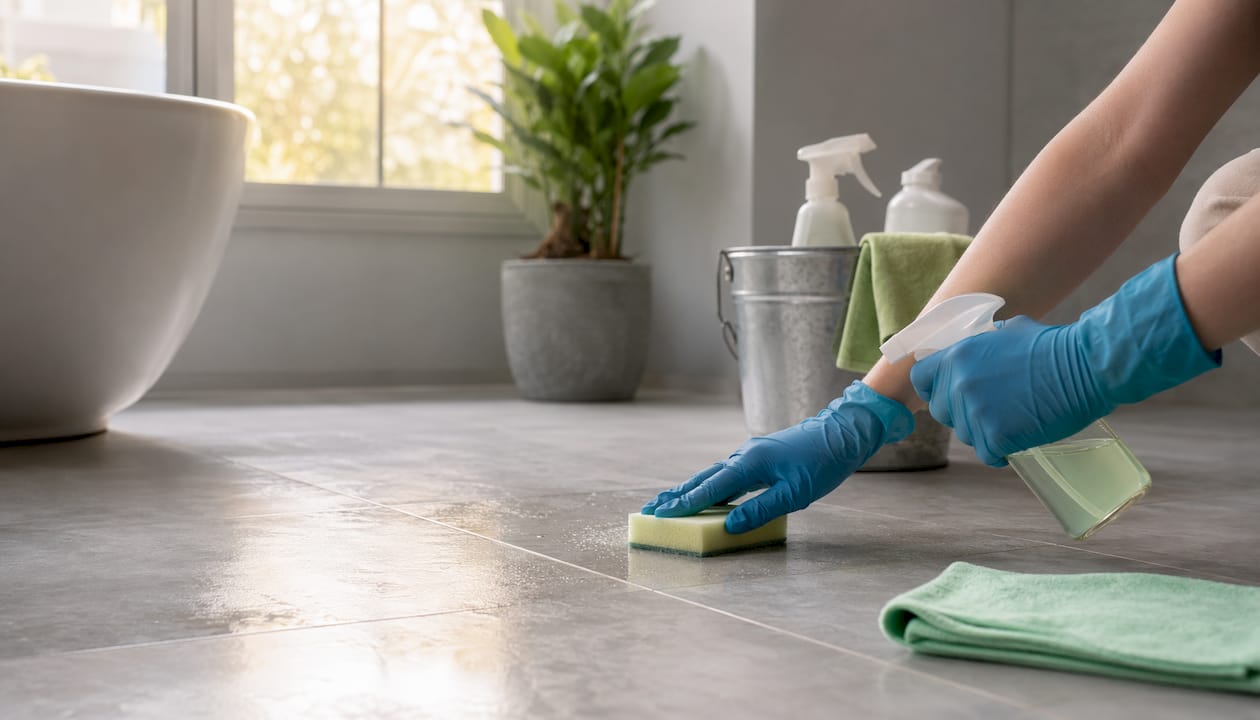
Ceramic is similarly straightforward. Wipe down with a mild household cleaner; avoid abrasive pads on glazed surfaces. Grout maintenance is the same as porcelain: seal on installation, reseal as needed.
Natural stone demands more. Seal before grouting, reseal every 12 months, and use only stone-specific cleaners. Acidic products (vinegar, lemon-based cleaners) etch the surface permanently. Tile Doctor Pro-Clean is a safe option for routine stone care.
Avoid bleach-based cleaners on coloured grout — they fade the pigment over time.
Epoxy grout in wet rooms needs only a wipe; it does not absorb staining the way cementitious grout does.
For polished porcelain, apply a one-time penetrating sealer before grouting to prevent grout haze bonding to the surface.
Pro Tip: Paste a simple maintenance schedule inside a kitchen cupboard or your renovation file: porcelain/ceramic — monthly neutral clean, annual grout check; natural stone — monthly specialist clean, annual reseal. It takes two minutes to set up and saves expensive remedial work later.
Design trends worth adopting in 2026
The dominant shift in 2026 is away from cold, large-format grey tiles towards warmer, tactile and pattern-forward choices. Wood-look porcelain is the standout practical winner: it delivers the warmth of timber with none of the moisture vulnerability, and it pairs well with the warm-toned fixtures popular in West London refurbishments right now.
Warm neutrals and earthy tones: Terracotta-look porcelain, warm beige and sand-toned ceramics replace cool greys as the default palette.
Tactile and 3D surfaces: Fluted, ribbed and handmade-look tiles add depth without pattern complexity; good for feature walls in smaller bathrooms.
Restrained mosaics: Small-format mosaics in a single tone work as shower-floor accents without overwhelming the space.
Pattern-forward floors: Encaustic-look or geometric floor tiles paired with plain walls — a practical way to add character without dating the room quickly.
Finishes to avoid on floors: High-gloss polished porcelain. It looks sharp in a showroom and becomes a slip hazard and a fingerprint magnet in daily use. For UK lighting conditions, a satin or matte finish reads just as luxurious and performs far better. For more inspiration, the luxury bathroom ideas guide covers natural stone versus porcelain in high-end London bathrooms.
How long does bathroom tiling take, and what does it cost?
These are ballpark figures. Every project requires a site survey before accurate costs can be confirmed.
Phase | Small bathroom | Medium bathroom | Large bathroom |
Survey and sampling | 1–2 days | 1–2 days | 2–3 days |
Materials lead time | 3–10 days | 3–10 days | 5 days |
Substrate preparation | 0.5–1 day | 1–2 days | 2–3 days |
Waterproofing | 0.5–1 day | 1 day | 1–2 days |
Tiling and grouting | 1–2 days | 2–4 days | 4–7 days |
Factors that push costs up: complex patterns (herringbone, chevron), large-format tiles requiring precise levelling, substrate remediation (removing old adhesive, repairing screeds), and natural stone requiring specialist handling. For a fuller picture of what drives renovation budgets, the bathroom renovation guide for West London covers sequencing and cost planning in detail.
How to sample tiles before you commit to buying
Ordering full volumes without sampling is one of the most common and costly mistakes in bathroom renovation. A short process prevents it:
Order 2–3 samples from your shortlisted ranges and bring them home before placing any order.
View them at different times of day — morning light, artificial evening light, and with the bathroom door closed. Colour and sheen shift dramatically.
Lay floor samples on the actual floor and tape wall samples to the wall at eye height. Scale reads very differently in situ versus a showroom shelf.
Create a simple cardboard template to simulate grout lines and check how the pattern repeat works across the full wall or floor area.
Photograph the samples alongside your existing fixtures and fittings — useful for discussions with your installer and for coordinating fixtures with the tile choice.
Pro Tip: Label every sample with the product code, supplier name, and datasheet reference. Keep them in a folder with the warranty information. If you need to order replacement tiles in two years, you will have everything you need without a search.
Best tile picks by use-case: a quick shortlist
Wet-room and shower floors: Textured or mosaic porcelain with a verified DCOF ≥ 0.42 or R11 rating. Brands such as Porcelanosa and Topps Tiles both carry suitable ranges. Pair with epoxy grout and a Schlüter-Systems waterproofing system.
General bathroom floors: Matte large-format porcelain (600×600mm or larger) with a flexible cement-based adhesive. Johnson Tiles and Marshalls offer reliable mid-range options.
Walls and backsplashes: Glazed ceramic from Johnson Tiles or Topps Tiles — cost-effective, easy to install, and available in the warm tones trending in 2026.
Feature areas and high-end finishes: Natural stone (marble, travertine) or premium large-format porcelain from Porcelanosa. Budget for regular sealing and specialist cleaning if you choose stone.
Key takeaways
Porcelain is the best overall tile for bathroom floors and wet areas because its water absorption below 0.5% and textured finishes make it both durable and safe underfoot.
Point | Details |
Porcelain for floors | Very low water absorption makes it a highly durable and water-resistant choice for bathroom floors and wet rooms. |
Ceramic for walls | Lighter, easier to install, and more affordable than porcelain; the practical default for walls and backsplashes. |
Slip rating is non-negotiable | Request a wet DCOF ≥ 0.42 or R10 minimum (R11 for wet rooms) and ask for the test certificate before buying. |
Match adhesive to tile and substrate | Use flexible cement-based adhesive for porcelain on heated floors; epoxy grout for wet rooms and high-traffic areas. |
Tenenltd for London bathrooms | Tenenltd handles tile selection, waterproofing, and full bathroom renovation across West and Central London with written quotes and director oversight. |
A note on what London bathrooms actually need
There is a tendency in bathroom renovation guides to treat tile selection as a purely aesthetic exercise. In practice, the decisions that matter most are substrate condition, waterproofing sequencing, and slip rating — and these are the ones that get skipped when homeowners buy tiles before booking a survey.
In West and Central London properties, you frequently encounter older substrates: Victorian floor boards, lime plaster walls, and uneven screeds. Large-format tiles look spectacular in a showroom, but on a substrate that has not been properly assessed and prepared, they crack. The tile is not the problem; the preparation is. Tenenltd’s approach on every bathroom project starts with a site survey precisely because the tile specification depends on what is underneath.
The 2026 move towards warmer, tactile finishes is genuinely worth embracing. Wood-look porcelain in particular suits the period proportions of many London bathrooms far better than the cold grey large-format tiles that dominated the last decade. But the finish choice should follow the zone assessment, not precede it. Get the slip rating right for the floor, get the waterproofing right for the wet room, and then choose the finish that makes you happy every morning.
Tenenltd’s bathroom renovation service: from tile selection to finished room
Choosing the right tiles is only the first step. Getting them installed correctly — with proper waterproofing, the right adhesive system, and trades sequenced so nothing gets damaged — is where most bathroom renovations either succeed or fall short.
Tenenltd has been completing bathroom renovations across Fulham, Chelsea, Kensington, Chiswick, Hammersmith, and Notting Hill since 2006. Every project starts with a site survey, includes a written itemised quote, and is managed with director oversight from start to finish. There are no hidden costs and no subcontracted surprises. Whether you need help selecting tiles for a wet room, coordinating waterproofing with your plumber, or managing a full bathroom renovation in London, the team handles it end to end. Request a site survey today and get a written quote with no obligation.
Useful sources and further reading
Use these to verify specifications, check ratings, and review manufacturer guidance before purchasing.
Materials and performance:
Porcelain tile performance and water absorption: Robbins Flooring — porcelain tile for showers guide
Tile types and maintenance requirements: Cle Tile — types of tiles for bathrooms
2026 design and safety trends: Spenza Ceramics — choosing bathroom tiles in 2026
Slip resistance:
DCOF guidance and floor tile selection: 101 Home Decor — bathroom floor tile ideas
Shower tile format and traction: TileBar — how to choose shower tile
Adhesives, grout and installer guidance:
Request product datasheets directly from Ardex, Mapei, Weber, and Everbuild before specifying adhesive and grout combinations.
Ask suppliers for PEI ratings, water absorption figures, and slip-test results (BS 7976-2 Pendulum Test) before purchase.
Schlüter-Systems publishes installation guides for KERDI waterproofing and DITRA uncoupling systems on their UK website.
Recommended
Comments