
Plan your kitchen layout: expert guide for West London homes

Most West London homeowners spend weeks choosing cabinet finishes and worktop materials, yet give their kitchen layout barely a second thought. That is a costly mistake. A well-planned layout can cut cooking time by 25 to 30%, reduce daily frustration, and add real value to your property. Whether you are renovating a Victorian terrace in Chiswick or modernising a flat in Fulham, the layout you choose will shape how your kitchen feels and functions for years to come. This guide walks you through every key decision, from layout types and design frameworks to measurements, budgeting, and expert tips drawn from real London projects.
Table of Contents
Key Takeaways
Point | Details |
Choose layout wisely | Selecting the right kitchen layout for your home maximises efficiency and improves daily use. |
Measure clearance areas | Ensuring proper walkway and appliance clearances prevents overcrowding and enhances workflow. |
Budget for real London costs | London kitchen renovations cost more than national averages, so factor in local price benchmarks and plan for value uplift. |
Hybrid triangle and zoning | Combining the work triangle and zoning approaches suits most modern London homes and families. |
Expert help streamlines projects | Working with experienced refurbishment professionals reduces stress and delivers better results. |
Core kitchen layout types explained
With a clear understanding of how a layout drives efficiency, let us review the options available for your kitchen space. The right choice depends on your room dimensions, how many people cook at once, and whether your kitchen connects to a living or dining area.
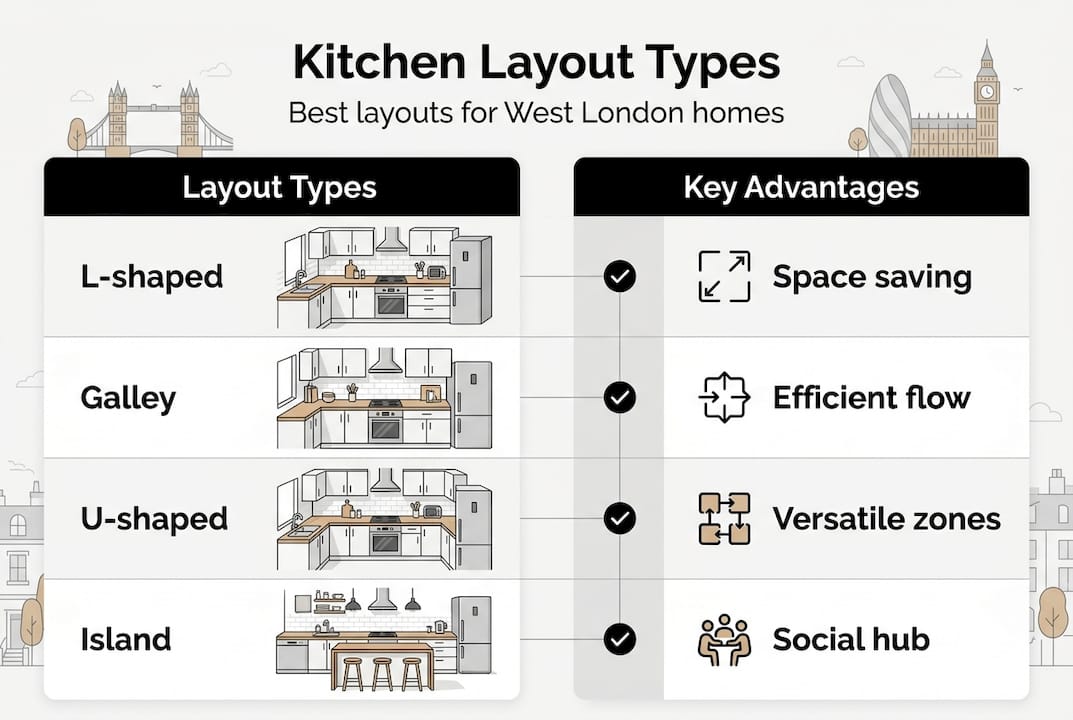
Core kitchen layouts include L-shaped, U-shaped, Galley, One-wall, and Peninsula or Island configurations. Each suits a different type of home and lifestyle. Here is a quick overview of which layout works best for common London home sizes:
L-shaped: Versatile and popular, suits small to medium kitchens. Creates a natural work triangle and leaves room for a dining table.
U-shaped: Maximises storage and worktop space. Ideal when multiple people cook, though it can feel enclosed in smaller rooms.
Galley: Two parallel runs of units facing each other. The most efficient layout for compact London flats, requiring minimal movement between tasks.
One-wall: All units along a single wall. Excellent for open-plan spaces or studio flats where the kitchen shares a room with living areas.
Island or Peninsula: Adds a social hub and extra prep space. Requires at least 90cm circulation space on all sides.
For space-efficient kitchen layouts in smaller London properties, the Galley and L-shaped options consistently outperform the rest. If your room is under 3.5 by 3.5 metres, avoid islands entirely as they create bottlenecks rather than breathing room.

Layout | Best for | Space needed | Key advantage |
L-shaped | Small to medium kitchens | From 2.5m x 3m | Flexible, allows dining space |
U-shaped | Larger kitchens, multiple cooks | From 3m x 3.5m | Maximum storage and worktop |
Galley | Compact flats | From 1.8m wide | Highly efficient, minimal steps |
One-wall | Open-plan or studio | Any width | Space-saving, sociable |
Island/Peninsula | Spacious kitchens | Min 3.5m x 3.5m | Social hub, extra prep area |
For a full review of your kitchen refurbishment options, it helps to consult a specialist early. Understanding the pros and cons of layouts before you commit saves time and money further down the line.
Work triangle versus zoning: what works in 2026?
Now that you have chosen a layout, it is time to consider how your household uses the kitchen day to day. Two main frameworks guide this thinking: the classic work triangle and the more modern zoning approach.
The work triangle connects your fridge, hob, and sink in a triangular path. It is a tried and tested principle for single-cook households, keeping movement efficient and reducing unnecessary steps. The triangle suits single-cook efficiency well, but it starts to break down when two or more people cook simultaneously.
Zoning takes a broader view. Rather than focusing on three points, it divides the kitchen into functional areas such as prep, cooking, cleaning, storage, and serving. This approach suits open-plan kitchens and busy family homes where different tasks happen at the same time.
Here is how to implement zoning in your kitchen:
Map your tasks. List every activity that happens in your kitchen, from making coffee to plating dinner.
Group related tasks. Pair prep and cooking zones near the hob. Place cleaning and storage zones near the sink and dishwasher.
Consider traffic flow. Keep the serving zone close to the dining area so food does not travel across the whole room.
Allow clear pathways. Each zone should be accessible without crossing another active zone.
Test it on paper first. Sketch your zones before any work begins to spot conflicts early.
“The shift towards zoning reflects how modern households actually live. Families want a kitchen that works for homework, entertaining, and cooking all at once. The triangle is still useful, but it is just one tool in the box.”
For most West London homes in 2026, a hybrid approach works best. Use the triangle as your starting point for the core cooking area, then layer zones around it for everything else. Your kitchen layout solutions should reflect your actual lifestyle, not a textbook diagram. Explore the full detail of work triangle and zoning principles to decide which blend suits your household.
Key measurements, pitfalls, and expert pro tips
After deciding on the conceptual framework, it is vital to plan for practical details that often trip up renovators. Getting measurements wrong at this stage is expensive to fix once units are installed.
Standard clearances matter enormously. Walkways should be between 90 and 120 centimetres wide. Counter depth is typically around 60 centimetres, and the minimum comfortable working height is 90 centimetres for most adults. Poor flow causes overcrowding and frustration, so measure every clearance before finalising your plan.
Common pitfalls to avoid in London kitchen renovations:
Traffic cutting through the work triangle. If your kitchen is a thoroughfare to the garden or another room, your cooking zone will constantly be interrupted.
Overcrowding with too many units. More storage sounds appealing, but cramped circulation space makes the kitchen unpleasant to use.
Poor corner cabinet use. Standard corner units waste a surprising amount of space. Opt for pull-out drawers or carousel fittings instead.
Ignoring ventilation. In older London properties, hob placement is often constrained by chimney breasts or structural walls. Plan ventilation early, not as an afterthought.
Underestimating lighting zones. Task lighting above prep areas and ambient lighting for dining zones are both essential, yet often forgotten until it is too late.
For planning kitchen layouts in period properties, structural constraints are common. Victorian and Edwardian homes in Kensington or Notting Hill often have load-bearing walls that limit where you can position appliances. Always get a structural assessment before moving anything significant.
Pro Tip: Before committing to an island or peninsula, tape out its footprint on your floor and live with it for a day. Walk around it with shopping bags, open the oven door, and check you can reach the sink comfortably. This simple test reveals problems that no floor plan can show you.
For broader guidance on enhancing home renovations and a practical home refurbishment checklist, both resources are worth reviewing before your project begins.
Cost, value and budgeting for a London kitchen remodel
With layout details in place, here is how to plan your investment sensibly for maximum impact. Kitchen renovations in London cost more than the national average, but they also deliver stronger returns.
UK kitchen renovation benchmarks show a national average of £10,000 to £20,000, with London projects running 20 to 30% higher. Most West London homeowners should budget between £12,000 and £26,000 for a full kitchen renovation. A well-executed project can add 4 to 6% to your property value, with a return on investment ranging from 50% to 90% depending on finish quality and how efficiently the space is used.
Main expenses to plan for:
Labour: Typically 40 to 50% of your total budget. This covers fitting, plumbing, electrical work, and plastering.
Units and worktops: Usually 30 to 40% of the budget. Material choice has the biggest impact here.
Appliances: Budget separately for integrated appliances, which cost more upfront but add value and a cleaner finish.
Contingency fund: Always set aside 10 to 15% for unexpected discoveries, particularly in older London properties where hidden issues are common.
Budget area | Typical share | Notes |
Labour | 40 to 50% | Fitting, plumbing, electrical |
Units and worktops | 30 to 40% | Material choice drives cost |
Appliances | 10 to 15% | Integrated options add value |
Contingency | 10 to 15% | Essential for period properties |
For a detailed look at refurbishment cost breakdown specific to West London, and to understand the broader property refurbishment benefits, both guides offer practical figures. If you are also considering boosting home value through other rooms, a kitchen renovation pairs particularly well with a bathroom upgrade for maximum impact on your property’s appeal.
Next steps: expert support for your kitchen project
Now that you are equipped with a plan and budget, partnering with specialists keeps your project on track and protects your investment. A kitchen renovation is one of the most complex refurbishments in any home, involving structural, electrical, plumbing, and design decisions that all need to align.
At Tenen Ltd, we have been helping West London homeowners transform their kitchens since 2006. From initial design consultations through to final fit-out, our team manages every stage with the attention to detail your home deserves. Whether you are planning a compact galley renovation in a Fulham flat or a full open-plan transformation in a Chiswick family home, we bring the expertise to make it work beautifully. Explore our London kitchen refurbishment service or browse our full range of home renovation services to find the right support for your project. We would love to help you get it right from the very first decision.
Frequently asked questions
What is the most efficient kitchen layout for a London flat?
Galley layouts are generally the most efficient for compact London flats, requiring minimal movement between tasks and making clever use of limited space.
How much space do I need for a kitchen island?
You should allow at least 90 centimetres around all sides of an island for clear circulation, and avoid installing one in any room smaller than 3.5 by 3.5 metres.
What is the typical cost of a kitchen renovation in London?
Most London kitchen renovations range from £12,000 to £26,000, reflecting the 20 to 30% premium above the national average, with labour accounting for nearly half the total cost.
Should I use the work triangle or zoning for my kitchen layout?
Single-cook households benefit most from the work triangle, while families or open-plan designs should consider zoning or a hybrid of both approaches.
Recommended
Comments