
Hire contractors in London: a homeowner's checklist

Start with a written project brief, arrange a director-led site survey, then collect 2–3 itemised quotes before signing any contract. That sequence alone puts you ahead of most London homeowners who call the first number they find online.
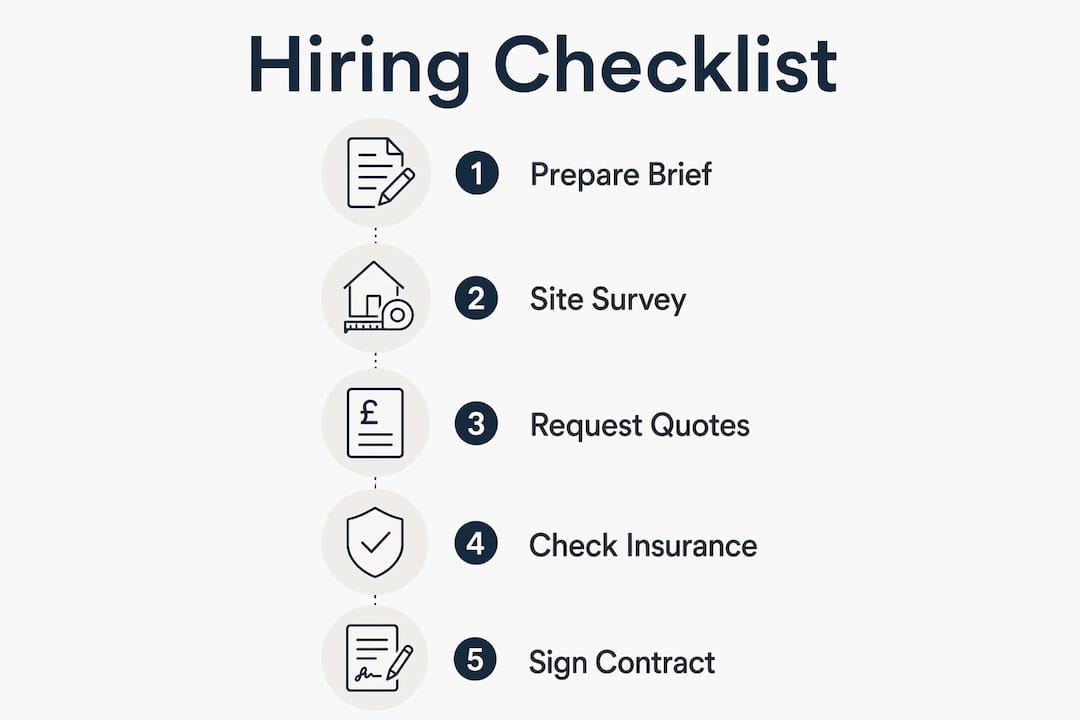
Here is the checklist to follow, in order:
Write your project brief before contacting anyone. Define deliverables, quality standard, provisional sums (for items not yet specified, such as tiles or sanitaryware), and whether quotes should include or exclude VAT.
Arrange an on-site survey. A site survey prevents most estimate errors and surfaces permissions or party wall issues early. Director-led surveys produce the most accurate schedule of works.
Collect 2–3 written, itemised quotes. Ask each contractor to break down labour, materials, provisional sums, and VAT separately so you can compare quotes on a like-for-like basis.
Verify credentials. Request proof of public liability insurance (require at least £2 million public liability cover for domestic work) and employers’ liability insurance. For specialist trades, check Gas Safe registration for gas work, NICEIC for electrical, and FENSA for replacement glazing — always verify directly on the regulator’s register, not from a logo on a van.
Check Companies House. For limited companies, review the filing history for late accounts or frequent director changes, both early indicators of financial instability.
Ask for references and portfolio photos from recent London projects, ideally in your area. West and Central London properties carry specific logistical constraints, and local contractor experience genuinely reduces risk.
Agree a written contract. For projects above roughly £5,000, use a JCT minor works form or a homeowner-friendly schedule of works. It must state scope, price, payment schedule, start and finish dates, the variations process, and dispute resolution. A build contract guide explains what each clause should cover.
Confirm permissions early. Planning permission, building regulations approval, and party wall agreements (where a shared wall is affected) must be in place before work starts, not after.
Budget a contingency. Set aside 10–15% above your quoted cost to cover provisional sums, permit fees, and unforeseen structural issues. Delays in London projects most often stem from late material deliveries, permit processing, and hidden structural conditions discovered once work begins.
Red flags that should make you walk away: cash-only payment requests, no proof of insurance, a quote with no itemised breakdown, or a demand for more than a modest staged deposit upfront.
Questions worth asking at the site visit: What time does your team arrive on site each day? Who supervises when you are not present? Will you use subcontractors, and if so, are they insured? How do you handle variations to the agreed scope?

If something goes wrong, your first step is the written contract. Document the issue in writing, refer to the relevant clause, and give the contractor a reasonable opportunity to remedy it. If that fails, the Royal Institution of Chartered Surveyors (RICS) offers a dispute resolution service, and the Construction Industry Training Board (CITB) can signpost further routes. For lower-value disputes, the small claims court is a practical option.
Table of Contents
Ready to get a site survey from a trusted London contractor?
Tenenltd has been refurbishing and extending homes across West and Central London since 2006, with every project overseen by a director from survey through to completion.

A director-led survey with Tenenltd covers scope verification, access and logistical checks, provisional sums identification, an initial timescale estimate, and early flagging of any planning or party wall considerations. You receive an itemised schedule of works to review before any deposit changes hands. Whether you are planning a full property refurbishment, a loft conversion, or a kitchen and bathroom renovation, the process starts the same way: a proper survey, a clear quote, and a contract that protects you.
Pro Tip: Before the survey, gather your title deeds or lease details, any existing planning or building regulations documents, and note the locations of fixed services such as gas, water, and electrical meters. It saves time and produces a more accurate quote.
Book your survey via the Tenenltd services page and get an itemised quote you can actually compare.
Key takeaways
Hiring a contractor in London requires a written brief, a director-led site survey, and 2–3 itemised quotes before you sign anything.
Point | Details |
Write the brief first | Define deliverables, quality standard, provisional sums, and VAT expectations before contacting any contractor. |
Verify insurance and credentials | Require at least £2 million public liability cover minimum; check Gas Safe, NICEIC, or FENSA directly on the regulator’s register. |
Use a written contract | For projects above roughly £5,000, a JCT minor works form or schedule of works protects both parties. |
Budget a contingency | Set aside 10–15% above the quoted cost to cover provisional sums, permits, and unforeseen structural issues. |
Tenenltd for London projects | Director-led surveys, itemised quotes, and in-house project management across West and Central London since 2006. |
Recommended
Comments